How to Write Better: The Complete Guide with Practical Tips
You stare at the blank page. You have something to say, but the words do not come. Or they come, but they feel flat, clunky, or confusing. You know you can write better, but you are not sure how.
You are not alone. Writing better is a journey, not a destination. Every writer , from beginners to professionals , is constantly working to improve. The good news is that writing is a skill, and like any skill, it can be learned, practised, and refined.
This guide will teach you how to write better with practical tips and techniques that you can apply immediately. We will cover the fundamentals of clear, concise writing, how to find your voice, how to structure your work, and the common mistakes to avoid. By the end, you will have a toolkit of strategies to take your writing to the next level.
Writing Better at a Glance
1 What Does It Mean to Write Better?
Writing better is not about using fancy words or complex sentences. It is about communicating your ideas clearly, effectively, and engagingly. Good writing is writing that achieves its purpose , whether that is to inform, persuade, entertain, or inspire.
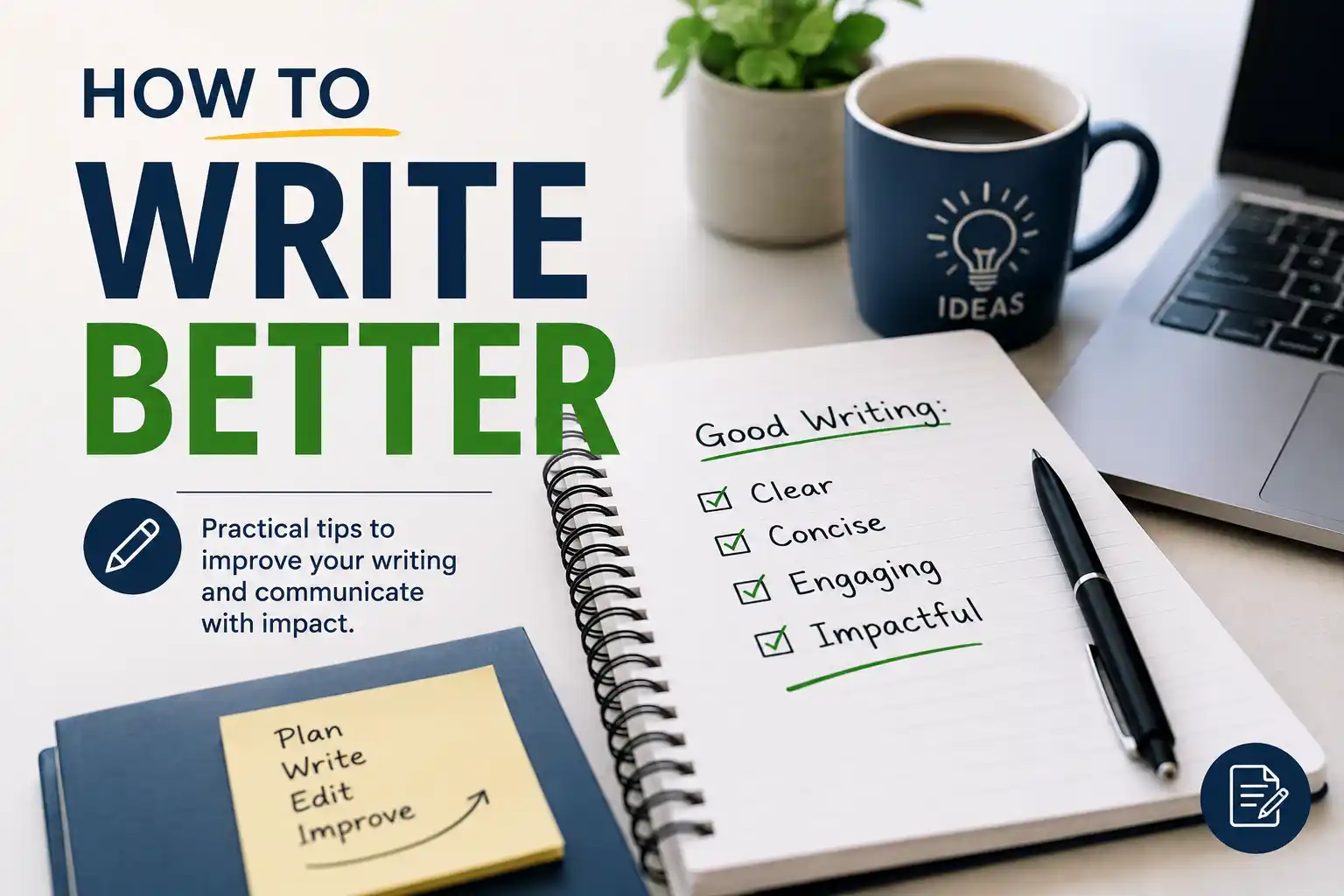
Better writing is clear: the reader understands your message without confusion. It is concise: every word earns its place. It is engaging: it holds the reader's attention. And it is authentic: it sounds like you.
Improving your writing is a lifelong pursuit. The best writers are always learning, always practising, and always striving to be better. But the journey starts with understanding the fundamentals and applying them consistently.
Clarity
Your reader should understand your message on the first read. Avoid ambiguity, jargon, and unnecessary complexity.
Conciseness
Every word should serve a purpose. Cut clutter, repetition, and anything that does not add value.
Engagement
Good writing holds the reader's attention. Use vivid language, varied sentence structure, and a compelling voice.
Authenticity
Your writing should reflect your unique voice and perspective. Do not try to sound like someone else.
2 The Fundamentals of Better Writing
Before you can write better, you need to understand the fundamental principles that underpin all good writing.
Clarity Is King
Your first job as a writer is to be understood. If your reader has to re-read a sentence to understand it, you have failed. Use simple, direct language. Prefer short sentences over long ones. Avoid jargon and unnecessary complexity.
Show, Don't Tell
This is the golden rule of writing. Instead of telling the reader that a character is angry, show them slamming a door. Instead of telling them that a place is beautiful, show them the sunlight filtering through the leaves. Showing creates a more vivid, immersive experience for the reader.
Write with the Reader in Mind
Good writing is reader-focused. Ask yourself: What does the reader need to know? What will they find interesting? What will keep them reading? Write to serve your reader, not to impress them.
The "Read Aloud" Test
The single best technique for improving your writing is to read it aloud. If it sounds awkward, clunky, or confusing when you speak it, it will read the same way. Reading aloud helps you catch errors, awkward phrasing, and unnatural rhythms that you might miss when reading silently.
3 How to Write Clearer Sentences
Clear sentences are the building blocks of clear writing. Here is how to write them.
Prefer the Active Voice
In the active voice, the subject performs the action: "The dog chased the ball." In the passive voice, the subject receives the action: "The ball was chased by the dog." The active voice is usually clearer, more direct, and more engaging.
Keep Sentences Short
Short sentences are easier to understand than long ones. Aim for an average sentence length of 15–20 words. Vary your sentence length to create rhythm, but avoid long, convoluted sentences that confuse the reader.
Use Strong Verbs
Strong verbs are specific and vivid. Instead of "walked slowly," use "strolled." Instead of "said loudly," use "shouted." Strong verbs make your writing more dynamic and engaging.
Weak Sentence
"The report was written by the team in a manner that was very comprehensive and detailed."
Strong Sentence
"The team wrote a comprehensive, detailed report."
4 How to Cut the Clutter
Most writing can be improved by cutting unnecessary words. Here is how to identify and eliminate clutter.
Eliminate Redundancies
Redundancies are phrases that say the same thing twice. Examples include "advance planning," "past history," "end result," and "unexpected surprise." Cut the unnecessary word.
Cut Filler Words
Filler words add nothing to your writing. Examples include "very," "really," "quite," "somewhat," and "actually." In most cases, you can cut them without changing the meaning.
Replace Wordy Phrases
Replace wordy phrases with simpler alternatives. "Due to the fact that" becomes "because." "In the event that" becomes "if." "At this point in time" becomes "now."
Common Wordy Phrases and Their Simple Replacements
- In order to → to
- Due to the fact that → because
- In the event that → if
- At this point in time → now
- With the exception of → except
- In the vicinity of → near
5 How to Find Your Voice
Your voice is what makes your writing uniquely yours. It is the combination of your word choices, sentence rhythms, and perspective that sets you apart from other writers.
Write Like You Speak
One of the best ways to develop your voice is to write like you speak. Not exactly like you speak , you will want to be more polished , but with the same natural rhythm and authenticity. Read your writing aloud and ask: "Does this sound like me?"
Read Widely
Reading widely exposes you to different voices and styles. Pay attention to what you like and what you do not like. Why does one writer's voice resonate with you while another's does not? Use this insight to develop your own voice.
Write a Lot
Voice is not something you find , it is something you develop through practice. The more you write, the more your voice will emerge. Do not try to force it. Let it develop naturally over time.
The "Imitation" Exercise
Find a writer whose voice you admire. Write a paragraph in their style. Then write the same paragraph in your own style. Compare the two. This exercise helps you understand what makes a voice distinctive and how to develop your own.
6 How to Structure Your Writing
Good structure makes your writing easy to follow and keeps your reader engaged. Here is how to structure your writing effectively.
Start with a Strong Opening
Your opening paragraph should grab the reader's attention and make them want to read more. Start with a compelling hook , a question, a surprising fact, a vivid image, or a bold statement. Then state your main point clearly.
Use Headings and Subheadings
Headings and subheadings help readers navigate your writing and understand its structure. They also make your writing more scannable, which is important for online readers.
End with a Strong Conclusion
Your conclusion should summarise your main points and leave the reader with something to think about. Do not introduce new information in the conclusion. Instead, reinforce what you have already said and end with a memorable statement.
Common Writing Structures
7 Common Writing Mistakes to Avoid
Even experienced writers make mistakes. Here are the most common errors and how to avoid them.
Wordiness
Using more words than necessary. This makes your writing feel bloated and slows the reader down.
Fix: Cut unnecessary words. Be ruthless. Every word should earn its place.
Jargon and Buzzwords
Using technical terms or trendy business jargon that your reader may not understand.
Fix: Use plain, simple language. If you must use a technical term, explain it.
Passive Voice Overuse
Using the passive voice too often, which makes your writing feel weak and indirect.
Fix: Use the active voice unless you have a good reason not to.
Weak Openings
Starting with a bland, generic opening that does not grab the reader's attention.
Fix: Start with a hook. Make the reader want to keep reading.
Lack of Focus
Wandering off-topic or including information that does not support your main point.
Fix: Stay focused on your main point. Cut anything that does not support it.
Not Revising
Submitting your first draft without revision. First drafts are rarely great.
Fix: Revise. Then revise again. Great writing is rewriting.
8 How to Revise Like a Pro
Great writing is not written; it is rewritten. Revision is where your writing goes from good to great. Here is a step-by-step process for revising your work.
Step 1: Take a Break
Step away from your writing for a few hours or a day. This gives you fresh eyes and helps you see your work more objectively.
Step 2: Read It Aloud
Read your work aloud. Does it sound natural? Are there any awkward phrases? Mark anything that does not flow smoothly.
Step 3: Check for Clarity
Is your main point clear? Is your writing easy to follow? If not, revise for clarity.
Step 4: Cut the Clutter
Go through your writing and cut unnecessary words, phrases, and sentences. Be ruthless.
Step 5: Check for Consistency
Is your tone consistent? Is your point of view consistent? Check for any shifts that might confuse the reader.
Step 6: Proofread
Check for spelling, grammar, and punctuation errors. These small mistakes can undermine your credibility.
9 The Power of Reading
If you want to write better, you must read more. Reading is the single best way to improve your writing. Here is why.
Reading Expands Your Vocabulary
The more you read, the more words you are exposed to. This expands your vocabulary and gives you more tools to express yourself precisely.
Reading Teaches You Structure
When you read well-written books, articles, and essays, you absorb their structure and organisation. You learn how to build a compelling argument, develop a narrative, and keep a reader engaged.
Reading Develops Your Ear
Good writing has rhythm and flow. The more you read, the more you develop an ear for what sounds good. You learn to recognise awkward phrasing, clunky sentences, and beautiful prose.
The 80/20 Rule for Writers
Many successful writers follow the 80/20 rule: spend 80% of your time reading and 20% of your time writing. Reading fills your mind with ideas, vocabulary, and techniques that you can then apply to your own writing.
10 Practice Exercises to Write Better
The best way to get better at writing is to practice. Here are some exercises to help you sharpen your skills.
Exercise 1: The Daily Writing Habit
Write for 15 minutes every day. It does not matter what you write about , just write. The goal is to build the habit of writing regularly.
Exercise 2: The Rewrite Exercise
Find a piece of writing that you admire. Rewrite it in your own words. Then compare the two versions. What did you do differently? What can you learn from the original?
Exercise 3: The "Cut 50%" Challenge
Take a piece of your own writing and try to cut 50% of the words without losing the meaning. This forces you to be concise and eliminate clutter.
Exercise 4: Read Aloud Practice
Read your writing aloud and record yourself. Listen back. Where do you stumble? What sounds awkward? Use this feedback to revise.
Final Thoughts
Writing better is a journey, not a destination. Every writer is constantly learning, practising, and improving. The key is to keep writing, keep reading, and keep revising.
Remember that good writing is not about fancy words or complex sentences. It is about communicating your ideas clearly, effectively, and authentically. Focus on clarity, cut the clutter, and write with your reader in mind.
Keep these principles in mind as you write:
- Clarity is king. Make sure your reader understands your message.
- Show, don't tell. Use vivid, specific language.
- Cut the clutter. Every word should earn its place.
- Read your work aloud. If it sounds wrong, it is wrong.
- Revise, revise, revise. Great writing is rewriting.
- Read widely. Reading is the best teacher.
Writing is a skill that can be learned and improved. With practice, patience, and persistence, you can become a better writer. The words are waiting for you. Pick up your pen, open your laptop, and start writing.
Now go write something better than you did yesterday.