How to Write in Third Person: The Complete Guide with Examples
You are writing an academic paper, a short story, or a professional report. You know you should write in the third person, but you keep slipping into "I" or "you." The sentences feel awkward. You are not sure if you are doing it right.
You are not alone. Writing in the third person is a fundamental skill that many writers find challenging. But mastering this point of view is essential for academic writing, professional communication, and many forms of creative writing. It allows you to present information objectively, create distance between the writer and the subject, and give your writing a formal, authoritative tone.
This guide will teach you everything you need to know about how to write in the third person. We will cover the different types of third-person point of view, the pronouns to use, the techniques to master, and the common mistakes to avoid. By the end, you will have the tools to write confidently in the third person for any context.
Third Person Writing at a Glance
1 What Is Third Person and Why Does It Matter?
Third person is a point of view in writing where the narrator is outside the story and refers to characters by their names or using third-person pronouns like "he," "she," "it," and "they." The narrator is not a character in the story and does not use "I" (first person) or "you" (second person).
Writing in the third person matters because it creates objectivity and distance. In academic and professional writing, it makes your work sound more formal and credible. It shows that your writing is based on research and evidence, not personal opinion. In fiction, the third person allows you to explore multiple characters' perspectives, create dramatic irony, and give readers a broader view of the story world.
The third person is the most common point of view in academic writing, journalism, and many forms of fiction. Mastering it is essential for effective communication in a wide range of contexts.
Academic Writing
Third person is the standard for academic papers, research reports, and formal essays. It creates objectivity and credibility.
Creative Writing
Third person allows you to explore multiple characters, create dramatic irony, and control what the reader knows.
Professional Communication
Business reports, memos, and official documents often use third person for a formal, authoritative tone.
Journalism
News articles are typically written in the third person to maintain objectivity and distance from the subject.
2 The Three Types of Third Person Point of View
There are three main types of third-person point of view: limited, omniscient, and objective. Understanding the differences is essential for choosing the right approach for your writing.
Third Person Limited
In third person limited, the narrator knows and focuses on the thoughts and feelings of one character. The reader sees the story through that character's eyes and experiences their emotions, but does not have access to the inner lives of other characters. This is the most common type of third-person narration in modern fiction.
Third Person Omniscient
In third person omniscient, the narrator knows the thoughts and feelings of all characters. The narrator is "all-knowing" and can provide information that no single character knows. This allows for a broad, sweeping perspective and is often used in epic or multi-character stories.
Third Person Objective
In third person objective, the narrator reports only facts and events like a neutral observer. The narrator does not share any character's thoughts or feelings. This is similar to a camera recording events — the reader sees what happens but must infer characters' emotions from their actions and dialogue.
Types of Third Person POV
3 Third Person Pronouns: What to Use and What to Avoid
Using the correct pronouns is the foundation of writing in the third person. Here is a clear guide.
Third Person Pronouns
Use these pronouns to refer to characters or subjects:
- Subject pronouns: he, she, it, they
- Object pronouns: him, her, it, them
- Possessive pronouns: his, hers, its, their
- Reflexive pronouns: himself, herself, itself, themselves
Pronouns to Avoid
In third-person writing, avoid these pronouns:
- First person: I, me, my, mine, we, us, our, ours
- Second person: you, your, yours
Using "They" as a Singular Pronoun
In modern writing, "they" is widely accepted as a singular pronoun for a person whose gender is unknown or non-binary. For example: "A student should bring their textbook to class." This is grammatically correct and inclusive.
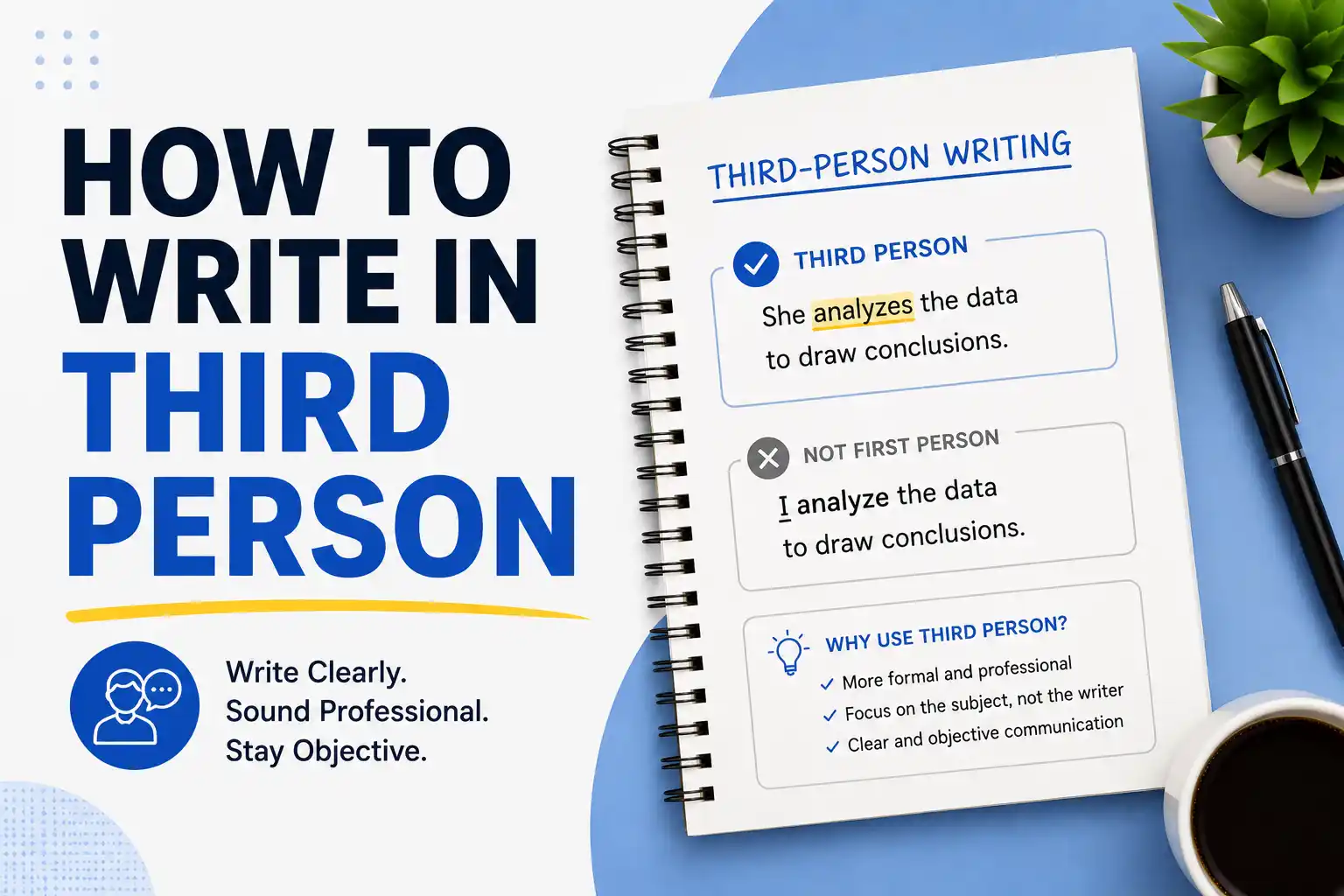
Correct Third Person
"The researcher conducted the experiment. She recorded the results carefully."
Incorrect (First Person)
"The researcher conducted the experiment. I recorded the results carefully."
4 How to Write in Third Person for Academic and Professional Writing
Academic and professional writing requires a formal, objective tone. Here is how to achieve that in the third person.
Avoid First Person ("I" and "We")
In most academic writing, you should avoid using "I" or "we." Instead of "I think the data shows," write "The data shows." Instead of "We conducted the experiment," write "The experiment was conducted."
Use the Passive Voice Strategically
The passive voice is often used in academic writing to focus on the action rather than the actor. For example, "The samples were analysed" instead of "We analysed the samples." However, use the passive voice sparingly — it can make your writing feel impersonal and wordy.
Refer to Yourself as "This Researcher" (with Caution)
Some academic writers refer to themselves as "this researcher" or "the author." However, this can feel awkward and artificial. In many fields, it is now acceptable to use "I" in certain contexts, especially in the introduction or conclusion. Check your institution's guidelines.
Focus on the Subject, Not the Writer
In academic writing, the focus should be on the research, the evidence, and the analysis — not on the writer. Keep the spotlight on the subject matter.
Academic Writing Examples
- First person: "I interpreted the results as evidence of a significant trend."
- Third person: "The results indicate a significant trend."
- First person: "I show that the hypothesis is supported."
- Third person: "The report shows that the hypothesis is supported."
5 How to Write in Third Person for Fiction and Creative Writing
In creative writing, the third person offers flexibility and control. Here is how to use it effectively.
Choose the Right Type of Third Person
Decide whether you want to use limited, omniscient, or objective third person. Your choice will shape the reader's experience. Limited creates intimacy with one character. Omniscient offers a broad perspective. Objective creates distance and mystery.
Establish a Consistent Point of View
Once you choose a point of view, stick with it. Do not switch between characters' thoughts in the same scene (head-hopping) unless you are using omniscient narration. Consistency is key to keeping readers engaged and avoiding confusion.
Show, Don't Tell
In third person limited, you can show a character's emotions through their actions, dialogue, and internal thoughts. Instead of telling the reader "She was angry," show her anger: "She slammed the door and clenched her fists."
Use the Narrator's Voice Wisely
In third person, the narrator has a distinct voice. In omniscient narration, the narrator can comment on events and characters. In limited narration, the narrator's voice is closely tied to the viewpoint character's perspective.
Creative Writing Examples
- Third person limited: "Maria looked out the window. She wondered if he would ever come back."
- Third person omniscient: "Maria looked out the window, wondering if he would ever come back. Meanwhile, across town, James was making a decision that would change everything."
- Third person objective: "Maria stood at the window. She stared at the street below. A car passed. She did not move."
6 Common Mistakes to Avoid
Even experienced writers make mistakes with third person. Here are the most common errors and how to avoid them.
Switching Person Mid-Sentence
Mixing first, second, and third person in the same sentence or paragraph. This confuses the reader.
Fix: Be consistent. Choose one point of view and stick to it throughout your piece.
Head-Hopping
Jumping between different characters' thoughts in the same scene without a clear transition.
Fix: In limited third person, stick to one character's perspective per scene. Use section breaks to change viewpoints.
Using "You" in Formal Writing
Addressing the reader directly with "you" in academic or professional writing.
Fix: Use third person pronouns or rephrase the sentence. "One might argue" instead of "You might argue."
Overusing the Passive Voice
Using the passive voice excessively to avoid first person. This can make your writing dull and wordy.
Fix: Use the active voice where possible, and only use the passive voice when the actor is unknown or unimportant.
Inconsistent Pronoun Agreement
Using a singular noun with a plural pronoun, or vice versa.
Fix: Ensure that your pronouns agree with their antecedents in number and gender.
Not Showing Emotion
In fiction, writing in third person without conveying the characters' emotions.
Fix: Use actions, dialogue, and internal thoughts to show how characters feel.
7 How to Choose the Right Type of Third Person
Choosing the right type of third person is essential for effective writing. Here is how to decide.
Third Person Limited
Best for: Most modern fiction, character-driven stories, and cases where you want to create intimacy with one character.
Advantage: Creates a strong connection between the reader and the viewpoint character. Allows for deep exploration of one character's psyche.
Challenge: You cannot show what other characters are thinking or feeling directly.
Third Person Omniscient
Best for: Epic stories, complex narratives with multiple characters, and cases where you want to provide a broad perspective.
Advantage: You can show the thoughts and feelings of all characters. You can provide information that no single character knows.
Challenge: Can feel distant or impersonal if not handled carefully.
Third Person Objective
Best for: Stories where you want to create mystery, distance, or a documentary-like feel. Also used in some journalism and reportage.
Advantage: Creates a neutral, unbiased tone. The reader must infer characters' emotions from their actions.
Challenge: Can feel cold or detached if not balanced with strong action and dialogue.
8 How to Revise Your Writing for Third Person
Revision is where your writing goes from good to great. Here is a step-by-step process for revising your writing to ensure it is in the third person.
Step 1: Identify All Pronouns
Go through your writing and highlight every pronoun. Identify which are first person (I, we), second person (you), and third person (he, she, it, they).
Step 2: Replace First and Second Person Pronouns
Replace "I," "we," and "you" with third person pronouns or rephrase the sentence. For example, change "I think" to "It is thought" or remove the phrase entirely.
Step 3: Check for Consistency
Ensure that you are using the same type of third person throughout your writing. If you are using limited, stick to one character's perspective per scene. If you are using omniscient, be clear about whose thoughts you are accessing.
Step 4: Read Aloud
Read your writing aloud. Does it sound natural? Are there any awkward shifts in person? Reading aloud helps you catch errors you might miss when reading silently.
Step 5: Get Feedback
Ask someone else to read your work and point out any inconsistencies in point of view. Fresh eyes can catch issues you have missed.
Step 6: Check for Pronoun Agreement
Ensure that all pronouns agree with their antecedents in number and gender. For example, "A student should bring their textbook" (singular they) is now widely accepted.
9 Practice Exercises to Improve Your Third Person Writing
The best way to get better at writing in third person is to practice. Here are some exercises to help you sharpen your skills.
Exercise 1: Rewrite a First Person Paragraph
Take a paragraph written in the first person (using "I") and rewrite it in the third person. Focus on changing the pronouns and maintaining a consistent point of view.
Exercise 2: Write a Scene in Each Type of Third Person
Write the same scene three times: once in third person limited, once in third person omniscient, and once in third person objective. Compare the effects of each approach.
Exercise 3: Identify the POV
Find a passage from a book or article and identify whether it is written in first, second, or third person. If it is third person, identify whether it is limited, omniscient, or objective.
Exercise 4: Revise for Consistency
Find a piece of your own writing that shifts between persons. Revise it to be consistently in the third person. Notice how the revision improves the clarity and professionalism of the writing.
10 Third Person Writing Examples
Here are some examples of third person writing in different contexts to illustrate how it works in practice.
Example 1: Academic Writing
"The experiment was conducted to test the hypothesis that increasing temperature accelerates the rate of photosynthesis. The results indicate a positive correlation between temperature and photosynthetic activity, with the highest rates observed at 35°C. These findings suggest that optimal conditions for photosynthesis occur within a narrow temperature range."
Example 2: Third Person Limited (Fiction)
"Maria stood at the window, her breath fogging the glass. She watched the street below, hoping to see his car turn the corner. The minutes dragged by. She checked her phone again — no messages. He had promised he would come."
Example 3: Third Person Omniscient (Fiction)
"Maria stood at the window, her heart heavy with worry. She did not know that across town, James was already on his way, his own heart racing with anticipation. The traffic was terrible, but he was determined to make it on time. Neither of them knew what the evening would bring."
Example 4: Third Person Objective (Fiction)
"Maria stood at the window. She looked down at the street. A car passed. She checked her phone. She put it back in her pocket. She did not move."
Example 5: Professional Writing
"The committee reviewed the proposal and recommended approval. The project is expected to be completed within six months, with a budget of $500,000. The team will provide regular progress reports to the board."
Final Thoughts
Writing in the third person is an essential skill for academic, professional, and creative writing. It allows you to present information objectively, create distance between the writer and the subject, and give your writing a formal, authoritative tone.
Remember that mastering the third person takes practice. Do not be discouraged if you slip into first or second person occasionally — revision is where you catch and correct these errors. With time and effort, writing in the third person will become second nature.
Keep these principles in mind as you write:
- Choose the right type of third person for your purpose: limited, omniscient, or objective.
- Use the correct pronouns — he, she, it, they — and avoid first and second person.
- Be consistent — maintain the same point of view throughout your writing.
- Show, don't tell — in fiction, use actions and dialogue to convey emotion.
- Revise carefully — check for shifts in person and correct them during revision.
Whether you are writing a research paper, a business report, or a novel, the third person is a powerful tool. Master it, and your writing will be clearer, more professional, and more engaging.
Now go write something in the third person.