How to Write Dialogue: The Complete Guide with Examples
You have characters in your head. They have things to say. But when you put their words on the page, something feels off. The conversation sounds stiff. Unnatural. Like robots reading a script.
You are not alone. Writing dialogue is one of the hardest skills to master in creative writing. It is also one of the most important. Great dialogue brings characters to life. It reveals personality, advances the plot, and keeps readers turning pages.
This guide will teach you everything you need to know about how to write dialogue that sounds authentic, serves your story, and captivates your readers. We will cover the fundamentals, the techniques, the formatting rules, and the common mistakes to avoid. By the end, you will have the tools to write conversations that crackle with life.
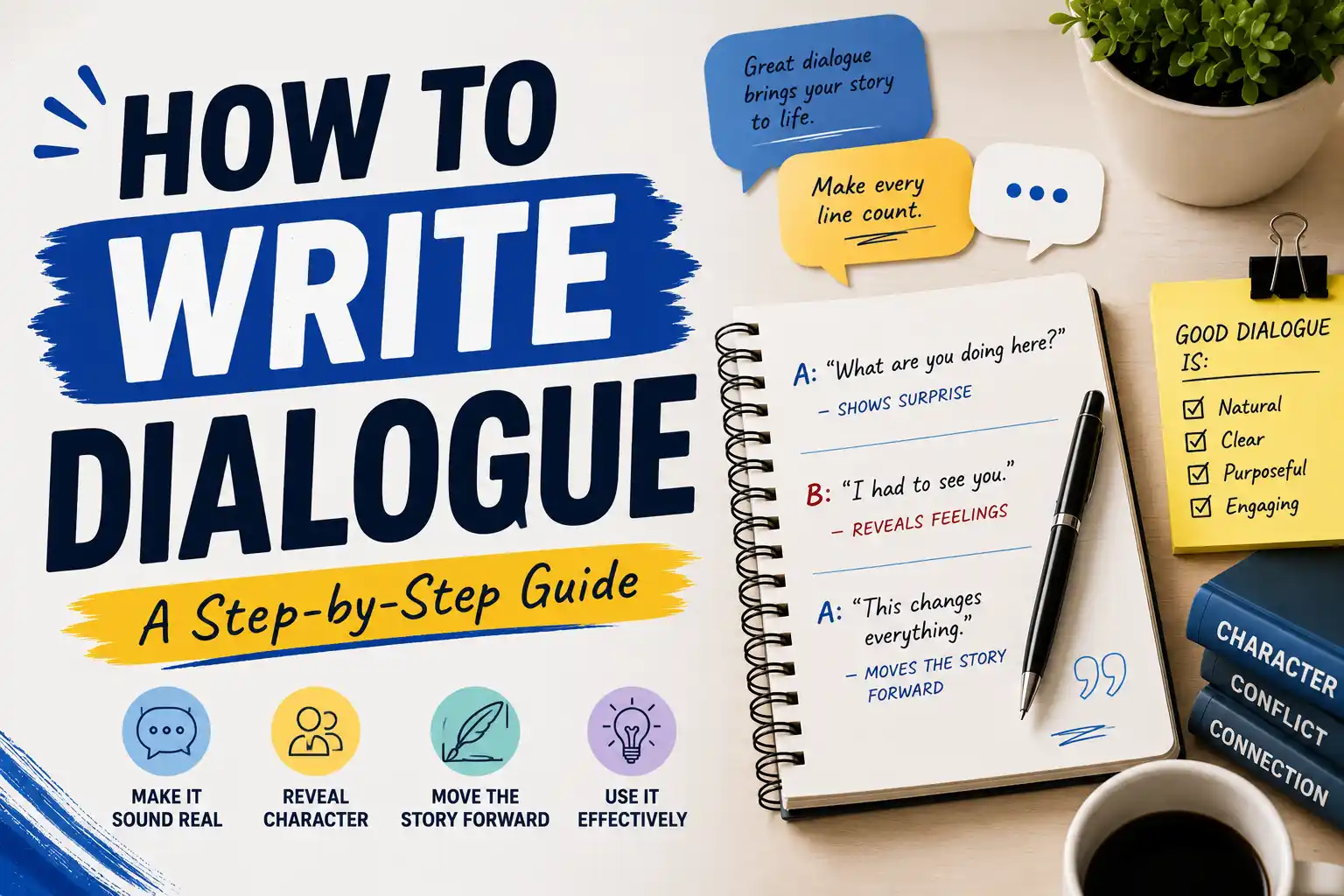
Dialogue Writing at a Glance
1 What Is Dialogue and Why Does It Matter?
At its simplest, dialogue is a conversation between two or more characters. But in fiction, it is so much more than that. Dialogue is a multipurpose tool that does several jobs at once.
Great dialogue reveals character. The way a person speaks tells us where they come from, their education level, their emotional state, and their personality. A nervous person uses different words than a confident one. An older character speaks differently than a teenager. Dialogue is characterization in action.
Dialogue also advances the plot. Characters exchange information, make decisions, and drive the story forward through conversation. A well-placed line of dialogue can reveal a secret, create a conflict, or change the course of the narrative.
And perhaps most importantly, dialogue creates engagement. Readers love to hear characters talk. It breaks up narrative exposition, adds variety to the page, and makes the story feel immediate and alive.
Reveals Character
Dialogue shows who your characters really are. Their word choices, speech patterns, and what they choose to say (or not say) all paint a picture of their inner world.
Advances Plot
Conversations move the story forward. Characters make plans, share discoveries, argue, and make decisions through dialogue.
Creates Tension
Conflict in dialogue creates dramatic tension. Arguments, misunderstandings, and loaded statements keep readers on the edge of their seats.
Breaks Up Narrative
Dialogue adds rhythm to your writing. It breaks up long passages of description and keeps the reader engaged with variety.
2 The Fundamentals of Writing Dialogue
Before you can write great dialogue, you need to understand the basics. These are the foundational principles that underpin every effective conversation in fiction.
Every Line Must Serve a Purpose
This is the single most important rule of writing dialogue. Every single line of dialogue should do at least one of these things: reveal character, advance the plot, provide information, or create tension. If a line does none of these, cut it. Readers can tell when characters are just talking to fill space.
Dialogue Reveals Character Through Voice
Each character should have a distinct voice. This means unique word choices, sentence structures, and speech patterns. A character's vocabulary reveals their education and background. Their sentence length reveals their emotional state and personality. Their dialect and slang reveal their region and social group.
Show, Don't Tell, Through Dialogue
Instead of telling readers a character is angry, show them through what the character says and how they say it. Short, clipped sentences. Interruptions. Raised voices (shown through exclamation points and action beats). Dialogue is a showing tool, not a telling tool.
The Iceberg Principle
In great dialogue, what is said is only the tip of the iceberg. The real meaning lies beneath the surface. Characters often say the opposite of what they mean. They deflect, evade, and hide their true feelings. This subtext is what makes dialogue feel real and compelling.
3 How to Format Dialogue
Proper dialogue formatting is essential for readability. Readers need to know who is speaking at a glance. Here are the standard rules for formatting dialogue in fiction.
Quotation Marks
In American English, use double quotation marks to enclose spoken words. Single quotation marks are used for quotes within quotes.
Example
Sarah said, "I cannot believe you actually did that."
Tom replied, "She told me, 'Go for it.' So I did."
Dialogue Tags
A dialogue tag tells the reader who is speaking. The most common and invisible tag is "said." Other tags like "whispered," "shouted," or "murmured" are fine in moderation. Avoid overly elaborate tags that draw attention to themselves.
Example
"I am leaving now," she said.
"Do not go," he whispered.
"I have to," she replied.
Action Beats
An action beat is a description of what a character is doing while speaking. Action beats are a great alternative to dialogue tags. They show the reader what is happening and can reveal character emotion through body language.
Example
"I am leaving now." She grabbed her coat from the hook.
"Do not go." He stepped in front of the door.
"I have to." She met his eyes, her hand on the doorknob.
Punctuation Inside Quotation Marks
Commas, periods, exclamation points, and question marks that belong to the dialogue go inside the quotation marks.
Example
"I am so excited to see you," she said.
"Where have you been?" he asked.
"We were worried about you!"
4 How to Make Dialogue Sound Natural
Natural-sounding dialogue is one of the hardest things to achieve in writing. Real conversation is full of "um," "uh," repetition, and tangents. But realistic dialogue in fiction is not a transcript of real speech. It is carefully crafted to sound authentic while serving the story.
Read Your Dialogue Aloud
This is the single best technique for testing whether your dialogue sounds natural. Read it out loud. Does it flow? Does it sound like something a real person would say? If you stumble over the words, your readers will too. Reading dialogue aloud catches awkward phrasing and unnatural rhythms.
Give Each Character a Unique Voice
Characters should not all sound the same. A teenager uses different vocabulary and sentence structures than an elderly professor. A busy executive speaks differently than a laid-back artist. Think about each character's background, personality, and current emotional state.
Example: Academic Voice
"In my estimation, the data suggests a significant correlation between the two variables. However, further research would be required to establish causality."
Example: Casual Voice
"Yeah, the numbers look pretty connected. But we would need to dig deeper to know for sure."
Cut the Fluff
Real conversation is full of filler words and repetition. In fiction, you want to strip away most of that. Keep the essence of the conversation, but remove the verbal clutter. Every word in dialogue should earn its place.
Show, Do Not Tell, Emotion
Instead of telling readers a character is angry, show their anger through what they say and how they say it. Short sentences. Interruptions. Sharp words. The emotion should be evident in the dialogue itself.
5 Subtext and What Characters Are Not Saying
Perhaps the most powerful tool in writing dialogue is subtext. Subtext is the hidden meaning beneath the words. It is what characters really mean but do not say directly. Subtext creates depth, tension, and realism.
In real life, people rarely say exactly what they mean. They hint. They deflect. They say one thing while meaning another. Your characters should do the same.
On the surface, this is a simple exchange about traffic and dry cleaning. But the subtext tells a different story. Anna is suspicious. She is checking on Mark. Her question about the dry cleaning is not really about the dry cleaning. It is a test. Mark knows it. The tension is palpable.
Hidden Meaning
Characters often say the opposite of what they mean. A character who says "I am fine" is probably not fine. A character who says "I do not care" probably cares deeply.
Conflict Without Direct Confrontation
Subtext allows characters to fight without fighting. Passive-aggressive comments, loaded questions, and pointed silences all create conflict without shouting.
Unspoken Feelings
Characters in love often struggle to say it directly. Their dialogue reveals their feelings through what they do not say as much as what they do.
Power Dynamics
Subtext reveals who holds the power in a conversation. Who defers? Who interrupts? Who changes the subject? These dynamics are often more telling than the actual words.
6 How to Write Dialogue for Different Genres
The way you write dialogue depends heavily on your genre. Different genres have different conventions and expectations for how characters speak.
Action & Thriller
Dialogue in action and thriller novels is lean and fast. Characters speak in short, punchy sentences. There is little time for lengthy conversations. Every line moves the plot forward at breakneck speed.
Key trait: Minimal dialogue tags. Short exchanges. High stakes.
Romance
Romance dialogue is all about chemistry and connection. Characters flirt, banter, and reveal their feelings gradually. The dialogue often has a rhythm that mirrors the emotional arc of the relationship.
Key trait: Witty banter. Emotional reveals. Tension and release.
Horror
Horror dialogue builds dread and tension. Characters often talk about normal things while the horror lurks beneath. The dialogue can become fragmented and desperate as the situation worsens.
Key trait: Unease. Fragmented speech. Contrast between normal and horrifying.
Literary Fiction
Literary fiction dialogue is often more nuanced and introspective. Characters speak in a way that reveals their inner lives. The dialogue is as much about what is not said as what is said.
Key trait: Subtext. Philosophical depth. Character-focused.
7 Common Dialogue Mistakes to Avoid
Even experienced writers fall into dialogue traps. Here are the most common mistakes and how to avoid them.
On-the-Nose Dialogue
Characters saying exactly what they mean. This is the most common mistake. It feels unrealistic and boring.
Example: "I am angry at you for forgetting my birthday."
Better: "Oh, you remembered. How nice." (said with sarcasm)
Overuse of Dialogue Tags
Using "said" too much is fine. Using elaborate tags like "he exclaimed," "she opined," "they retorted" draws attention to the tag, not the dialogue.
Better: Use action beats instead of tags. "I am leaving." He grabbed his keys.
Characters Sounding the Same
If you remove the dialogue tags, can you tell which character is speaking? If not, you have a problem. Each character needs a distinct voice.
Information Dumping
Using dialogue to dump exposition. "As you know, your father was the king of this land before he was assassinated by the rival kingdom." No one talks like this.
Better: Reveal information gradually and naturally.
Overly Formal Language
Characters using overly formal or grammatically perfect speech. Real people use contractions, slang, and sentence fragments.
No Subtext
Every character says exactly what they mean. This makes the dialogue feel flat and unrealistic.
8 Advanced Dialogue Techniques
Once you have mastered the basics, you can start using advanced techniques to take your dialogue to the next level.
Interruptions
Real conversations are full of interruptions. Characters cut each other off, talk over each other, and leave sentences unfinished. This creates a sense of urgency and realism.
Example
Lisa: "I was thinking we could go to the cinema"
Mark: "No. We are not going there again."
Lisa: "But you promised you would go"
Mark: "I do not care what I promised."
Silences and Pauses
What characters do not say is just as important as what they do say. Use pauses, hesitations, and silences to create tension and reveal emotion.
Example
David: "So... you are leaving?"
Sarah: ... She looked away.
David: "I see."
Contradictions
Characters often say one thing while doing another. This creates dramatic irony and reveals their true feelings.
Example
He said, "I am fine." His hands were shaking.
Repetition
Strategic repetition can emphasise emotion and create rhythm in dialogue. A character who repeats a phrase is often trying to convince themselves or someone else.
Example
"It is fine. Everything is fine. It is all fine."
9 How to Revise Dialogue
Great dialogue is not written; it is rewritten. Revision is where your dialogue goes from good to great. Here is a step-by-step process for revising dialogue.
Step 1: Read It Aloud
Read your dialogue out loud. Does it sound natural? Are there any awkward phrases? Does it flow? Mark any places where you stumble or pause.
Step 2: Check for Purpose
Go through every line of dialogue. Does each line reveal character, advance the plot, provide information, or create tension? If a line does none of these, cut it.
Step 3: Listen for Distinct Voices
Cover up the dialogue tags. Can you tell who is speaking? If not, you need to differentiate your characters' voices more clearly.
Step 4: Trim the Fat
Cut unnecessary words. Replace long phrases with shorter ones. Make every word count. Realistic dialogue is polished dialogue.
Step 5: Check for Subtext
Are your characters saying what they mean, or is there hidden meaning beneath the surface? Add subtext where it is missing.
Step 6: Get Feedback
Have someone else read your dialogue aloud. Or ask a beta reader for feedback specifically on the dialogue. Fresh ears catch things you will miss.
10 Practice Exercises to Improve Your Dialogue
The best way to get better at writing dialogue is to practice. Here are some exercises to help you sharpen your skills.
Exercise 1: Eavesdrop
Go to a coffee shop, park, or bus stop. Listen to real conversations. Write down snippets of dialogue. Notice the rhythms, the interruptions, the subtext. Real people are your best teachers.
Exercise 2: Character Voice Swap
Write a scene where two characters have a conversation. Then swap their voices. How does the dialogue change? This helps you understand the importance of distinct character voices.
Exercise 3: The Cutting Game
Write a 500-word dialogue scene. Then cut it down to 250 words. Then cut it down to 100 words. What is the absolute minimum you need to convey the scene? This teaches you to write lean dialogue.
Exercise 4: Subtext Rewrite
Write a scene where two characters have a straightforward conversation about a mundane topic. Then rewrite it so they are actually talking about something else entirely. The words stay the same; the meaning changes.
Final Thoughts
Writing dialogue is a craft that takes time to master. Do not expect your first draft to have perfect dialogue. Great dialogue comes through revision, practice, and a willingness to listen to how real people talk.
Remember that dialogue is not just words on a page. It is character. It is emotion. It is conflict. It is the beating heart of your story. When you write dialogue, you are giving your characters a voice. You are bringing them to life.
Keep these principles in mind as you write:
- Every line must serve a purpose. If it does not, cut it.
- Each character needs a distinct voice. Readers should be able to tell who is speaking without tags.
- Subtext is your secret weapon. What is not said is often more important than what is said.
- Read your dialogue aloud. If it sounds wrong, it is wrong.
- Revision is where dialogue becomes great. Do not settle for your first draft.
The characters in your head have stories to tell. They have words waiting to be written. Give them a voice. Write their dialogue with intention, with care, and with a willingness to revise until it sings.
Now go write something your characters would be proud to say.