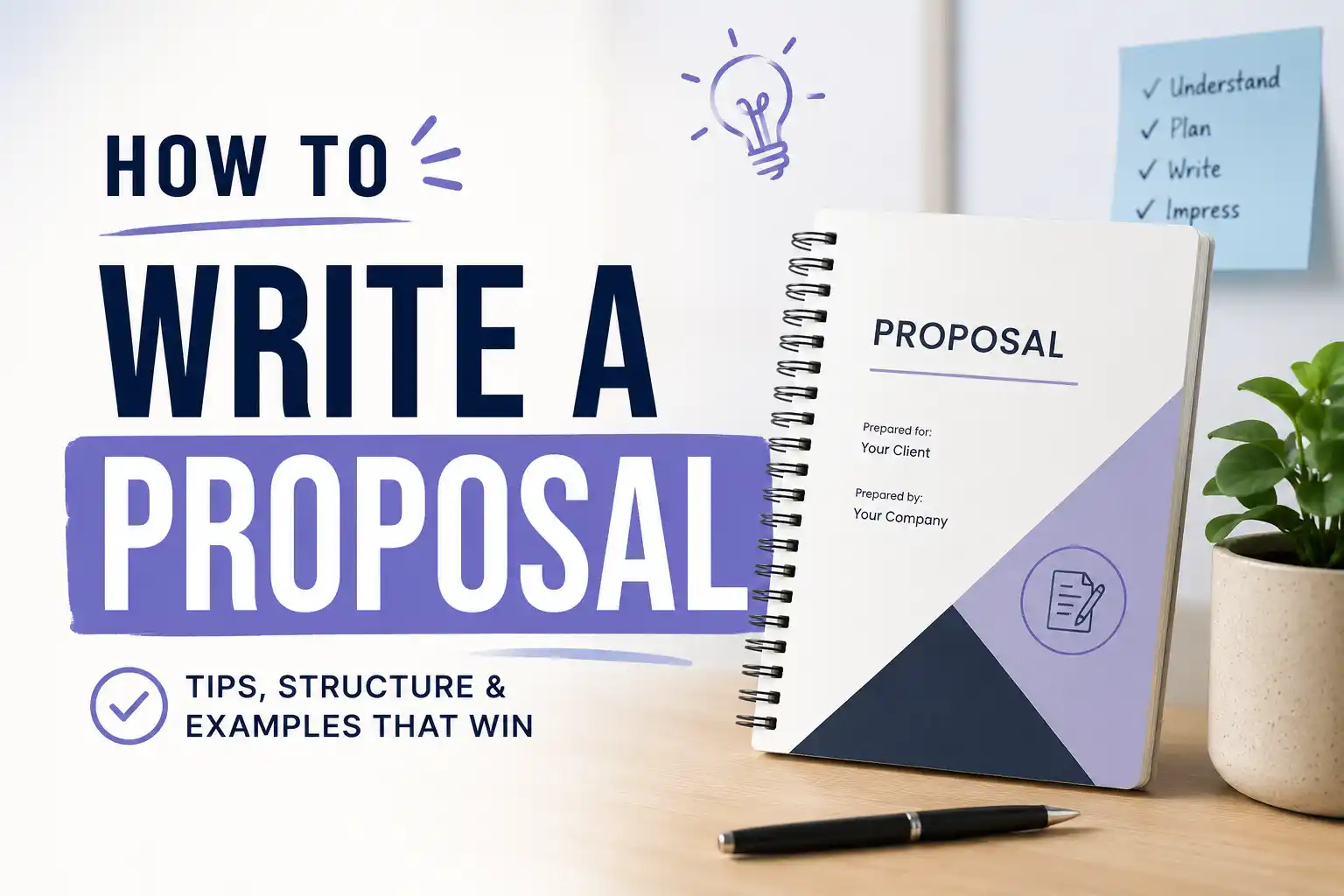
How to Write a Proposal: The Complete Guide with Examples
You have a great idea. You have a solution to a problem. You know it could make a difference. But when you sit down to write a proposal, you are not sure where to start. How do you structure it? What should you include? How do you make it persuasive?
You are not alone. Writing a proposal is a skill that many professionals find challenging. But a well-crafted proposal can win clients, secure funding, and get your ideas approved. It is a powerful tool in business, academia, and non-profit work.
This guide will teach you everything you need to know about how to write a proposal that is persuasive, professional, and effective. We will cover the structure, the content, the tone, and the common mistakes to avoid. By the end, you will have the tools to write proposals that get results.
Proposal Writing at a Glance
1 What Is a Proposal and Why Does It Matter?
A proposal is a formal document that presents a plan, project, or idea to a decision-maker. It outlines a problem, proposes a solution, and makes a case for why that solution should be adopted. Proposals are used in business, academia, government, and non-profit organisations.
Proposals matter because they are persuasive documents that can change minds and open doors. A well-written proposal can win a new client, secure funding for a project, or get approval for a new initiative. It is your chance to make a compelling case for your idea.
In a competitive environment, a strong proposal can be the difference between success and failure. It demonstrates that you understand the problem, have a viable solution, and are capable of delivering results. A poorly written proposal can undermine your credibility and cost you opportunities.
Builds Credibility
A well-crafted proposal shows that you are professional, thorough, and capable. It builds trust with the reader.
Persuades Decision-Makers
Proposals are designed to persuade. They present a clear problem and a compelling solution, making it easy for decision-makers to say yes.
Secures Resources
Whether it is funding, approval, or support, a strong proposal secures the resources you need to move forward.
Provides a Roadmap
A proposal outlines the scope, timeline, and deliverables of a project. It serves as a roadmap for implementation.
2 The Fundamentals of Writing a Proposal
Before you start writing, you need to understand the foundational principles that underpin every effective proposal.
Focus on the Reader's Needs
This is the single most important rule of proposal writing. Your proposal is not about you — it is about the reader. What problem are they facing? What do they need? How can you help them? Frame your proposal around their needs, not your features.
Be Clear and Concise
Decision-makers are busy. They do not have time to wade through long, complex documents. Use clear, simple language. Get straight to the point. Use headings and bullet points to make your proposal easy to scan.
Be Persuasive
A proposal is both informative and persuasive. You are not just presenting information — you are making a case. Use evidence, data, and logic to support your arguments. Anticipate objections and address them proactively.
The "So What?" Test
For every statement you make in your proposal, ask yourself: "So what?" Why does this matter to the reader? How does this help them? If you cannot answer that question, revise or remove the statement. Every line should demonstrate value to the reader.
3 Types of Proposals
There are several types of proposals, each with a specific purpose and audience. Understanding the type of proposal you are writing will help you tailor your content and structure.
Business Proposals
Used to win new clients or projects. They present a solution to a client's problem and outline the scope, timeline, and cost of the project.
Key trait: Focus on client needs, ROI, and competitive advantage.
Project Proposals
Used to propose a new project within an organisation. They outline the goals, scope, deliverables, and timeline of the project.
Key trait: Focus on alignment with organisational goals and measurable outcomes.
Grant Proposals
Used to secure funding from government agencies, foundations, or other grant-making organisations. They require a clear research hypothesis and alignment with the funder's goals.
Key trait: Focus on alignment with funder priorities and clear outcomes.
Academic Proposals
Used to propose research projects, conference presentations, or academic papers. They situate the work within a broader scholarly conversation.
Key trait: Focus on scholarly contribution and methodological rigour.
Research Proposals
Used to propose a research project. They outline the research question, methodology, and expected outcomes.
Key trait: Focus on research hypothesis, methodology, and significance.
Sales Proposals
Used to sell products or services. They focus on benefits, features, and pricing. They are often shorter and more visually appealing.
Key trait: Focus on benefits, pricing, and call to action.
4 How to Structure a Proposal
A well-structured proposal is easy to read and understand. Here is a standard structure that works for most types of proposals.
Executive Summary
The executive summary is the most important part of your proposal. It summarises the entire proposal and captures the reader's attention. It should be short, to the point, and motivational. State the problem, your solution, and the key benefits. Write this last, but place it first.
Problem Statement
Clearly and fully define the problem or opportunity addressed by the proposal. Explain why it matters and why it needs to be solved now. Use data and evidence to support your claims. This section establishes the need for your proposal.
Proposed Solution
Describe your solution in detail. Explain how it addresses the problem. What are the key features and benefits? Why is your approach the best one? Be specific and persuasive.
Scope of Work and Deliverables
Outline the specific activities, tasks, and deliverables that will be completed. This section should be clear and detailed so the reader knows exactly what to expect.
Timeline and Schedule
Provide a timeline for the project. When will key milestones be reached? When will the project be completed? A clear timeline demonstrates that you have thought through the implementation.
Budget and Resources
Outline the costs associated with the project. Be transparent and detailed. Explain how the budget aligns with the scope of work. If you are applying for funding, this section is critical.
Conclusion and Call to Action
Summarise the key points and state what you want the reader to do. This could be approving the project, signing a contract, or providing funding. Make it easy for them to take the next step.
Sample Proposal Structure
- 1. Executive Summary — Overview of the proposal
- 2. Problem Statement — The issue or opportunity
- 3. Proposed Solution — Your approach and methodology
- 4. Scope of Work — Tasks and deliverables
- 5. Timeline — Key milestones and deadlines
- 6. Budget — Costs and resources
- 7. Conclusion — Summary and call to action
5 What to Include in a Proposal
Every proposal should include certain essential elements. Here is what to include, section by section.
Executive Summary
This is your elevator pitch. Summarise the problem, your solution, and the key benefits. Keep it to one page or less. Write it in a way that makes the reader want to learn more.
Background and Context
Provide the context for your proposal. What is the current situation? What has led to the problem? This section helps the reader understand why your proposal is needed.
Objectives and Goals
Clearly state the objectives of your proposal. What do you hope to achieve? Make your goals specific and measurable.
Methodology and Approach
Explain how you will achieve your objectives. What methods will you use? Why are they appropriate? This section demonstrates that you have a plan.
Evaluation and Metrics
How will you measure success? What metrics will you use? This section shows that you are committed to accountability and results.
Qualifications and Experience
Why are you the right person or team to do this work? Highlight your relevant experience, skills, and qualifications. This section builds credibility.
Budget and Justification
Provide a detailed budget. Justify each cost. This section should be transparent and show that you have thought carefully about the resources required.
Conclusion and Next Steps
Summarise your proposal and state what you want the reader to do. Make it easy for them to take the next step.
6 How to Write a Proposal: Step-by-Step
Here is a step-by-step process for writing a proposal.
Step 1: Research and Understand Your Audience
Before you write anything, research your audience. Who are they? What are their needs and pain points? What are their priorities? Understanding your audience is the foundation of a persuasive proposal.
Step 2: Define the Problem
Clearly define the problem or opportunity you are addressing. Why does it matter? Why now? Use data and evidence to support your claims.
Step 3: Develop Your Solution
Develop a clear, compelling solution to the problem. Why is your approach the best one? What are the key benefits? Be specific and persuasive.
Step 4: Create an Outline
Create a detailed outline of your proposal. This will help you organise your thoughts and ensure you cover all the essential sections.
Step 5: Write the Executive Summary Last
Write the executive summary last, after you have completed the rest of the proposal. This ensures that it accurately reflects the content of your proposal.
Step 6: Write the Body
Write the body of your proposal, following your outline. Use clear, concise language. Use headings and bullet points to make it easy to scan.
Step 7: Revise and Proofread
Revise your proposal for clarity, persuasiveness, and accuracy. Proofread carefully for errors. A polished proposal demonstrates professionalism.
Sample Executive Summary
"This proposal outlines a comprehensive digital marketing strategy for ABC Company to increase online engagement and drive revenue growth. Over the past year, ABC Company has seen a 15% decline in website traffic and a 10% drop in conversion rates. Our proposed solution leverages data-driven content marketing, SEO optimisation, and targeted social media campaigns to reverse these trends. We project a 30% increase in engagement and a 20% boost in revenue within six months. This proposal includes a detailed scope of work, timeline, and budget."
7 Common Mistakes to Avoid
Even experienced writers make mistakes. Here are the most common errors and how to avoid them.
Focusing on Features Instead of Benefits
Listing the features of your solution without explaining how they benefit the reader.
Fix: Always connect features to benefits. Explain how your solution will help the reader.
Being Too Vague
Failing to provide specific details about the problem, solution, or implementation.
Fix: Be specific. Use data, examples, and concrete details.
Ignoring the Reader's Needs
Writing a proposal that focuses on what you want instead of what the reader needs.
Fix: Frame your proposal around the reader's needs and priorities.
Using Jargon
Using technical jargon that the reader may not understand.
Fix: Use clear, plain language. Define any necessary terms.
Poor Formatting
Using inconsistent formatting, small fonts, or cluttered layouts.
Fix: Use a clean, professional format with clear headings and plenty of white space.
Forgetting to Proofread
Sending a proposal with spelling or grammar errors. This undermines your credibility.
Fix: Proofread carefully. Ask someone else to review it.
8 How to Write a Persuasive Proposal
A persuasive proposal is one that gets approved. Here are some advanced techniques to make your proposal more persuasive.
Use Data and Evidence
Support your arguments with data, statistics, and evidence. This builds credibility and makes your case more compelling. Use charts and graphs to visualise data where appropriate.
Anticipate Objections
Think about what objections the reader might have. Address them proactively in your proposal. This shows that you have thought through the issues and are prepared.
Use Persuasive Language
Use strong, confident language. Avoid hedging or weak phrasing. Use active voice and declarative statements.
Show ROI
If you are proposing a project or investment, show the return on investment. Explain how the benefits outweigh the costs.
Make It Visually Appealing
Use headings, bullet points, and white space to make your proposal easy to scan. Use visuals like charts, graphs, and images where appropriate.
Weak Language
"We think this might be a good solution for your needs."
Strong Language
"This solution is designed to meet your specific needs and deliver measurable results."
9 How to Revise Your Proposal
A great proposal is not written; it is rewritten. Revision is where your proposal goes from good to great. Here is a step-by-step process for revising your proposal.
Step 1: Check for Clarity
Is your proposal easy to read and understand? Is your purpose clear? If not, revise for clarity.
Step 2: Check for Persuasiveness
Does your proposal make a compelling case? Is it focused on the reader's needs? If not, revise to strengthen your arguments.
Step 3: Check for Completeness
Have you included all the essential sections? Is there any missing information? Fill any gaps.
Step 4: Check for Accuracy
Are your facts, figures, and details accurate? Double-check everything.
Step 5: Check for Errors
Proofread carefully for spelling, grammar, and punctuation errors.
Step 6: Get Feedback
Ask a colleague or mentor to review your proposal. Fresh eyes can catch issues you have missed.
10 Practice Exercises to Improve Your Proposals
The best way to get better at writing proposals is to practice. Here are some exercises to help you sharpen your skills.
Exercise 1: Write a Business Proposal
Choose a product or service you are familiar with. Write a business proposal to a fictional client. Include all the essential sections.
Exercise 2: Write a Project Proposal
Think of a project you would like to implement. Write a project proposal for your organisation. Focus on the problem, solution, and expected outcomes.
Exercise 3: The "Features to Benefits" Rewrite
Take a list of features for a product or service. Rewrite each one as a benefit to the customer. Compare the two versions.
Exercise 4: Peer Review Swap
Swap proposals with a colleague. Review each other's proposals and provide honest feedback. What is working? What could be stronger?
Final Thoughts
Writing a proposal is an essential professional skill. A well-crafted proposal can win clients, secure funding, and get your ideas approved. It is a powerful tool for making things happen.
Remember that a proposal is not just about presenting information. It is about persuading someone to take action. Focus on the reader's needs, be clear and concise, and make a compelling case for your solution.
Keep these principles in mind as you write:
- Focus on the reader. Frame your proposal around their needs and priorities.
- Be clear and concise. Use simple language and a clean structure.
- Be persuasive. Use evidence, logic, and strong language.
- Be specific. Provide concrete details about the problem, solution, and implementation.
- Be polished. Proofread carefully and format your proposal professionally.
Proposal writing is a skill that can be learned and improved. With practice, you will become more confident and effective. Your proposals will reflect your professionalism and help you achieve your goals.
Now go write a proposal that gets approved.