How to Use "To" in a Sentence: The Complete Guide with Examples
You have probably used the word "to" thousands of times without thinking about it. It is one of the most common words in the English language , and one of the most confusing. Should you say "I am used to" or "I am used for"? Is it "to go" or "for go"? When do you use "to" and when do you use "toward"?
You are not alone. Using "to" correctly is a challenge for many English learners and even native speakers. The word "to" has multiple functions: it can be a preposition, an infinitive marker, or part of a phrasal verb. Each function has its own rules, exceptions, and common pitfalls.
This guide will teach you everything you need to know about how to use "to" in a sentence. We will cover its various functions, the grammar rules that govern its use, common mistakes to avoid, and plenty of examples to illustrate each point. By the end, you will use "to" with confidence and precision.
"To" Usage at a Glance
1 What Is "To" and Why Does It Matter?
The word "to" is a versatile function word in English. It is used as a preposition, an infinitive marker, and as part of phrasal verbs. Despite its small size, "to" plays a crucial role in sentence structure and meaning.
Using "to" correctly matters because it helps you communicate clearly and accurately. Misusing "to" can confuse your reader or listener. It can change the meaning of a sentence entirely. For example, "I want to eat" (infinitive) means something very different from "I want for eat" (incorrect).
Understanding "to" also helps you avoid common spelling and grammar errors, such as confusing "to," "too," and "two" , one of the most frequent mistakes in English writing.
Preposition
As a preposition, "to" shows direction, relationship, or connection. Example: "She went to the store."
Infinitive Marker
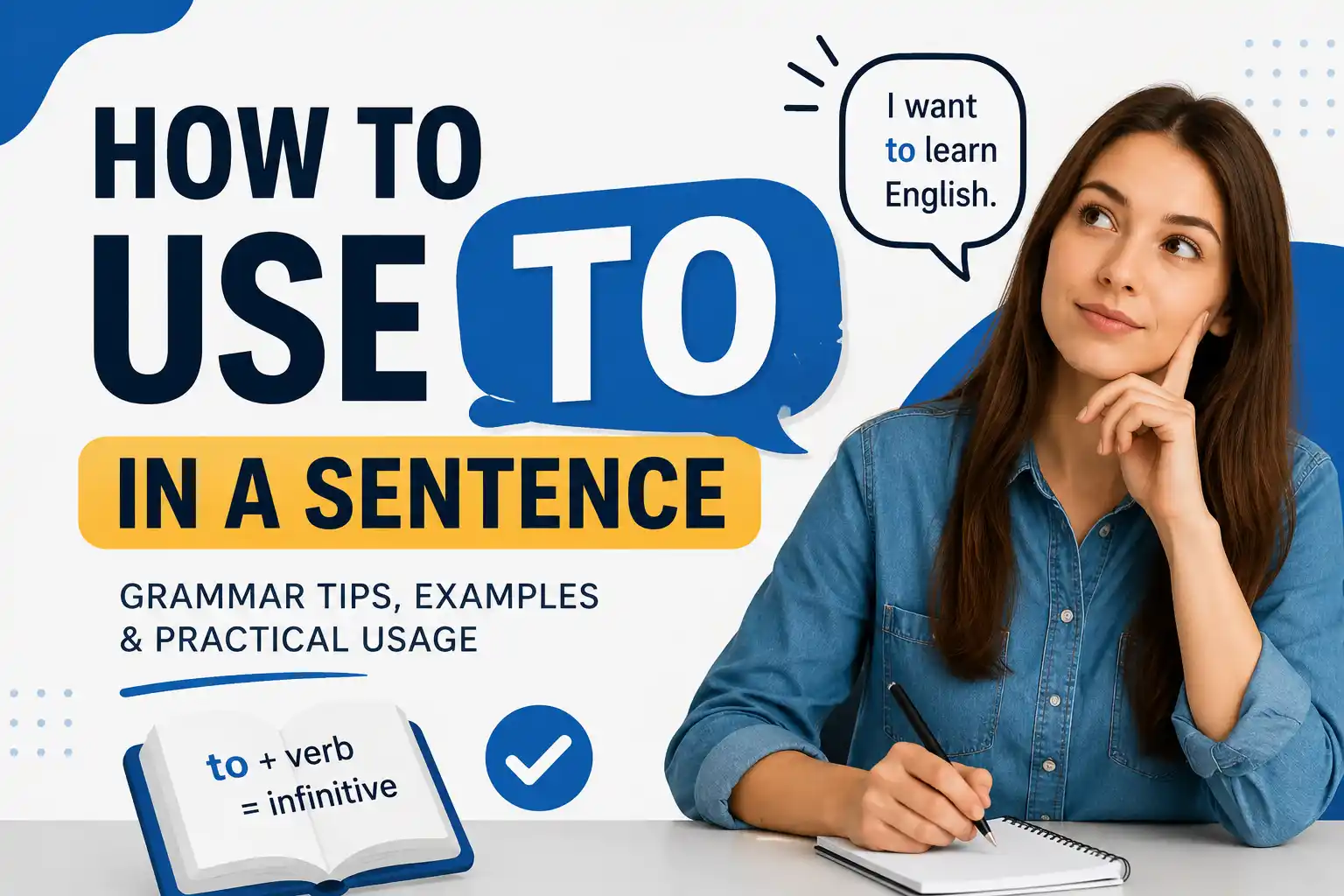
As an infinitive marker, "to" precedes the base form of a verb. Example: "I want to go home."
Phrasal Verb Particle
As a particle, "to" is part of a multi-word verb. Example: "Please hand it to me."
Homophones
"To" is often confused with "too" (meaning "also" or "excessively") and "two" (the number).
2 "To" as a Preposition: Showing Direction and Relationship
As a preposition, "to" is used to show direction, movement, purpose, or a relationship between elements in a sentence. Here are the most common uses.
Indicating Direction or Movement
Use "to" to show where someone or something is moving or heading.
Examples
- "She walked to the park."
- "He drove to the office."
- "The train goes to Chicago."
- "Turn left to reach the station."
Indicating a Recipient or Receiver
Use "to" to show who receives an action or object.
Examples
- "I gave the book to my brother."
- "She sent a letter to her grandmother."
- "Please pass this message to everyone."
- "He spoke to the manager."
Indicating Purpose or Intention
Use "to" to show the purpose of an action or the reason for something.
Examples
- "She works hard to support her family."
- "He saved money to buy a car."
- "They came here to learn English."
- "We need food to survive."
Indicating a Range or Limit
Use "to" to show the extent of time, distance, or a range.
Examples
- "The store is open from 9 AM to 6 PM."
- "She counted from one to ten."
- "It is five miles to the next town."
Indicating Attachment or Connection
Use "to" to show a connection, attachment, or relationship.
Examples
- "She is married to him."
- "This key belongs to that door."
- "He is committed to his work."
3 "To" as an Infinitive Marker: The Base Form of Verbs
In English, the infinitive is the base form of a verb, usually preceded by the word "to." It is used in a variety of ways: after certain verbs, to express purpose, as the subject of a sentence, and more. The infinitive can act as a noun, an adjective, or an adverb.
Using the Infinitive after Certain Verbs
Many verbs are followed by the infinitive form of another verb. These include "want," "need," "decide," "plan," "promise," "refuse," and many others.
Examples
- "I want to go to the store."
- "She needs to finish her homework."
- "They decided to start a new business."
- "He promised to help me."
- "We planned to travel to Europe."
Using the Infinitive to Express Purpose
Use the infinitive to explain why you are doing something. This is one of the most common uses of the infinitive.
Examples
- "I came here to study."
- "She woke up early to catch the train."
- "He called to apologize."
- "We need more time to finish the project."
Using the Infinitive as the Subject
In formal or academic writing, you can use an infinitive as the subject of a sentence. This sounds more sophisticated than using the gerund (-ing form) in some contexts.
Examples
- "To succeed in life is a common goal."
- "To love and be loved is the greatest joy."
- "To err is human; to forgive, divine."
Using the Infinitive after Adjectives
Some adjectives are followed by the infinitive form of a verb, often to explain what the adjective refers to.
Examples
- "I am happy to help you."
- "She is excited to start her new job."
- "He was surprised to see her there."
- "We are ready to begin."
4 "To" vs. "For": What Is the Difference?
One of the most common questions about "to" is: When do I use "to" and when do I use "for"? Both are prepositions, but they are used in different contexts.
Use "To" to Show Direction or Recipient
Use "to" when you are talking about movement toward something or someone, or when you are indicating the receiver of an action.
Examples
- "I am going to the store." (direction)
- "I gave the book to her." (recipient)
- "I spoke to my boss." (recipient of speech)
Use "To" for Infinitive Verbs
Use "to" before the base form of a verb to form the infinitive. This is never done with "for."
Examples
- "I want to eat." (infinitive)
- "She needs to leave." (infinitive)
- "He likes to play soccer." (infinitive)
Use "For" to Show Benefit or Purpose
Use "for" when you are talking about the reason or benefit of an action, or when you are doing something on behalf of someone else.
Examples
- "I bought this gift for you." (benefit)
- "She works hard for her family." (benefit)
- "We need a solution for this problem." (purpose)
- "I am here for the meeting." (purpose)
Quick Guide: "To" vs. "For"
5 Common Phrasal Verbs and Expressions with "To"
"To" appears in many common phrasal verbs and expressions. Here are some of the most useful ones to know.
Phrasal Verbs with "To"
- Get to , arrive at a place; have the opportunity to
- Look forward to , anticipate with pleasure
- Be used to , be accustomed to
- Get used to , become accustomed to
- Be about to , be on the verge of doing something
- Have to , must, need to
- Ought to , should
- Listen to , hear and pay attention to
Common Expressions with "To"
- To and fro , back and forth
- To the point , relevant and direct
- To be honest , in all honesty
- To tell the truth , speaking honestly
- To make matters worse , to worsen a situation
Example Sentences
- "I am looking forward to the holiday." (phrasal verb with -ing)
- "I am used to waking up early." (be used to + -ing)
- "You have to finish your homework." (have to + infinitive)
- "I ought to call her back." (ought to + infinitive)
- "She listened to the music." (listen to + noun)
6 Common Mistakes to Avoid
Even native speakers make mistakes with "to." Here are the most common errors and how to avoid them.
Confusing "To," "Too," and "Two"
This is one of the most common mistakes in English. "To" is a preposition or infinitive marker. "Too" means "also" or "excessively." "Two" is the number.
Fix: "I want to go too." (infinitive + also) , "I bought two apples."
Using "To" Instead of "Too"
Saying "I want to go to" when you mean "I want to go too." This is a common typo and spelling error.
Fix: Remember: "too" has two 'o's. Use it when you mean "also" or "excessively."
Using "For" Instead of "To" for Infinitives
Saying "I want for go" instead of "I want to go." English uses "to" before the base form of the verb to form the infinitive , never "for."
Fix: Always use "to" before the base form of a verb in the infinitive.
Using "To" with the Wrong Verb Form
Using the infinitive after "be used to" or "look forward to" is a common mistake. These expressions are followed by the -ing form, not the infinitive.
Fix: "I am used to waking up early" (not "to wake up"). "I look forward to seeing you" (not "to see").
Omitting "To" in Infinitive Constructions
Forgetting "to" when it is needed, especially after certain verbs.
Fix: "I want go" is incorrect. Always use "I want to go."
Using "To" for Distance When You Mean "From"
Using "to" to express distance between two points is correct, but make sure you also use "from."
Fix: "It is 10 miles from my house to the city." (not just "to the city")
7 How to Teach "To" to English Learners
If you are teaching English or helping someone learn the language, here are some effective strategies for teaching the word "to."
Start with the Basics
Begin by teaching "to" as a preposition showing direction and as an infinitive marker. Use simple, clear examples and plenty of repetition.
Use Visuals
Use pictures and diagrams to show direction: a person walking to a building, a line showing movement from one point to another. Visuals help learners understand the concept of direction and destination.
Teach "To" and "For" Together
Comparing "to" and "for" helps learners understand the difference. Use side-by-side examples and practice exercises.
Practice Common Expressions
Teach common expressions and phrasal verbs that use "to," such as "look forward to," "be used to," and "have to." Practise these in context so learners can use them naturally.
Common Phrases for Practice
- I want to... , express a desire
- I need to... , express a necessity
- I plan to... , express a plan
- I am going to... , express future plans
- I like to... , express likes
- I am used to... , express habit
8 "To" in Different Sentence Types
The word "to" appears in various sentence structures. Here is how "to" functions in different contexts.
Declarative Sentences
In simple statements, "to" is used as a preposition or infinitive marker.
Examples
- "She went to the store." (preposition)
- "She wants to go home." (infinitive)
Interrogative Sentences
In questions, "to" often appears in the infinitive form or as part of a prepositional phrase.
Examples
- "Where are you going to?" (preposition , in informal English, the "to" can be left at the end)
- "Do you want to come with us?" (infinitive)
Imperative Sentences
In commands, "to" appears in infinitives used to give instructions.
Examples
- "Remember to call me." (infinitive)
- "Please go to the front desk." (preposition)
Complex Sentences
In complex sentences, "to" is used in dependent clauses, often as an infinitive or as part of a prepositional phrase.
Examples
- "I need to save money so that I can travel to Europe."
- "She decided to leave because the job was not to her liking."
9 How to Revise for Correct "To" Usage
When revising your writing, pay special attention to your use of "to." Here is a step-by-step process to catch and correct errors.
Step 1: Check for Homophones
Search for "to," "too," and "two" in your writing. Make sure you have used the correct form for each context. "To" is a preposition/infinitive, "too" means also/excessively, and "two" is the number.
Step 2: Check Infinitive Constructions
Look for verbs that should be followed by the infinitive. Make sure you have included "to" before the base form. "I want go" should be "I want to go."
Step 3: Check "To" vs. "For"
Review each use of "to" and ask yourself: Am I showing direction or recipient? If yes, "to" is correct. Am I showing benefit or purpose? If yes, you may need "for."
Step 4: Check Phrasal Verbs
Review common phrasal verbs with "to." Make sure you have used the correct verb form after them. "Be used to" and "look forward to" take the -ing form, not the infinitive.
Step 5: Read Aloud
Read your writing aloud. Does the use of "to" sound natural? If you stumble over a phrase or it sounds awkward, you may have used "to" incorrectly.
Step 6: Get Feedback
Ask a friend or use a grammar checker to catch errors you may have missed.
10 Practice Exercises to Master "To"
The best way to master the use of "to" is to practice. Here are some exercises to help you sharpen your skills.
Exercise 1: Fill in the Blanks
Complete each sentence with "to," "too," or "two":
- 1. I want __ go __ the beach.
- 2. She bought __ apples.
- 3. I want __ go, __!
Exercise 2: Choose "To" or "For"
Complete each sentence with "to" or "for":
- 1. I bought this gift __ you.
- 2. She went __ the store.
- 3. This is a solution __ the problem.
Exercise 3: Identify the Function
Identify whether "to" is used as a preposition, an infinitive marker, or part of a phrasal verb:
- 1. "She went to the store."
- 2. "I want to go home."
- 3. "I am used to waking up early."
Exercise 4: Correct the Mistakes
Find and correct the errors in these sentences:
- 1. "I want to go to, but I am too tired."
- 2. "She is used to get up early."
- 3. "I look forward to see you tomorrow."
Final Thoughts
Using "to" correctly is essential for clear and effective communication in English. Despite its small size, "to" plays a big role in sentence structure and meaning. Whether you are using it as a preposition, an infinitive marker, or part of a phrasal verb, understanding its functions and rules will make your writing and speaking more precise and natural.
Remember that mastering "to" takes practice. Do not be discouraged if you make mistakes , even native speakers do. The key is to learn the patterns, practise regularly, and revise your work carefully.
Keep these principles in mind as you write:
- Know your "to" functions: preposition, infinitive marker, phrasal verb particle.
- Watch for homophones: to, too, two , they are not interchangeable.
- Remember "to" vs. "for": "to" shows direction/recipient; "for" shows benefit/purpose.
- Use the right verb form: "be used to" and "look forward to" take -ing, not the infinitive.
- Read your work aloud: if it sounds wrong, it probably is.
With practice and attention, you will use "to" with confidence and precision. The word is small, but its impact on your writing is enormous.
Now go write sentences that use "to" correctly.