How to Write Net Ionic Equations: The Complete Guide with Examples
You have a chemical equation. You know the reactants and products. But when you look at it, you see ions that appear on both sides — they do not actually participate in the reaction. How do you remove them? How do you write the net ionic equation that shows only what is really happening?
You are not alone. Writing net ionic equations is a skill that many chemistry students find challenging. But once you understand the process — identifying spectator ions, applying solubility rules, and balancing charges — it becomes a straightforward and powerful tool for understanding chemical reactions.
This guide will teach you everything you need to know about how to write net ionic equations step by step. We will cover the solubility rules, the process for writing complete ionic and net ionic equations, and common mistakes to avoid. By the end, you will have the tools to write net ionic equations with confidence.
Net Ionic Equations at a Glance
1 What Is a Net Ionic Equation and Why Does It Matter?
A net ionic equation is a chemical equation that shows only the species that actually participate in a chemical reaction. It removes the "spectator ions" — ions that are present in the solution but do not undergo any chemical change. The net ionic equation represents the actual chemical change that occurs in a reaction.
Net ionic equations matter because they simplify chemical reactions and show the essential chemistry. In a precipitation reaction, the net ionic equation shows the formation of the precipitate. In an acid-base reaction, it shows the transfer of protons. By removing spectator ions, you can see exactly what is happening at the molecular level.
Writing net ionic equations is a critical skill in chemistry. It helps you understand reaction mechanisms, predict products, and communicate chemical changes clearly. It is also essential for understanding more advanced topics in chemistry.
Removes Spectator Ions
Net ionic equations show only the ions that participate in the reaction, ignoring those that remain unchanged.
Reveals the Essential Chemistry
By stripping away spectator ions, net ionic equations show the actual chemical change that occurs.
Simplifies Complex Reactions
Net ionic equations make it easier to understand what is really happening in a reaction.
Foundation for Advanced Chemistry
Understanding net ionic equations is essential for topics like equilibrium, electrochemistry, and reaction mechanisms.
2 The Fundamentals: Solubility Rules and Strong Electrolytes
Before you can write net ionic equations, you need to understand two key concepts: solubility rules and strong electrolytes.
Solubility Rules
Solubility rules tell you whether a compound will dissolve in water. If a compound is soluble, it will dissociate into ions in solution. If it is insoluble, it will form a precipitate (solid).
Key Solubility Rules
- Soluble: All salts of Na⁺, K⁺, NH₄⁺; all nitrates (NO₃⁻); all acetates (CH₃COO⁻); most chlorides, bromides, and iodides (except Ag⁺, Pb²⁺, Hg₂²⁺); most sulfates (except Ba²⁺, Pb²⁺, Ca²⁺)
- Insoluble: Most carbonates (CO₃²⁻), phosphates (PO₄³⁻), sulfides (S²⁻), and hydroxides (OH⁻) (except with Group 1 metals and NH₄⁺)
Strong Electrolytes
Strong electrolytes are compounds that completely dissociate into ions in water. These include:
- Soluble salts (ionic compounds that dissolve in water)
- Strong acids (HCl, HBr, HI, HNO₃, H₂SO₄, HClO₄)
- Strong bases (NaOH, KOH, Ba(OH)₂, Ca(OH)₂)
Strong vs. Weak Electrolytes
3 Types of Equations: Molecular, Complete Ionic, and Net Ionic
There are three types of equations used to represent chemical reactions in aqueous solution. Understanding the differences is essential for writing net ionic equations.
Molecular Equation
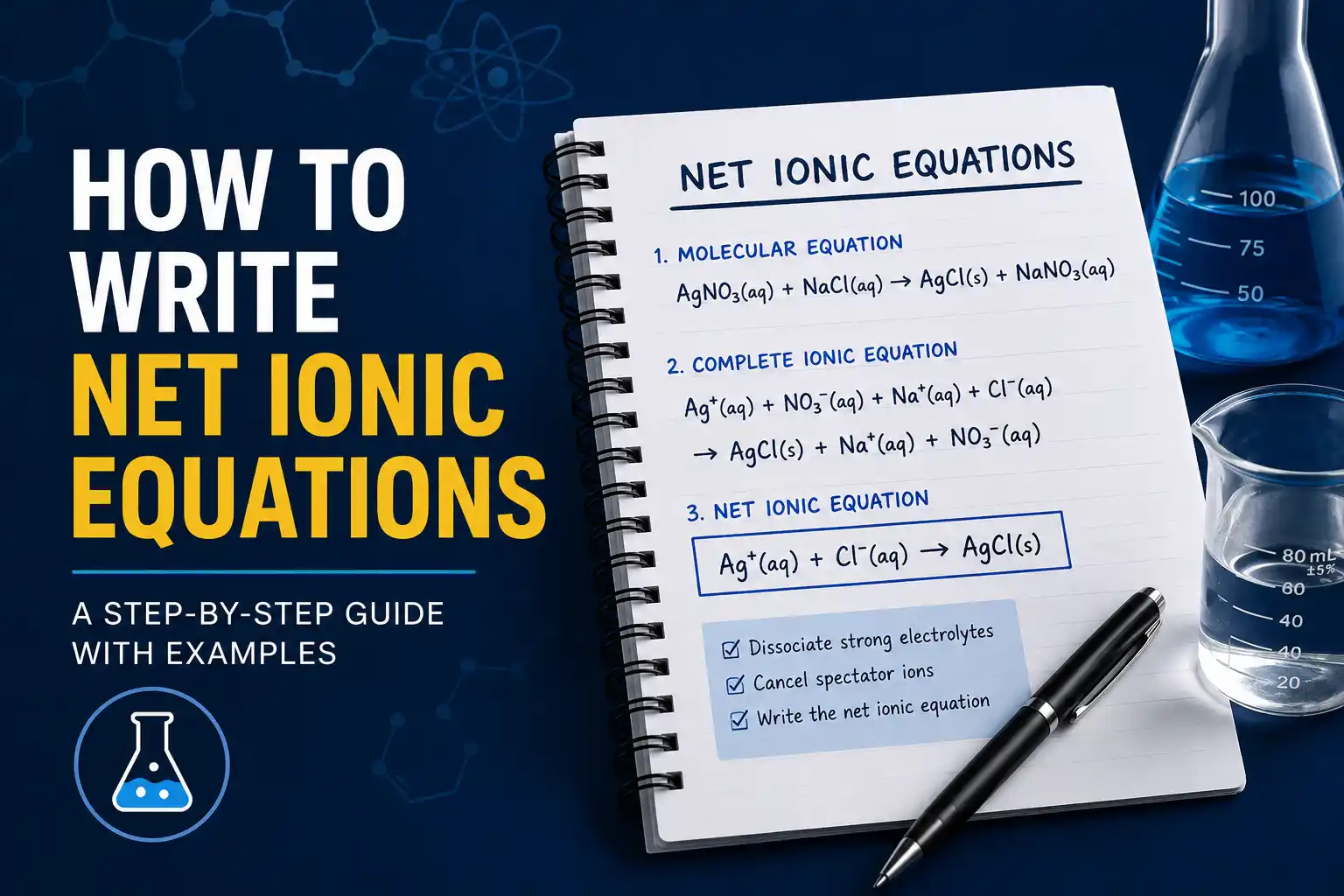
The molecular equation shows the complete formulas of all reactants and products. It does not show ions. For example: AgNO₃(aq) + NaCl(aq) → AgCl(s) + NaNO₃(aq)
Complete Ionic Equation
The complete ionic equation shows all soluble strong electrolytes as separate ions. For example: Ag⁺(aq) + NO₃⁻(aq) + Na⁺(aq) + Cl⁻(aq) → AgCl(s) + Na⁺(aq) + NO₃⁻(aq)
Net Ionic Equation
The net ionic equation removes spectator ions (ions that appear on both sides of the equation). For example: Ag⁺(aq) + Cl⁻(aq) → AgCl(s)
Example: Three Types of Equations
Molecular: AgNO₃(aq) + NaCl(aq) → AgCl(s) + NaNO₃(aq)
Complete Ionic: Ag⁺(aq) + NO₃⁻(aq) + Na⁺(aq) + Cl⁻(aq) → AgCl(s) + Na⁺(aq) + NO₃⁻(aq)
Net Ionic: Ag⁺(aq) + Cl⁻(aq) → AgCl(s)
4 How to Write Net Ionic Equations: Step-by-Step
Here is a step-by-step process for writing net ionic equations.
Step 1: Write the Balanced Molecular Equation
Start with the balanced molecular equation. Make sure it is balanced in terms of both atoms and charges. Include the physical states: (s) for solid, (l) for liquid, (g) for gas, and (aq) for aqueous.
Step 2: Identify Strong Electrolytes
Identify which compounds are strong electrolytes (soluble salts, strong acids, strong bases). These will dissociate into ions in the complete ionic equation.
Step 3: Write the Complete Ionic Equation
Write all strong electrolytes as separate ions. Keep solids, liquids, gases, and weak electrolytes in their molecular form. For example: Ag⁺(aq) + NO₃⁻(aq) + Na⁺(aq) + Cl⁻(aq) → AgCl(s) + Na⁺(aq) + NO₃⁻(aq)
Step 4: Identify and Cancel Spectator Ions
Spectator ions are ions that appear on both sides of the complete ionic equation. Cancel them out. In the example above, Na⁺ and NO₃⁻ are spectator ions.
Step 5: Write the Net Ionic Equation
Write the remaining species as the net ionic equation. Make sure the equation is balanced in terms of both atoms and charges. For example: Ag⁺(aq) + Cl⁻(aq) → AgCl(s)
Step-by-Step Example
Reaction: BaCl₂(aq) + Na₂SO₄(aq) → BaSO₄(s) + 2NaCl(aq)
Step 1 (Molecular): BaCl₂(aq) + Na₂SO₄(aq) → BaSO₄(s) + 2NaCl(aq)
Step 2 (Identify strong electrolytes): BaCl₂, Na₂SO₄, and NaCl are soluble salts (strong electrolytes). BaSO₄ is insoluble (precipitate).
Step 3 (Complete ionic): Ba²⁺(aq) + 2Cl⁻(aq) + 2Na⁺(aq) + SO₄²⁻(aq) → BaSO₄(s) + 2Na⁺(aq) + 2Cl⁻(aq)
Step 4 (Cancel spectator ions): 2Na⁺ and 2Cl⁻ are spectator ions.
Step 5 (Net ionic): Ba²⁺(aq) + SO₄²⁻(aq) → BaSO₄(s)
5 Solubility Rules Reference
Knowing the solubility rules is essential for identifying which compounds will dissociate and which will form precipitates. Here is a comprehensive reference.
Soluble Compounds
- Group 1 salts: All salts of Li⁺, Na⁺, K⁺, Rb⁺, Cs⁺ are soluble.
- Ammonium salts: All salts of NH₄⁺ are soluble.
- Nitrates: All nitrates (NO₃⁻) are soluble.
- Acetates: Most acetates (CH₃COO⁻) are soluble (except Ag⁺).
- Chlorides, bromides, iodides: Most are soluble (except Ag⁺, Pb²⁺, Hg₂²⁺).
- Sulfates: Most sulfates (SO₄²⁻) are soluble (except Ba²⁺, Pb²⁺, Ca²⁺).
Insoluble Compounds
- Carbonates: Most carbonates (CO₃²⁻) are insoluble (except Group 1 and NH₄⁺).
- Phosphates: Most phosphates (PO₄³⁻) are insoluble (except Group 1 and NH₄⁺).
- Sulfides: Most sulfides (S²⁻) are insoluble (except Group 1, Group 2, and NH₄⁺).
- Hydroxides: Most hydroxides (OH⁻) are insoluble (except Group 1, Ba²⁺, and Ca²⁺).
- Oxides: Most oxides (O²⁻) are insoluble (except Group 1 and Ca²⁺).
Quick Solubility Reference
6 Common Mistakes to Avoid
Even experienced chemistry students make mistakes. Here are the most common errors and how to avoid them.
Forgetting to Balance the Equation
Writing a net ionic equation that is not balanced in terms of atoms or charges.
Fix: Always check that both atoms and charges are balanced in your net ionic equation.
Including Spectator Ions
Forgetting to cancel spectator ions that appear on both sides of the complete ionic equation.
Fix: Carefully identify and cancel all spectator ions. They should not appear in the net ionic equation.
Incorrectly Applying Solubility Rules
Assuming a compound is soluble when it is actually insoluble, or vice versa.
Fix: Memorise the solubility rules and apply them carefully. When in doubt, check a reference.
Not Including Physical States
Omitting the physical states (s, l, g, aq) in the equation.
Fix: Always include physical states — they are essential for determining solubility and identifying spectator ions.
Breaking Apart Weak Electrolytes
Writing weak electrolytes (like weak acids and weak bases) as separate ions.
Fix: Only strong electrolytes (soluble salts, strong acids, strong bases) dissociate completely. Keep weak electrolytes in molecular form.
Forgetting Polyatomic Ions
Breaking apart polyatomic ions that should remain intact in the equation.
Fix: Polyatomic ions (like NO₃⁻, SO₄²⁻, CO₃²⁻) remain intact in solution. Do not break them apart.
7 Net Ionic Equations for Different Types of Reactions
Net ionic equations can be written for different types of reactions. Here are some common types.
Precipitation Reactions
In precipitation reactions, two soluble salts react to form an insoluble solid (precipitate). The net ionic equation shows the formation of the precipitate.
Example: Ag⁺(aq) + Cl⁻(aq) → AgCl(s)
Key trait: Formation of a solid precipitate.
Acid-Base Reactions
In acid-base reactions, an acid reacts with a base to form water and a salt. The net ionic equation typically shows the formation of water.
Example: H⁺(aq) + OH⁻(aq) → H₂O(l)
Key trait: Formation of water from H⁺ and OH⁻.
Redox Reactions
In redox reactions, electrons are transferred between species. The net ionic equation shows the oxidation and reduction half-reactions.
Example: Zn(s) + Cu²⁺(aq) → Zn²⁺(aq) + Cu(s)
Key trait: Transfer of electrons.
Gas-Forming Reactions
In gas-forming reactions, a gas is produced. The net ionic equation shows the formation of the gas.
Example: CO₃²⁻(aq) + 2H⁺(aq) → CO₂(g) + H₂O(l)
Key trait: Formation of a gas.
8 Advanced Examples and Practice
Here are some more advanced examples to help you practice writing net ionic equations.
Example 1: Precipitation with Polyatomic Ions
Molecular: CaCl₂(aq) + Na₂CO₃(aq) → CaCO₃(s) + 2NaCl(aq)
Complete Ionic: Ca²⁺(aq) + 2Cl⁻(aq) + 2Na⁺(aq) + CO₃²⁻(aq) → CaCO₃(s) + 2Na⁺(aq) + 2Cl⁻(aq)
Net Ionic: Ca²⁺(aq) + CO₃²⁻(aq) → CaCO₃(s)
Example 2: Acid-Base with a Weak Acid
Molecular: CH₃COOH(aq) + NaOH(aq) → CH₃COONa(aq) + H₂O(l)
Complete Ionic: CH₃COOH(aq) + Na⁺(aq) + OH⁻(aq) → CH₃COO⁻(aq) + Na⁺(aq) + H₂O(l)
Net Ionic: CH₃COOH(aq) + OH⁻(aq) → CH₃COO⁻(aq) + H₂O(l)
Note: CH₃COOH is a weak acid and is not written as separate ions.
Example 3: Gas-Forming Reaction
Molecular: Na₂CO₃(aq) + 2HCl(aq) → 2NaCl(aq) + CO₂(g) + H₂O(l)
Complete Ionic: 2Na⁺(aq) + CO₃²⁻(aq) + 2H⁺(aq) + 2Cl⁻(aq) → 2Na⁺(aq) + 2Cl⁻(aq) + CO₂(g) + H₂O(l)
Net Ionic: CO₃²⁻(aq) + 2H⁺(aq) → CO₂(g) + H₂O(l)
Practice Problems
- 1. Write the net ionic equation for: Pb(NO₃)₂(aq) + KI(aq) → PbI₂(s) + KNO₃(aq)
- 2. Write the net ionic equation for: HCl(aq) + NH₃(aq) → NH₄Cl(aq)
- 3. Write the net ionic equation for: Ba(OH)₂(aq) + H₂SO₄(aq) → BaSO₄(s) + 2H₂O(l)
9 How to Revise Your Net Ionic Equations
A great net ionic equation is one that is accurate and balanced. Here is a step-by-step process for checking your work.
Step 1: Check the Molecular Equation
Make sure the molecular equation is balanced and includes correct physical states.
Step 2: Check the Complete Ionic Equation
Ensure that all strong electrolytes are written as separate ions and that weak electrolytes and precipitates are kept in molecular form.
Step 3: Check for Spectator Ions
Make sure you have correctly identified and cancelled all spectator ions.
Step 4: Balance Atoms and Charges
Check that the net ionic equation is balanced in terms of both atoms and charges.
Step 5: Check Physical States
Ensure that the correct physical states are included for all species.
Step 6: Get Feedback
Ask a teacher or peer to review your work. Fresh eyes can catch mistakes you may have missed.
10 Practice Exercises to Improve Your Net Ionic Equations
The best way to get better at writing net ionic equations is to practice. Here are some exercises to help you sharpen your skills.
Exercise 1: Precipitation Reactions
Write the net ionic equations for the following precipitation reactions:
- AgNO₃(aq) + NaCl(aq) → AgCl(s) + NaNO₃(aq)
- BaCl₂(aq) + Na₂SO₄(aq) → BaSO₄(s) + 2NaCl(aq)
- Pb(NO₃)₂(aq) + 2KI(aq) → PbI₂(s) + 2KNO₃(aq)
Exercise 2: Acid-Base Reactions
Write the net ionic equations for the following acid-base reactions:
- HCl(aq) + NaOH(aq) → NaCl(aq) + H₂O(l)
- H₂SO₄(aq) + 2KOH(aq) → K₂SO₄(aq) + 2H₂O(l)
- CH₃COOH(aq) + KOH(aq) → CH₃COOK(aq) + H₂O(l)
Exercise 3: Gas-Forming Reactions
Write the net ionic equations for the following gas-forming reactions:
- Na₂CO₃(aq) + 2HCl(aq) → 2NaCl(aq) + CO₂(g) + H₂O(l)
- Na₂S(aq) + 2HCl(aq) → 2NaCl(aq) + H₂S(g)
Exercise 4: Mixed Practice
Write the net ionic equations for the following reactions:
- CaCO₃(s) + 2HCl(aq) → CaCl₂(aq) + CO₂(g) + H₂O(l)
- Fe₂O₃(s) + 6HCl(aq) → 2FeCl₃(aq) + 3H₂O(l)
- Al₂(SO₄)₃(aq) + 3BaCl₂(aq) → 2AlCl₃(aq) + 3BaSO₄(s)
Final Thoughts
Writing net ionic equations is an essential skill in chemistry. It allows you to see the essential chemistry of a reaction, removing the "noise" of spectator ions and focusing on what really matters.
Remember that the process is logical and systematic: start with the molecular equation, write the complete ionic equation, identify and cancel spectator ions, and write the net ionic equation. With practice, this process becomes second nature.
Keep these principles in mind as you write:
- Know your solubility rules. They are essential for identifying precipitates and spectator ions.
- Identify strong electrolytes. Only strong electrolytes dissociate into ions.
- Cancels spectator ions. Remove ions that appear on both sides of the complete ionic equation.
- Balance atoms and charges. Your net ionic equation must be balanced in all respects.
- Include physical states. They provide important information about the reaction.
Net ionic equations are a powerful tool for understanding chemical reactions. With these skills, you are well on your way to mastering chemistry.
Now go write some net ionic equations and see the chemistry clearly.