How to Write a Hypothesis: The Complete Guide with Examples
You have a research question. You have an idea of what the answer might be. But how do you turn that idea into a testable statement? How do you write a hypothesis that is clear, specific, and scientifically rigorous?
You are not alone. Writing a hypothesis is a fundamental skill in science and research , and one that many students and early-career researchers find challenging. But a well-crafted hypothesis is the foundation of any good study. It focuses your research, guides your methodology, and gives your work direction and purpose.
This guide will teach you everything you need to know about how to write a hypothesis that is clear, testable, and scientifically sound. We will cover the definition, the types, the step-by-step process, the common mistakes to avoid, and plenty of examples. By the end, you will have the tools to formulate hypotheses that drive meaningful research.
Hypothesis Writing at a Glance
1 What Is a Hypothesis and Why Does It Matter?
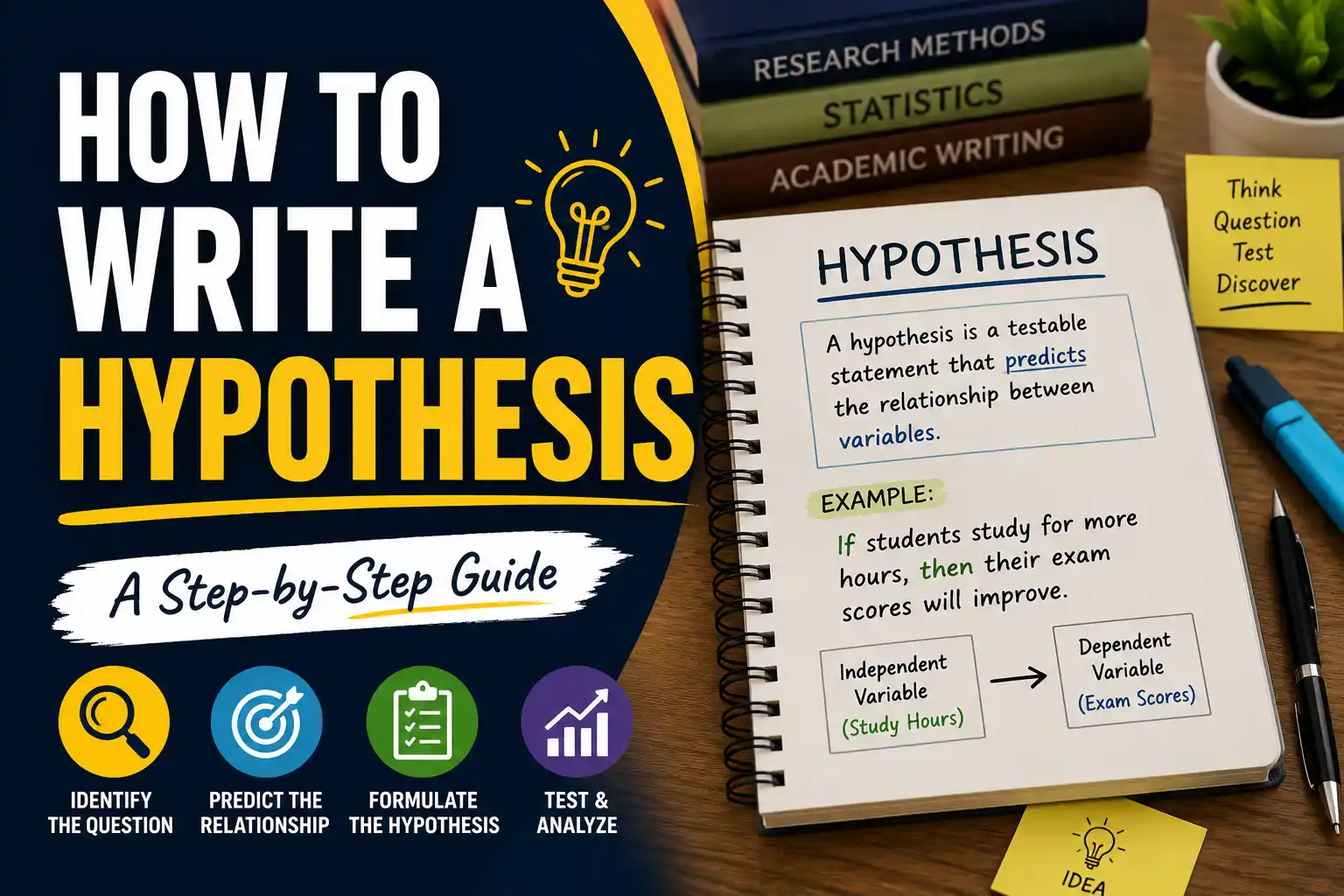
A hypothesis is a clear, testable statement that predicts the relationship between two or more variables. It is an educated guess about what you expect to find in your research , a proposition made in response to a research question that you will test to confirm or disprove.
As the Texas A&M Writing Center explains, "a hypothesis is an educated guess about what conclusions you might be able to draw from an observation, experiment, or data". It is distinct from a research question because it predicts an outcome rather than simply asking about one.
Hypotheses matter because they:
- Focus your research , They give your study a clear direction and purpose
- Guide your methodology , They determine what data you need to collect and how to analyse it
- Make your work testable , They allow you to design experiments that can prove or disprove your prediction
- Advance scientific knowledge , Whether supported or rejected, hypotheses contribute to our understanding
Testable
A hypothesis must be testable through observation or experiment. If you cannot test it, it is not a hypothesis.
Specific
A good hypothesis is clear and specific in scope. It names the variables and predicts the relationship between them.
Disprovable
A hypothesis must be falsifiable , capable of being proven wrong. If it cannot be disproven, it is not scientific.
Statement-Based
A hypothesis is always a statement, never a question. Avoid conditional terms like "should," "might," or "could".
2 The Fundamentals of Writing a Hypothesis
Before you start writing, it is essential to understand the core principles that make a hypothesis scientifically sound.
Understand the Difference Between a Research Question and a Hypothesis
A research question is an open-ended inquiry ("What is the effect of X on Y?"). A hypothesis is a specific, testable prediction about the answer ("If X happens, then Y will occur"). While a research question asks, a hypothesis asserts.
Identify Your Variables
Every hypothesis involves at least two variables: the independent variable (what you manipulate or change) and the dependent variable (what you measure or observe). A good hypothesis clearly defines both.
Make It Testable
A hypothesis is only useful if it can be tested. This means you need a means to prove or disprove it through observation, experimentation, or data analysis. If you cannot test it, it is not a hypothesis.
Keep It Simple and Clear
Use clear, concise language. Avoid vague words like "better," "worse," or "good". Be measurable. Nothing should be left to interpretation.
The Checklist for a Good Hypothesis
Once you've written a possible hypothesis, make sure it checks the following boxes:
- Testable: You have a means to prove or disprove it
- Includes variables: At least one independent and one dependent variable
- Easy to understand: Clear and concise language
- Relevant: Directly related to your research topic
- Statement-based: Not a question, not vague
3 Types of Hypotheses
There are several types of hypotheses used in research. Understanding the differences is essential for choosing the right one for your study.
Null Hypothesis (H₀)
The null hypothesis states that there is no effect or relationship between variables. It is the hypothesis that you assume to be true and that you test against. It is always treated as the main hypothesis, since it is the one being tested. For example: "There is no difference in plant growth between plants watered daily and plants watered weekly."
Alternative Hypothesis (H₁ or Hₐ)
The alternative hypothesis states that there is an effect or relationship between variables. It is the opposite of the null hypothesis and is what you hope to find evidence for. For example: "Plants watered daily grow taller than plants watered weekly."
Directional Hypothesis
A directional hypothesis predicts the specific direction of the effect or relationship. It states not only that there is a relationship but also what that relationship will look like. For example: "Students who study for two hours per day score higher on exams than those who study for one hour per day."
Non-Directional Hypothesis
A non-directional hypothesis predicts an effect or relationship but does not specify the direction. For example: "There is a difference in exam scores between students who study for one hour per day and those who study for two hours per day."
Types of Hypotheses Compared
4 How to Write a Hypothesis: Step-by-Step
Here is a step-by-step process for writing a strong, testable hypothesis.
Step 1: Pose It as a Question First
Start with a research question using the journalistic approach , ask one of the five W's: Who, what, when, where, or why. For example: "Why is the sky blue?" or "What is the effect of caffeine on concentration?"
Step 2: Do Preliminary Research
Read research around your topic. Collect information from academic journals, books, and reputable sources. Understand what is already known about your topic, identify gaps in current knowledge, and recognise areas that need further investigation.
Step 3: Identify Your Variables
Define your independent variable (what you change or manipulate) and your dependent variable (what you measure or observe). The independent variable is the cause; the dependent variable is the effect.
Step 4: Write a Working Draft
Create a working hypothesis. At this stage, do not stress over perfection. Your first hypothesis is not permanent , look at it as a draft. For example, a first draft could be: "Certain molecules in the Earth's atmosphere are responsive to the sky being the color blue."
Step 5: Refine and Perfect
Take your working hypothesis and make it perfect. Narrow it down to include only the information listed in the checklist above. Your refined hypothesis should be clear, specific, and testable. For example: "Light from the sun hitting oxygen molecules in the sky makes the color of the sky appear blue."
Step 6: Write Your Null Hypothesis
Your null hypothesis should be the opposite of your research hypothesis. It should be able to be disproven by your research. In the sky example, the null hypothesis would be: "Light from the sun hitting oxygen molecules in the sky does not make the color of the sky appear blue."
Common Hypothesis Formats
- If/then format: "If [independent variable], then [dependent variable]." Example: If administered drug X, then patients will experience reduced fatigue.
- When/then format: "When [condition], then [outcome]." Example: When workers spend significant time in sedentary work, then they experience digestive problems.
- Direct statement: A simple declarative statement. Example: Drug X and drug Y reduce the risk of cognitive decline through the same chemical pathways.
5 Hypothesis Examples
Here are some examples of well-written hypotheses in different contexts to illustrate what a strong hypothesis looks like.
Science (Biology)
Research question: Does sunlight affect plant growth?
Hypothesis: If plants receive more sunlight, then they will grow taller.
Null hypothesis: Sunlight has no effect on plant growth.
Psychology
Research question: Does stress-reduction training improve well-being?
Hypothesis: Undergraduate students who participate in a stress-reduction seminar will report an increase in their well-being after six weeks.
Null hypothesis: Undergraduate students who participate in a stress-reduction seminar will not report an increase in their well-being.
Medicine
Research question: Is Topical Treatment A effective for treating baldness?
Hypothesis: If you use Topical Treatment A for male pattern baldness, then you will see a 50% increase in hair growth within 3 months.
Null hypothesis: Topical Treatment A does not increase hair growth.
Education
Research question: Does reading improve vocabulary?
Hypothesis: If students read for 30 minutes every day, then their vocabulary scores will improve.
Null hypothesis: Reading for 30 minutes every day does not improve vocabulary scores.
Environmental Science
Research question: Do masks reduce viral infections?
Hypothesis: If everyone wears masks at State University, then there will be fewer cases of viral infection.
Null hypothesis: Wearing masks at State University does not reduce cases of viral infection.
6 Common Mistakes to Avoid
Even experienced researchers make mistakes. Here are the most common errors in hypothesis writing and how to avoid them.
Writing a Question Instead of a Statement
Asking a question rather than making a testable prediction.
Fix: Always write your hypothesis as a statement, not a question.
Using Vague or Unmeasurable Language
Using words like "better," "worse," or "good" that cannot be measured.
Fix: Use specific, measurable terms.
Using Conditional Terms
Using words like "should," "might," or "could".
Fix: Use confident, declarative language.
Being Too Broad or Too Vague
A hypothesis that is not specific enough to test.
Fix: Be clear and specific in scope. Name your variables and predict the relationship between them.
Making It Untestable
A hypothesis that cannot be tested through observation or experimentation.
Fix: Ensure your hypothesis allows you to work towards observable and testable results.
Being Unoriginal
A hypothesis that does not contribute anything new to the field.
Fix: Conduct thorough background research and identify a genuine knowledge gap.
7 How to Refine and Test Your Hypothesis
Writing a hypothesis is not the end of the process. Here is how to refine and test your hypothesis effectively.
Check for Clarity and Specificity
Read your hypothesis and ask: "Is it clear? Is it specific? Can someone else understand exactly what I am predicting?" If not, refine it.
Ensure It Is Testable
Ask: "How would I test this?" If you cannot identify a clear method for testing your hypothesis, you need to revise it.
Design Your Experiment
Once you have a solid hypothesis, design an experiment or study that can test it. What data do you need? How will you collect it? How will you analyse it?
Be Objective
Remember that a hypothesis is not created to push an agenda. You either show it to be verifiable (accept it) or falsifiable (reject it). Even a rejected hypothesis can inform a new one that may be more acceptable.
Be Open to Revision
Your hypothesis may need to change as you learn more. As one guide notes, "The plan isn't finished when you finish writing it. A real plan is a living thing , you review it, you compare it to what actually happened, and you change it." The same applies to hypotheses.
The Scientific Method and the Hypothesis
The hypothesis is a key step in the scientific method:
- Ask a Question , Identify what you want to investigate
- Do Background Research , Learn what is already known
- Construct a Hypothesis , Make a testable prediction
- Test Your Hypothesis , Do an experiment
- Analyze Your Data , Draw conclusions
- Communicate Your Results , Share what you found
8 Null vs. Alternative Hypotheses in Practice
Understanding the relationship between null and alternative hypotheses is essential for statistical testing.
The Role of the Null Hypothesis
The null hypothesis (H₀) is the hypothesis that you assume to be true until you have evidence to reject it. It is the starting point for statistical testing. For example: "The new drug has no effect on blood pressure."
The Role of the Alternative Hypothesis
The alternative hypothesis (H₁ or Hₐ) is what you hope to find evidence for. For example: "The new drug lowers blood pressure."
How They Work Together
In statistical testing, you start by assuming the null hypothesis is true. Then you collect data and analyse it. If the data are sufficiently unlikely under the null hypothesis, you reject the null hypothesis in favour of the alternative.
Writing It Up
When writing up your results, do not state that the alternative hypothesis was accepted or rejected. Instead, state: "H₀ is rejected in favour of Hₐ".
Examples of Null and Alternative Hypotheses
- Null: The rate of species decline in habitat X is the same as in the last 100 years.
- Alternative: The rate of species decline in habitat X is different from the rate in the last 100 years.
- Null: Topical Treatment A is as effective on average as Ingested Drug B.
- Alternative: Topical Treatment A is less effective on average than Ingested Drug B.
9 How to Revise Your Hypothesis
A great hypothesis is not written; it is revised. Here is a step-by-step process for refining your hypothesis.
Step 1: Check for Clarity
Is your hypothesis clear and easy to understand? Would someone else reading it know exactly what you are predicting?
Step 2: Check for Testability
Can your hypothesis be tested through observation or experiment? If not, revise it.
Step 3: Check Your Variables
Have you clearly defined your independent and dependent variables? Are they measurable?
Step 4: Check the Scope
Is your hypothesis specific enough? Is it too broad or too narrow? A good hypothesis is focused.
Step 5: Check the Language
Have you used conditional terms like "should" or "might"? If so, revise to use declarative language.
Step 6: Get Feedback
Share your hypothesis with a colleague, mentor, or advisor. Fresh eyes can catch issues you have missed.
10 Practice Exercises to Improve Your Hypothesis Writing
The best way to get better at writing hypotheses is to practice. Here are some exercises to help you sharpen your skills.
Exercise 1: Turn Questions into Hypotheses
Take a research question (e.g., "Does caffeine affect concentration?") and turn it into a testable hypothesis using the if/then or when/then format.
Exercise 2: Identify the Variables
For a given hypothesis, identify the independent and dependent variables. For example: "If students study for two hours, then they will score higher on exams." (Independent: study time. Dependent: exam scores.)
Exercise 3: Write Null and Alternative Hypotheses
For a given research topic, write both a null hypothesis and an alternative hypothesis. Practice using the correct notation (H₀ and H₁).
Exercise 4: Peer Review
Swap hypotheses with a classmate or colleague. Review each other's work using the checklist: Is it testable? Is it specific? Does it include variables? Is it a statement?
Final Thoughts
Writing a hypothesis is a fundamental skill in scientific research. A well-crafted hypothesis focuses your study, guides your methodology, and helps you communicate your research clearly. It is the bridge between your research question and your experimental design.
Remember that a hypothesis is not set in stone. It is a starting point , a testable prediction that you will either support or refute through your research. Whether your hypothesis is confirmed or rejected, you will have contributed to scientific knowledge.
Keep these principles in mind as you write:
- Write it as a statement. Never as a question.
- Make it testable. If you cannot test it, it is not a hypothesis.
- Be specific. Name your variables and predict the relationship between them.
- Use clear, measurable language. Avoid vague or unmeasurable terms.
- Include a null hypothesis. It is essential for statistical testing.
- Revise and refine. A great hypothesis is the result of careful thought and revision.
Hypothesis writing is a skill that improves with practice. Each hypothesis you write will be better than the last. With time and effort, you will become confident in formulating hypotheses that drive meaningful, rigorous research.
Now go write a hypothesis that advances knowledge.