How to Write Chemical Formulas: The Complete Guide with Examples
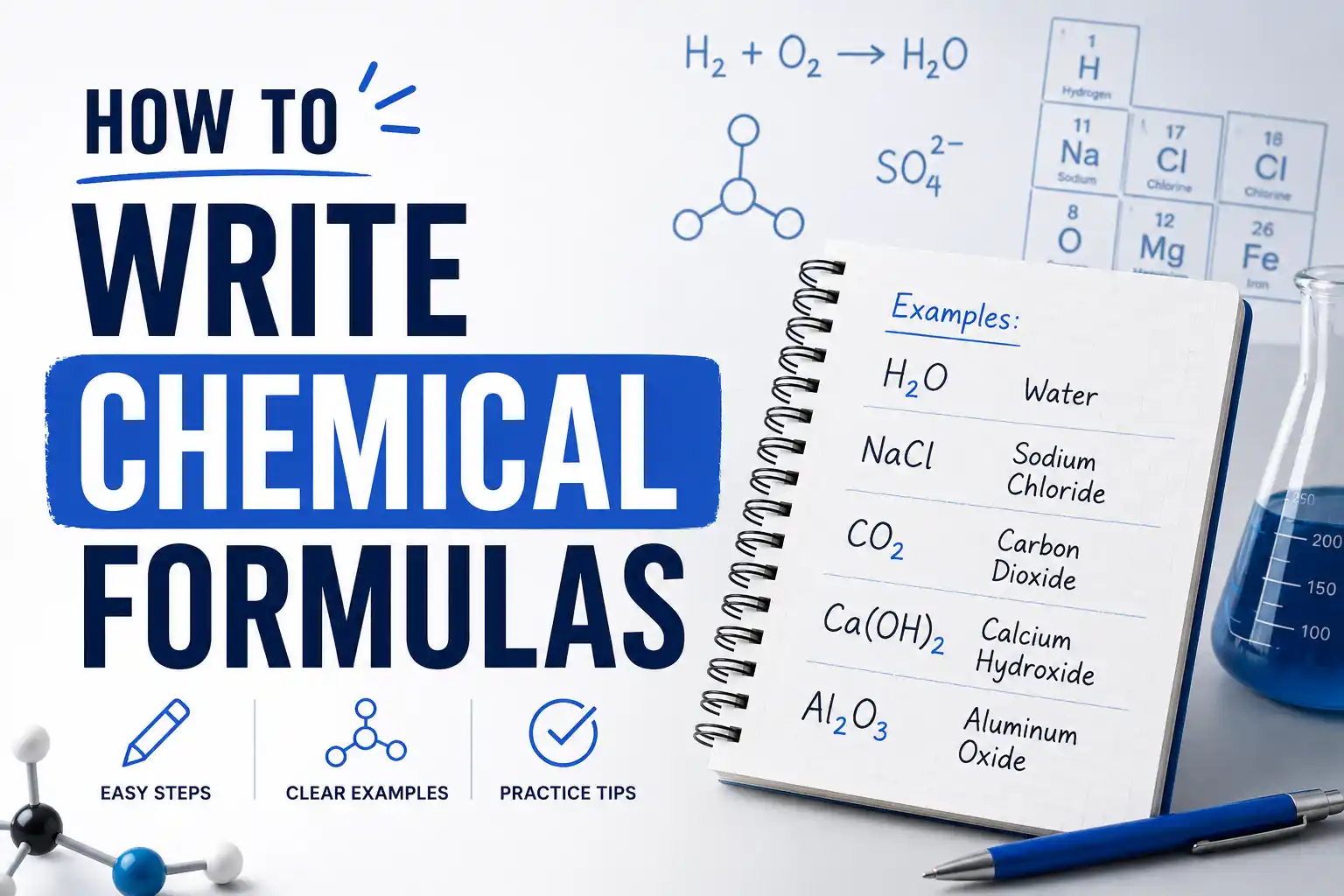
You are staring at a list of elements and trying to figure out how they combine. Sodium and chlorine — NaCl. Hydrogen and oxygen — H₂O. But what about calcium and phosphate? Or iron and sulfur with different oxidation states? The rules seem confusing, and you are not sure where to start.
You are not alone. Writing chemical formulas is a fundamental skill in chemistry that many students find challenging. But once you understand the rules — the charges, the prefixes, and the cross-over method — it becomes a logical and even elegant system. Chemical formulas are the language of chemistry, and learning to write them correctly is essential for understanding reactions, balancing equations, and communicating scientific ideas.
This guide will teach you everything you need to know about how to write chemical formulas for ionic compounds, molecular compounds, and acids. We will cover the rules, the nomenclature, the common mistakes, and plenty of examples. By the end, you will have the tools to write chemical formulas with confidence.
Chemical Formula Writing at a Glance
1 What Is a Chemical Formula and Why Does It Matter?
A chemical formula is a symbolic representation of a chemical compound. It shows the types and numbers of atoms that make up the compound. For example, the formula H₂O tells us that a water molecule contains two hydrogen atoms and one oxygen atom.
Chemical formulas matter because they are the universal language of chemistry. They allow scientists around the world to communicate exactly what compounds are involved in a reaction. A correct chemical formula tells you the composition of a substance, its properties, and how it will behave in chemical reactions.
Without the ability to write chemical formulas, you cannot balance equations, predict reaction products, or understand the stoichiometry of chemical processes. It is a foundational skill that underpins all of chemistry.
Identifies Composition
A chemical formula tells you exactly which elements are present and in what proportions.
Enables Communication
Chemical formulas are the universal language of chemistry, allowing scientists to share information precisely.
Predicts Properties
The formula of a compound gives clues about its structure, properties, and reactivity.
Foundation of Stoichiometry
Chemical formulas are essential for calculating quantities in chemical reactions and balancing equations.
2 The Fundamentals of Writing Chemical Formulas
Before you start writing formulas, you need to understand the foundational principles that underpin every chemical formula.
The Octet Rule
Atoms tend to gain, lose, or share electrons to achieve a full outer shell of eight electrons (or two for hydrogen and helium). This is the octet rule. It explains why atoms form ions and bonds, and it is the basis for determining the charges of ions and the formulas of compounds.
Valence Electrons and Oxidation States
The valence electrons are the electrons in the outermost shell of an atom. They determine how an atom will bond. The oxidation state (or charge) of an ion is the charge it would have if it gained or lost electrons to achieve a full outer shell. Knowing the common oxidation states of elements is essential for writing formulas.
The Principle of Charge Neutrality
For ionic compounds, the total positive charge must equal the total negative charge. The compound must be electrically neutral. This is the most important rule for writing formulas of ionic compounds.
The Cross-Over Method
The cross-over method is a simple technique for writing formulas of ionic compounds: write the symbols of the ions, write the charges as superscripts, cross the charges over to become subscripts, and simplify if necessary. For example, for calcium (Ca²⁺) and phosphate (PO₄³⁻), cross over to get Ca₃(PO₄)₂.
3 Types of Chemical Formulas
There are several types of chemical formulas, each with a specific purpose. Understanding the differences will help you choose the right type for your needs.
Empirical Formula
The empirical formula shows the simplest whole-number ratio of atoms in a compound. For example, the empirical formula of glucose is CH₂O (simplest ratio), while its molecular formula is C₆H₁₂O₆.
Key trait: Simplest ratio of atoms.
Molecular Formula
The molecular formula shows the actual number of atoms of each element in a molecule. For example, the molecular formula of glucose is C₆H₁₂O₆.
Key trait: Actual number of atoms in a molecule.
Structural Formula
The structural formula shows the arrangement of atoms in a molecule, including the bonds between them. It provides information about the structure of the compound.
Key trait: Shows atomic arrangement and bonding.
Condensed Formula
A condensed formula is a simplified version of the structural formula that groups atoms together. For example, CH₃CH₂OH for ethanol.
Key trait: Simplified structural representation.
4 How to Write Formulas for Ionic Compounds
Ionic compounds are formed when a metal transfers electrons to a non-metal, creating positively charged cations and negatively charged anions. Here is how to write their formulas.
Step 1: Identify the Ions
Determine the cation (positive ion) and the anion (negative ion). For example, in sodium chloride, the cation is Na⁺ and the anion is Cl⁻.
Step 2: Write the Symbols and Charges
Write the symbols of the ions with their charges. For example: Na⁺ Cl⁻
Step 3: Apply the Cross-Over Method
Cross the charges over to become subscripts. For Na⁺ and Cl⁻, the charges are 1 and 1, so the formula is NaCl.
Step 4: Simplify if Necessary
If the subscripts have a common factor, simplify. For example, Ca²⁺ and O²⁻ cross over to Ca₂O₂, which simplifies to CaO.
Step 5: Use Parentheses for Polyatomic Ions
If a polyatomic ion (a group of atoms with a charge) is needed more than once, place it in parentheses and add the subscript outside. For example, calcium phosphate: Ca²⁺ and PO₄³⁻ cross over to Ca₃(PO₄)₂.
Examples of Ionic Compound Formulas
- Sodium chloride: Na⁺ + Cl⁻ → NaCl
- Magnesium oxide: Mg²⁺ + O²⁻ → MgO (simplified from Mg₂O₂)
- Calcium phosphate: Ca²⁺ + PO₄³⁻ → Ca₃(PO₄)₂
- Ammonium sulfate: NH₄⁺ + SO₄²⁻ → (NH₄)₂SO₄
- Iron(III) oxide: Fe³⁺ + O²⁻ → Fe₂O₃
5 How to Write Formulas for Molecular (Covalent) Compounds
Molecular compounds (also called covalent compounds) are formed when two non-metals share electrons. Writing their formulas requires a different approach — using prefixes to indicate the number of atoms.
Use Greek Prefixes
Molecular compounds use Greek prefixes to indicate the number of atoms of each element:
- 1 = mono-
- 2 = di-
- 3 = tri-
- 4 = tetra-
- 5 = penta-
- 6 = hexa-
- 7 = hepta-
- 8 = octa-
- 9 = nona-
- 10 = deca-
Write the Elements in Order
Write the more electropositive element (the one further left on the periodic table) first, followed by the more electronegative element (further right).
Add Prefixes
Add the appropriate prefix to each element. The prefix "mono-" is often omitted for the first element. For example: CO₂ is carbon dioxide, not monocarbon dioxide.
Examples of Molecular Compound Formulas
- Carbon dioxide: CO₂ (one carbon, two oxygens)
- Dinitrogen monoxide: N₂O (two nitrogens, one oxygen)
- Sulfur hexafluoride: SF₆ (one sulfur, six fluorines)
- Phosphorus pentachloride: PCl₅ (one phosphorus, five chlorines)
- Carbon tetrachloride: CCl₄ (one carbon, four chlorines)
6 How to Write Formulas for Acids
Acids are compounds that release hydrogen ions (H⁺) in water. There are two main types of acids: binary acids and oxyacids.
Binary Acids
Binary acids contain hydrogen and one other element. Their formulas are written as H + the other element. For example:
- Hydrochloric acid: HCl
- Hydrofluoric acid: HF
- Hydrobromic acid: HBr
- Hydroiodic acid: HI
Oxyacids
Oxyacids contain hydrogen, oxygen, and another element (the central atom). Their formulas are written with hydrogen first, then the central atom, then oxygen. For example:
- Sulfuric acid: H₂SO₄
- Nitric acid: HNO₃
- Phosphoric acid: H₃PO₄
- Carbonic acid: H₂CO₃
Common Acids and Their Formulas
7 Common Polyatomic Ions You Need to Know
Polyatomic ions are groups of atoms that carry a charge. Memorising the common ones is essential for writing formulas of ionic compounds.
Common Polyatomic Ions
- Ammonium: NH₄⁺
- Hydroxide: OH⁻
- Nitrate: NO₃⁻
- Nitrite: NO₂⁻
- Sulfate: SO₄²⁻
- Sulfite: SO₃²⁻
- Phosphate: PO₄³⁻
- Phosphite: PO₃³⁻
- Carbonate: CO₃²⁻
- Bicarbonate: HCO₃⁻
- Acetate: CH₃COO⁻ (or C₂H₃O₂⁻)
- Permanganate: MnO₄⁻
- Dichromate: Cr₂O₇²⁻
- Chromate: CrO₄²⁻
Memory Trick for Polyatomic Ions
Notice the patterns: ions ending in "-ate" have more oxygen atoms than ions ending in "-ite." For example, nitrate (NO₃⁻) has three oxygens, while nitrite (NO₂⁻) has two. The prefix "per-" indicates even more oxygen (e.g., perchlorate ClO₄⁻), while "hypo-" indicates fewer (e.g., hypochlorite ClO⁻).
8 Common Mistakes to Avoid
Even experienced chemists make mistakes. Here are the most common errors and how to avoid them.
Forgetting to Balance Charges
Writing an ionic compound formula without ensuring the total positive charge equals the total negative charge.
Fix: Always use the cross-over method and check that the charges cancel out.
Using Incorrect Oxidation States
Using the wrong charge for a transition metal or polyatomic ion.
Fix: Memorise common charges and use Roman numerals for transition metals with variable oxidation states.
Forgetting Parentheses for Polyatomic Ions
Writing Ca₃PO₄₂ instead of Ca₃(PO₄)₂.
Fix: Use parentheses when a polyatomic ion needs more than one in the formula.
Confusing Ionic and Molecular Compounds
Using prefixes for ionic compounds or charges for molecular compounds.
Fix: Use prefixes for molecular compounds (non-metal + non-metal) and the cross-over method for ionic compounds (metal + non-metal).
Simplifying Incorrectly
Simplifying subscripts that cannot be simplified because they represent actual atom counts in a molecule.
Fix: Only simplify subscripts in ionic compounds. Do not simplify molecular formulas.
Misplacing Subscripts
Writing the subscript for the first element instead of the second.
Fix: Remember that the subscript applies to the element immediately before it.
9 How to Write Formulas: Step-by-Step Process
Here is a step-by-step process for writing chemical formulas, whether ionic or molecular.
Step 1: Identify the Type of Compound
Is it an ionic compound (metal + non-metal), a molecular compound (non-metal + non-metal), or an acid (H + anion)? This determines which rules to use.
Step 2: Identify the Ions or Atoms
For ionic compounds, identify the cation and anion and their charges. For molecular compounds, identify the elements and their positions on the periodic table.
Step 3: Apply the Appropriate Method
Use the cross-over method for ionic compounds, prefixes for molecular compounds, or the acid rules for acids.
Step 4: Check Your Work
For ionic compounds, check that the charges balance to zero. For molecular compounds, check that the prefixes match the subscripts.
Step 5: Simplify if Necessary
For ionic compounds, simplify subscripts if they have a common factor. Do not simplify molecular formulas.
Quick Reference: Formula Writing Flowchart
- Is it metal + non-metal? → Ionic → Use cross-over method
- Is it non-metal + non-metal? → Molecular → Use prefixes
- Is it H + anion? → Acid → Use acid rules
10 Practice Exercises to Improve Your Formula Writing
The best way to get better at writing chemical formulas is to practice. Here are some exercises to help you sharpen your skills.
Exercise 1: Ionic Compounds
Write the formulas for the following ionic compounds: sodium oxide, magnesium chloride, calcium nitrate, ammonium phosphate, iron(III) sulfate.
Exercise 2: Molecular Compounds
Write the formulas for the following molecular compounds: carbon monoxide, dinitrogen tetroxide, sulfur trioxide, phosphorus pentabromide, iodine heptafluoride.
Exercise 3: Acids
Write the formulas for the following acids: hydrochloric acid, sulfuric acid, nitric acid, phosphoric acid, acetic acid.
Exercise 4: Name to Formula and Formula to Name
Practice converting names to formulas and formulas to names for a mix of ionic, molecular, and acid compounds. Check your answers with a chemistry reference.
Final Thoughts
Writing chemical formulas is a fundamental skill that opens the door to understanding chemistry. It is the language in which chemical reactions are written and understood. With practice, the rules become second nature, and you will be able to write formulas quickly and accurately.
Remember that chemical formula writing is a logical system, not a collection of random facts. Once you understand the principles — the octet rule, the cross-over method, and the prefixes — you can apply them to any compound.
Keep these principles in mind as you write:
- Balance charges. For ionic compounds, the total positive charge must equal the total negative charge.
- Use prefixes for molecular compounds. Non-metal + non-metal compounds use Greek prefixes.
- Know your polyatomic ions. Memorise the common ones — they appear frequently.
- Use parentheses for polyatomic ions. When a polyatomic ion appears more than once, put it in parentheses.
- Practice, practice, practice. The more you write formulas, the more natural it becomes.
Chemistry is a fascinating subject, and chemical formulas are its alphabet. With these tools, you are well on your way to becoming fluent in the language of chemistry.
Now go write some chemical formulas and see the world at the molecular level.