How to Write in MLA Format: The Complete Guide with Examples
You have been assigned a paper in MLA format. You open the style guide and feel overwhelmed. There are rules about margins, headers, citations, and a Works Cited page. Where do you even start?
You are not alone. Writing in MLA format is a challenge for many students and researchers. But mastering MLA style is essential for academic success in the humanities. It ensures your work is credible, professional, and properly attributed.
This guide will teach you everything you need to know about how to write in MLA format. We will cover the 9th edition rules for formatting your paper, creating in-text citations, building a Works Cited page, and using headings. By the end, you will have the tools to write MLA-formatted papers with confidence.
MLA Format at a Glance
1 What Is MLA Format and Why Does It Matter?
MLA format is a set of rules and guidelines for writing academic papers, developed by the Modern Language Association. The 9th edition, published in 2021, is the most current version. MLA style is used widely in the humanities, including literature, language, history, philosophy, and the arts.
MLA format matters because it provides a standardised system for scholarly communication. It ensures consistency and clarity in academic writing. It gives credit to sources and helps readers locate them. Proper formatting also enhances the credibility of your work.
Using MLA format demonstrates that you are a serious, careful scholar who follows professional standards. It shows respect for the work of others and helps you avoid plagiarism.
Ensures Consistency
MLA provides a standardised format that makes academic papers easier to read and understand.
Gives Credit
MLA citation rules ensure that you properly credit the work of other scholars and avoid plagiarism.
Enhances Credibility
Properly formatted papers look professional and signal that you are a careful, serious scholar.
Helps Readers
MLA formatting helps readers locate your sources and follow your arguments more easily.
2 The Fundamentals of MLA Format
Before you start writing, you need to understand the foundational principles of MLA style.
MLA 9th Edition vs. 8th Edition
The 9th edition builds on the 8th edition's core element system. Key features include:
- A flexible system for citing sources based on nine core elements
- No need for URLs in most cases (but DOIs are encouraged)
- New guidelines for citing social media, podcasts, and other digital sources
- Emphasis on inclusive and bias-free language
The Author-Page Citation System
MLA uses the author-page citation system. In-text citations include the author's last name and the page number(s) referenced (e.g., Smith 45). The full reference appears on the Works Cited page at the end of the paper.
Use the Nine Core Elements
MLA 9th edition organises citations around nine core elements:
- Author.
- Title of source.
- Title of container,
- Other contributors,
- Version,
- Number,
- Publisher,
- Publication date,
- Location.
MLA 9th Edition Key Features
- Core elements: Flexible citation system based on nine core elements
- No cover page: MLA does not require a separate title page
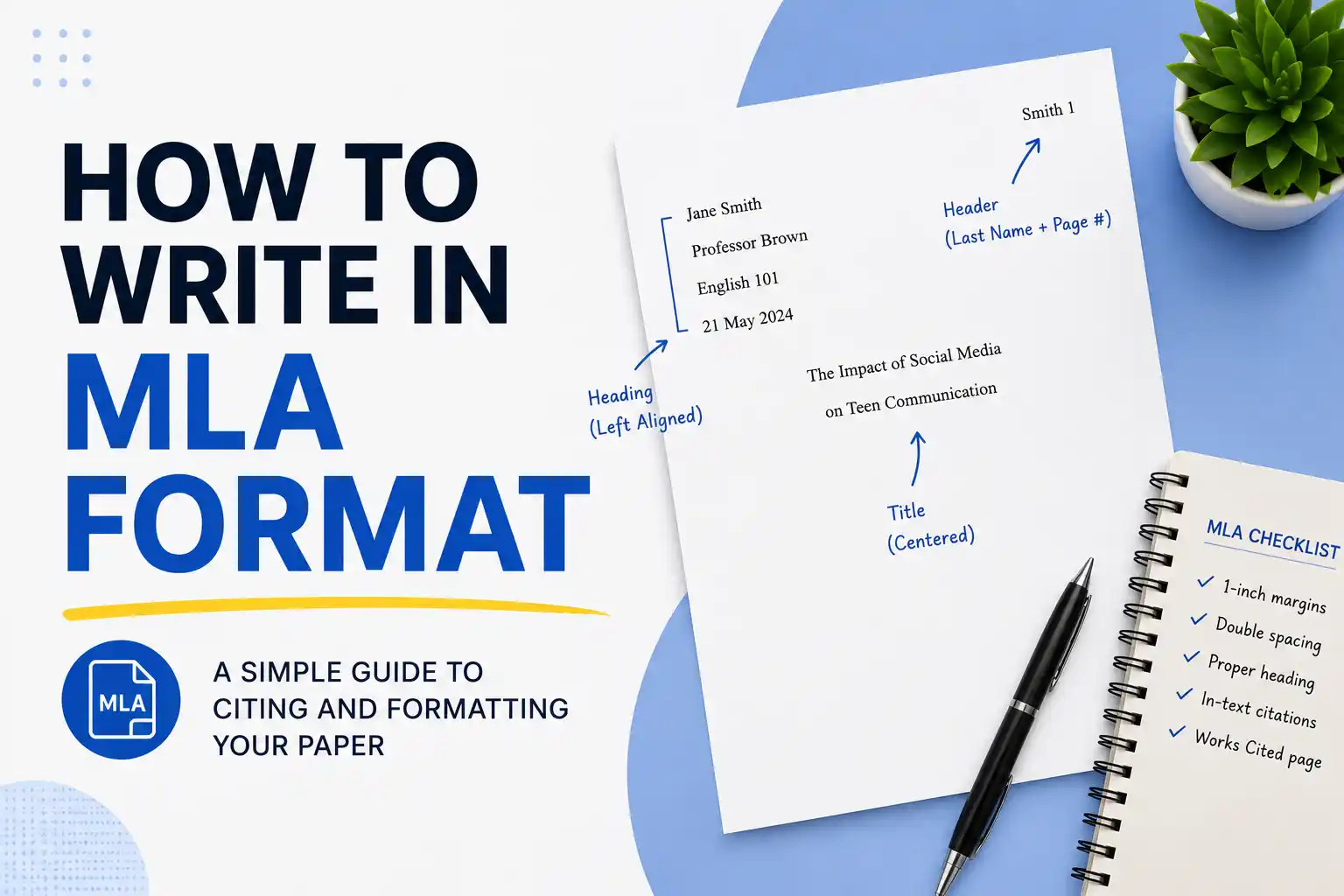
- Header: Last name and page number in top right corner
- Heading: Four lines on the first page (name, instructor, course, date)
- Works Cited: Separate page with hanging indent
3 How to Format Your MLA Paper
Proper paper formatting is essential for an MLA paper. Here are the key formatting rules.
Margins and Spacing
Use 1-inch margins on all sides of the page. Double-space the entire paper, including the heading, body, and Works Cited page. Do not add extra spaces between paragraphs.
Font
MLA recommends using an easily readable font such as 12-point Times New Roman. Use the same typeface and type size throughout the paper.
Page Header
Include a running header in the top right corner of every page: your last name followed by the page number (e.g., Smith 1). The header should be ½ inch from the top of the page.
First Page Heading
On the first page, include a four-line heading aligned to the left margin:
- Your name
- Instructor's name
- Course number and name
- Date (day month year format)
Centre the paper title after the heading. Do not use bold, italics, or underlining for the title.
Paragraph Indentation
Indent the first line of each paragraph by ½ inch.
Sample MLA First Page
Jane Doe
Professor Smith
English 101
29 June 2026
The Impact of Social Media on Adolescent Mental Health
[Text begins here with ½-inch indent...]
4 How to Write MLA In-Text Citations
MLA uses the author-page citation system. Here are the basic rules for in-text citations.
Parenthetical Citations
Place the author's last name and the page number in parentheses at the end of the sentence: (Smith 45).
Citation in Prose (Narrative Citation)
Incorporate the author's name into the sentence and place the page number in parentheses: According to Smith, the results were significant (45).
Multiple Authors
- Two authors: (Smith and Kim 9)
- Three or more authors: (Smith et al. 9)
No Author
Use a shortened title in place of the author. Use quotation marks for article titles and italics for book titles: ("Title of Article" 45).
Direct Quotations
Include the page number in the citation: (Smith 45). For sources without page numbers (e.g., websites), use paragraph numbers if available.
Parenthetical Citation
"Recent studies have shown a significant correlation between social media use and anxiety (Smith 45)."
Citation in Prose
"Smith found a significant correlation between social media use and anxiety (45)."
5 How to Write an MLA Works Cited Page
The Works Cited page appears at the end of your paper. It provides full publication details for all sources cited in the text.
Works Cited Formatting
- Start on a new page at the end of your paper
- Centre the words "Works Cited" in regular font at the top of the page
- Double-space all entries
- Use a hanging indent (first line flush left, subsequent lines indented ½ inch)
- Order entries alphabetically by the author's last name
Book
Author Last, First Name. Title of Book. Publisher, Publication Year.
Said, Edward W. Culture and Imperialism. Knopf, 1994.
Journal Article
Author(s). "Title of Article." Title of Journal, Volume, Issue, Year, pages.
Bagchi, Alaknanda. "Conflicting Nationalisms: The Voice of the Subaltern in Mahasweta Devi's Bashai Tudu." Tulsa Studies in Women's Literature, vol. 15, no. 1, 1996, pp. 41-50.
Website
Author. "Title of Page." Title of Website, Publisher, Publication Date, URL.
Lundman, Susan. "How to Make Vegetarian Chili." eHow, www.ehow.com/how_10727_make-vegetarian-chili.html. 12 June 2021.
Works Cited Checklist
- New page: Start on a separate page
- Title: "Works Cited" centred at the top
- Spacing: Double-spaced throughout
- Indent: Hanging indent (½ inch)
- Order: Alphabetical by author's last name
- Punctuation: End each entry with a period
6 How to Cite Different Source Types in MLA
Different source types require different citation formats in MLA. Here are some common examples.
Book with One Author
Last Name, First Name. Title of Book. Publisher, Year.
Example: Saaad, Layla F. Me and White Supremacy: Combat Racism, Change the World, and Become a Good Ancestor. Sourcebooks, 2020.
Book with Two Authors
Last Name, First Name, and First Name Last Name. Title of Book. Publisher, Year.
Example: Welters, Linda, and Abby Lillethun. Fashion History: A Global View. Bloomsbury Academic, 2017.
Journal Article
Author(s). "Title of Article." Title of Journal, vol. #, no. #, Year, pp. xx-xx.
Example: Acim, Rachid. "Islamophobia, Racism and the Vilification of the Muslim Diaspora." Islamophobia Studies Journal, vol. 5, no. 1, 2019, pp. 26-44.
Website
Author. "Title of Page." Title of Website, Publisher, Date, URL.
Example: Lundman, Susan. "How to Make Vegetarian Chili." eHow, www.ehow.com/how_10727_make-vegetarian-chili.html. 12 June 2021.
Article from a Database
Author. "Title of Article." Title of Journal, vol. #, no. #, Year, pp. xx-xx. Database, URL or DOI.
Example: Estes, Nick, et al. Red Nation Rising: From Bordertown Violence to Native Liberation. PM Press, 2021. EBSCOhost, search-ebscohost-com.ezproxy-h.pierce.ctc.edu/login.aspx?direct=true&db=nlebk&AN=2768121.
Film or Video
Title of Film. Directed by First Name Last Name, Studio, Year.
Example: Fantastic Beasts: The Crimes of Grindelwald. Directed by David Yates, Warner Brothers, 2018.
7 Common MLA Mistakes to Avoid
Even experienced writers make mistakes. Here are the most common errors and how to avoid them.
Incorrect Header
Forgetting the page header with last name and page number, or placing it on the title page only.
Fix: Include your last name and page number in the top right corner of every page.
Incorrect Heading on First Page
Missing the four-line heading or placing it in the wrong position.
Fix: Place the heading aligned left, double-spaced, with name, instructor, course, and date.
Incorrect In-Text Citations
Missing the page number, using the wrong format for multiple authors, or forgetting the author's name.
Fix: Double-check citation formats against the MLA handbook.
Works Cited Errors
Incorrect formatting, missing hanging indent, wrong alphabetical order, or missing punctuation.
Fix: Use a citation generator and double-check each entry against MLA guidelines.
Incorrect Title Capitalisation
Using the wrong capitalisation for titles in the Works Cited page or in-text citations.
Fix: Use title case for all source titles (capitalise all major words).
Incorrect Spacing
Not double-spacing the paper or adding extra spaces between paragraphs.
Fix: Double-space everything, including the heading, body, and Works Cited.
8 Practice Exercises to Improve Your MLA Skills
The best way to get better at MLA format is to practice. Here are some exercises to help you sharpen your skills.
Exercise 1: Format a First Page
Create a properly formatted MLA first page for a fictional paper. Include the heading, title, and a sample paragraph with indentation.
Exercise 2: Write In-Text Citations
Given a set of sources, write both parenthetical and in-prose citations for each. Include direct quotations with page numbers.
Exercise 3: Build a Works Cited Page
Take a set of sources (books, journal articles, websites) and format them as an MLA Works Cited page. Check for correct formatting, alphabetical order, and hanging indent.
Exercise 4: Peer Review
Swap papers with a classmate. Review each other's formatting and citations. Provide constructive feedback on MLA compliance.
Final Thoughts
Writing in MLA format is an essential skill for students and researchers in the humanities. Mastering MLA style ensures your work is professional, credible, and properly attributed.
Remember that MLA format is not just about following rules — it is about clear, effective communication. The guidelines help you present your ideas in a way that is easy for readers to understand and verify.
Keep these principles in mind as you write:
- Follow the rules. MLA format has specific guidelines — follow them carefully.
- Be consistent. Consistency in formatting and citation is key.
- Cite your sources. Give credit where it is due and avoid plagiarism.
- Proofread. Check your formatting and citations carefully.
- Use resources. The MLA handbook and online guides are valuable references.
MLA format may seem daunting at first, but it becomes easier with practice. Each paper you write will help you become more familiar with the rules. With time and effort, you will be able to write in MLA format with confidence and ease.
Now go write an MLA-formatted paper that meets the highest academic standards.