How to Write in APA Format: The Complete Guide
You have been told to write your paper in APA format. You open the style guide and feel overwhelmed. There are so many rules — margins, fonts, headings, citations, references. Where do you even start?
You are not alone. Writing in APA format is a challenge for many students and researchers. But mastering APA style is essential for academic success. It ensures your work is credible, professional, and properly attributed.
This guide will teach you everything you need to know about how to write in APA format. We will cover the 7th edition rules for formatting your paper, creating in-text citations, building a reference list, and using headings. By the end, you will have the tools to write APA-formatted papers with confidence.
APA Format at a Glance
1 What Is APA Format and Why Does It Matter?
APA format is a set of rules and guidelines for writing academic papers, developed by the American Psychological Association. The 7th edition, published in 2020, is the most current version. APA style is used widely in the social sciences, education, psychology, and business.
APA format matters because it provides a standardised system for scholarly communication. It ensures consistency and clarity in academic writing. It gives credit to sources and helps readers locate them. Proper formatting also enhances the credibility of your work.
Using APA format demonstrates that you are a serious, careful scholar who follows professional standards. It shows respect for the work of others and helps you avoid plagiarism.
Ensures Consistency
APA provides a standardised format that makes academic papers easier to read and understand.
Gives Credit
APA citation rules ensure that you properly credit the work of other scholars and avoid plagiarism.
Enhances Credibility
Properly formatted papers look professional and signal that you are a careful, serious scholar.
Helps Readers
APA formatting helps readers locate your sources and follow your arguments more easily.
2 The Fundamentals of APA Format
Before you start writing, you need to understand the foundational principles of APA style.
APA 7th Edition vs. 6th Edition
The 7th edition introduced several key changes from the 6th edition. These include:
- More flexibility with fonts (Times New Roman, Calibri, Arial, etc.)
- No need for "Running head" on the title page for student papers
- Up to 20 authors in the reference list (instead of 7)
- New guidelines for inclusive and bias-free language
The Author-Date Citation System
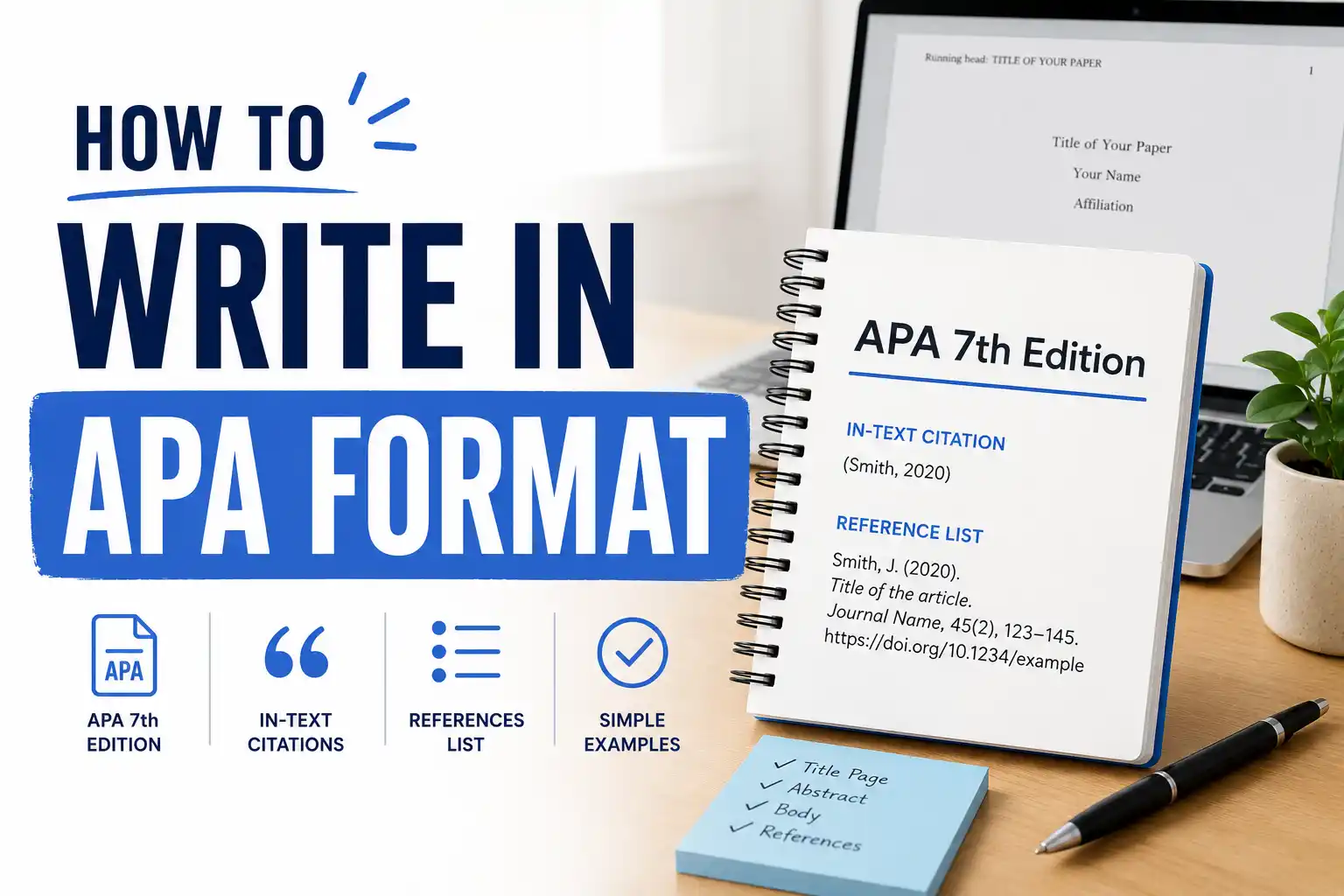
APA uses the author-date citation system. In-text citations include the author's last name and the year of publication (e.g., Smith, 2020). The full reference appears in the reference list at the end of the paper.
Use Inclusive and Bias-Free Language
APA 7th edition emphasises the use of inclusive, bias-free language. This means avoiding gender-specific terms, using person-first language, and being respectful of all groups.
APA 7th Edition Key Changes
- Font: More options (Times New Roman 12pt, Calibri 11pt, Arial 11pt)
- Running head: No longer required for student papers
- Authors: Up to 20 authors listed in references
- Language: Emphasis on inclusive and bias-free language
- DOIs: Now hyperlinked and presented as URLs
3 How to Format Your APA Paper
Proper paper formatting is essential for an APA paper. Here are the key formatting rules.
Margins and Spacing
Use 1-inch margins on all sides of the page. Double-space the entire paper, including the title page, abstract, body, and reference list. Do not add extra spaces between paragraphs.
Font
APA 7th edition recommends these fonts:
- 12-point Times New Roman
- 11-point Calibri
- 11-point Arial
- 10-point Lucida Sans Unicode
- 11-point Georgia
Page Numbers
Include page numbers in the top right corner of every page. The title page is page 1.
Title Page
The title page should include:
- Paper title: Centred, bold, 3-4 lines from the top
- Author's name: Centred, below the title
- Institutional affiliation: Centred, below the author's name
- Course number and name: Centred, below the affiliation (student papers)
- Instructor's name: Centred, below the course
- Due date: Centred, below the instructor's name
Sample Title Page (Student Paper)
The Impact of Social Media on Adolescent Mental Health
Jane Doe
Department of Psychology, University of Example
PSY 101: Introduction to Psychology
Dr. Sarah Johnson
June 29, 2026
4 How to Write an APA Title Page
The title page is the first page of your APA paper. Here is a step-by-step guide to creating one.
Page Header
In APA 7th edition, student papers no longer require a running head. Simply include the page number in the top right corner of every page.
Paper Title
Your title should be concise and descriptive. It should clearly indicate the topic and main variables. Centre the title, bold it, and place it 3-4 lines from the top of the page. Capitalise major words.
Author's Name
Centre your full name below the title. Do not include titles (e.g., Dr., Prof.) or degrees.
Institutional Affiliation
Centre the name of your institution below your name.
Course Information (Student Papers)
Centre the course number and name, the instructor's name, and the due date below the affiliation.
Title Page Checklist
- Page number: Top right corner (page 1)
- Title: Centred, bold, 3-4 lines from top
- Author's name: Centred, below title
- Institution: Centred, below author's name
- Course: Centred, below institution (student papers)
- Instructor: Centred, below course (student papers)
- Due date: Centred, below instructor (student papers)
5 How to Write an APA Abstract
The abstract is a concise summary of your paper. It appears on a separate page after the title page. Not all student papers require an abstract — check with your instructor.
Abstract Formatting
Place the abstract on a new page. Centre the word "Abstract" in bold at the top of the page. Write the abstract as a single paragraph, double-spaced. Do not indent the first line.
What to Include in the Abstract
Your abstract should include:
- The research problem or purpose
- The methods used
- The key findings or results
- The main conclusions or implications
Keywords
After the abstract, include a list of keywords. Indent and italicise the word "Keywords:" followed by 3-5 terms that describe your paper.
Sample Abstract
This study examined the relationship between social media use and adolescent mental health. A survey of 500 adolescents aged 13-17 was conducted to measure social media usage patterns and symptoms of anxiety and depression. Results indicated a significant positive correlation between daily social media use and reported anxiety symptoms. However, the relationship was moderated by the type of social media engagement, with active engagement associated with lower anxiety levels. These findings suggest that the quality of social media use may be more important than the quantity. Implications for parents and educators are discussed.
Keywords: social media, adolescent mental health, anxiety, depression, engagement
6 How to Format APA Headings
APA uses a five-level heading structure to organise papers. Most student papers only need levels 1-3.
Level 1 Heading
Centred, Bold, Title Case — The main section headings (e.g., Method, Results, Discussion).
Level 2 Heading
Left-aligned, Bold, Title Case — Subsections within a Level 1 heading.
Level 3 Heading
Left-aligned, Bold Italic, Title Case — Subsections within a Level 2 heading.
Level 4 Heading
Indented, Bold, Title Case, ending with a period. Paragraph text begins on the same line.
Level 5 Heading
Indented, Bold Italic, Title Case, ending with a period. Paragraph text begins on the same line.
APA Heading Levels
7 How to Write APA In-Text Citations
APA uses the author-date citation system. Here are the basic rules for in-text citations.
Parenthetical Citations
Place the author's last name and the year in parentheses at the end of the sentence: (Smith, 2020).
Narrative Citations
Incorporate the author's name into the sentence and place the year in parentheses: Smith (2020) found that...
Multiple Authors
- Two authors: (Smith & Jones, 2020)
- Three or more authors: (Smith et al., 2020) — Use "et al." for all citations.
Direct Quotations
Include the page number (or paragraph number for online sources): (Smith, 2020, p. 45).
No Author
Use the title in place of the author. For articles, use shortened title in quotation marks: ("Title of Article," 2020).
Parenthetical Citation
"Recent studies have shown a significant correlation between social media use and anxiety (Smith, 2020)."
Narrative Citation
"Smith (2020) found a significant correlation between social media use and anxiety."
8 How to Write an APA Reference List
The reference list appears at the end of your paper. It provides full publication details for all sources cited in the text.
Reference List Formatting
- Start on a new page
- Centre the word "References" in bold at the top
- Double-space all entries
- Use a hanging indent (first line flush left, subsequent lines indented 0.5 inches)
- Order entries alphabetically by the author's last name
Journal Article
Author, A. A., & Author, B. B. (Year). Title of article. Title of Journal, volume(issue), page-page. DOI
Book
Author, A. A. (Year). Title of book. Publisher.
Website
Author, A. A. (Year, Month Date). Title of page. Site Name. URL
Sample Reference List Entries
Journal Article:
Smith, J. A., & Jones, M. B. (2020). The impact of social media on adolescent mental health. Journal of Adolescent Psychology, 45(3), 234-251.
Book:
Brown, T. L. (2019). Understanding research methods (3rd ed.). Academic Press.
Website:
American Psychological Association. (2020, January 15). APA style overview. APA Style. https://apastyle.apa.org/
9 Common APA Mistakes to Avoid
Even experienced writers make mistakes. Here are the most common errors and how to avoid them.
Incorrect Font or Spacing
Using the wrong font or not double-spacing the paper.
Fix: Use the recommended fonts and double-space everything.
Missing Page Numbers
Forgetting to include page numbers in the top right corner.
Fix: Include page numbers on every page.
Incorrect In-Text Citations
Missing the year, using the wrong format for multiple authors, or forgetting page numbers for direct quotes.
Fix: Double-check citation formats against the APA manual.
Reference List Errors
Incorrect formatting, missing DOIs, or alphabetical order errors.
Fix: Use a citation generator and double-check each entry.
Using "Retrieved from"
APA 7th edition no longer requires "Retrieved from" before URLs for most sources.
Fix: Simply include the URL without "Retrieved from."
Incorrect Heading Levels
Using the wrong heading level or not following the correct format.
Fix: Review the heading levels and use them consistently.
10 Practice Exercises to Improve Your APA Skills
The best way to get better at APA format is to practice. Here are some exercises to help you sharpen your skills.
Exercise 1: Format a Title Page
Create a properly formatted APA title page for a fictional paper. Include all the required elements.
Exercise 2: Write In-Text Citations
Given a set of sources, write both parenthetical and narrative citations for each. Include direct quotations with page numbers.
Exercise 3: Build a Reference List
Take a set of sources (journal articles, books, websites) and format them as an APA reference list. Check for correct formatting and alphabetical order.
Exercise 4: Peer Review
Swap papers with a classmate. Review each other's formatting and citations. Provide constructive feedback on APA compliance.
Final Thoughts
Writing in APA format is an essential skill for students and researchers in the social sciences. Mastering APA style ensures your work is professional, credible, and properly attributed.
Remember that APA format is not just about following rules — it is about clear, effective communication. The guidelines help you present your ideas in a way that is easy for readers to understand and verify.
Keep these principles in mind as you write:
- Follow the rules. APA format has specific guidelines — follow them carefully.
- Be consistent. Consistency in formatting and citation is key.
- Cite your sources. Give credit where it is due and avoid plagiarism.
- Proofread. Check your formatting and citations carefully.
- Use resources. The APA manual and online guides are valuable references.
APA format may seem daunting at first, but it becomes easier with practice. Each paper you write will help you become more familiar with the rules. With time and effort, you will be able to write in APA format with confidence and ease.
Now go write an APA-formatted paper that meets the highest academic standards.