How to Write Dates: The Complete Guide with Examples
You are writing an important email, filling out a form, or drafting a formal document. You pause. How do you write the date? Is it "June 1" or "June 1st"? Do you use a comma? Should it be "01/06/2026" or "06/01/2026"? Suddenly, something so simple feels confusing.
You are not alone. Writing dates correctly is a surprisingly common source of confusion. The rules vary depending on whether you are using American or British English, whether you are writing formally or informally, and even what country you are in. But getting it right matters — dates that are unclear can lead to misunderstandings, missed appointments, and unprofessional communication.
This guide will teach you everything you need to know about how to write dates correctly in English. We will cover the different formats, the regional differences, the punctuation rules, and the common mistakes to avoid. By the end, you will have the confidence to write dates correctly in any situation.
Date Writing at a Glance
1 Why Writing Dates Correctly Matters
At first glance, writing a date might seem like a minor detail. But getting it wrong can have real consequences. A misunderstood date can mean missing a deadline, showing up on the wrong day for an appointment, or creating confusion in business communications.
Writing dates correctly is also a matter of professionalism. In formal writing, such as business letters, legal documents, or academic papers, the way you write the date reflects your attention to detail. A correctly written date shows that you are careful, precise, and respectful of the reader.
In a globalised world, date formats can vary significantly between countries. A date written as "06/07/2026" could mean July 6 in the United States or June 7 in the United Kingdom. Understanding these differences is essential for clear international communication.
Avoids Confusion
Different regions interpret dates differently. Using the wrong format can lead to misunderstandings about dates and deadlines.
Shows Professionalism
Correctly formatted dates demonstrate attention to detail and respect for the reader. It enhances your credibility.
Ensures Clarity
A clear, unambiguous date format ensures that everyone understands exactly when something is happening.
Builds Trust
Consistent and correct date writing builds trust with colleagues, clients, and readers. It shows that you are reliable.
2 The Fundamentals of Writing Dates
Before we dive into the specific formats, let's cover the fundamental principles that apply to writing dates in English.
Know Your Audience
The most important factor in choosing a date format is your audience. Who is reading your writing? Where are they from? If you are writing for an American audience, use the American format. For a British or international audience, use the British or ISO format. When in doubt, spell out the month to avoid ambiguity.
Be Consistent
Whatever format you choose, be consistent. Do not mix American and British formats in the same document. Consistency makes your writing look professional and reduces confusion.
Consider the Context
The formality of your writing matters. In informal writing (texts, emails to friends), you can use abbreviations and numerals. In formal writing (business letters, academic papers), spell out the month and follow the standard rules.
The Golden Rule
The golden rule of writing dates is simple: make it clear. If there is any chance your date could be misunderstood, spell it out. "June 29, 2026" is much clearer than "06/29/26" and leaves no room for confusion.
3 The Three Main Date Formats
There are three main date formats used in English. Understanding the differences is the key to writing dates correctly.
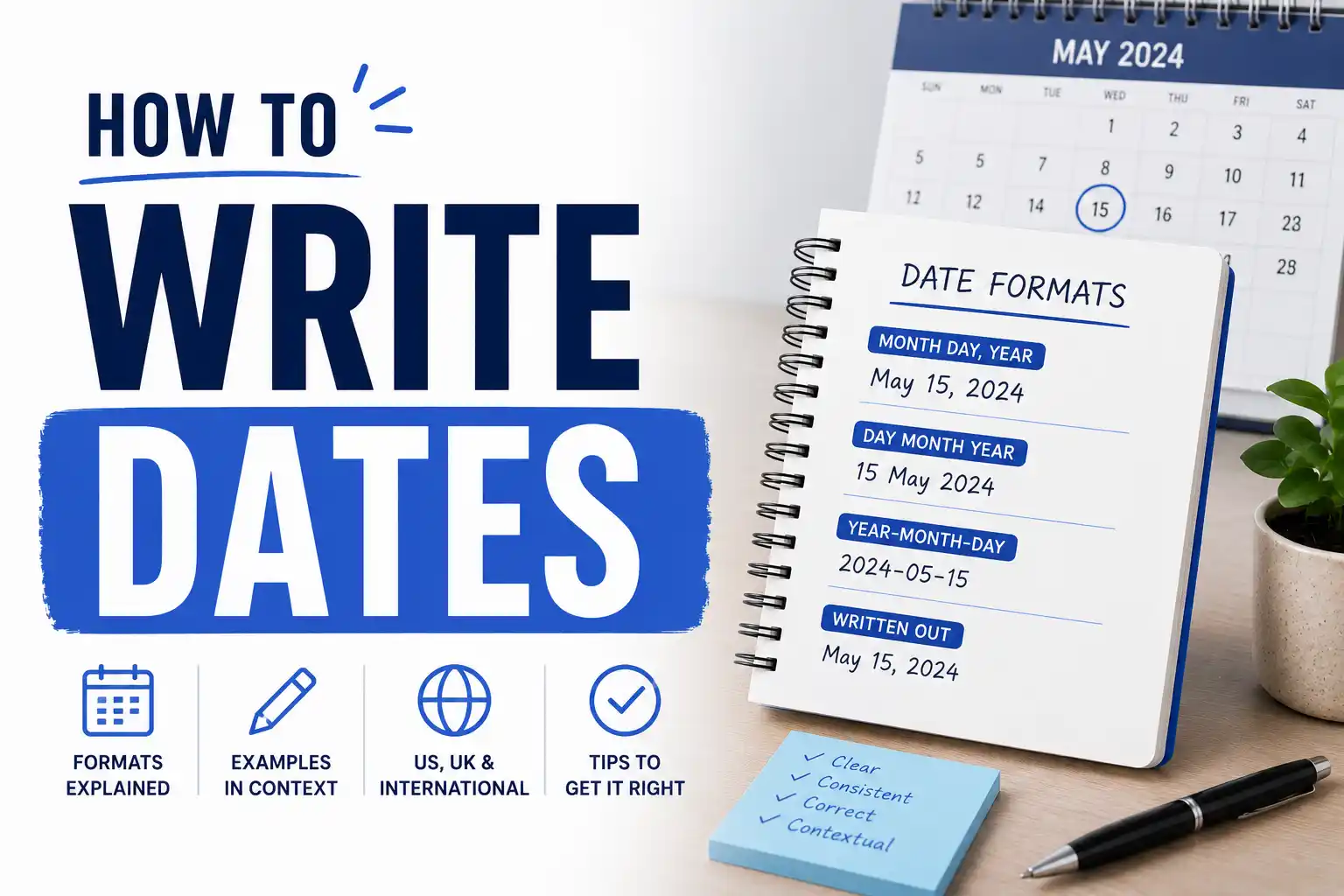
American Format: Month/Day/Year
The American format puts the month first, followed by the day, then the year. This is the standard in the United States and is also used in some other countries.
Examples
- Written out: June 29, 2026
- Numerical: 06/29/2026 or 06/29/26
- With day of week: Monday, June 29, 2026
British Format: Day/Month/Year
The British format puts the day first, followed by the month, then the year. This is standard in the United Kingdom, Australia, New Zealand, and many other countries.
Examples
- Written out: 29 June 2026 (no comma)
- Numerical: 29/06/2026 or 29/06/26
- With day of week: Monday 29 June 2026 (no comma)
International Standard: Year/Month/Day (ISO 8601)
The ISO 8601 format puts the year first, followed by the month, then the day. This is the international standard and is used in technical and official documents worldwide. It eliminates all ambiguity because the order is clear and the year is written with four digits.
Examples
- Standard: 2026-06-29
- With time: 2026-06-29T14:30:00
Date Format Comparison
4 Punctuation Rules for Dates
Punctuation is a key part of writing dates correctly. Here are the essential rules.
Commas in American Dates
In the American format, use a comma between the day and the year. If the date appears in the middle of a sentence, use a comma after the year as well.
Examples
- End of sentence: "The conference is on June 29, 2026."
- Middle of sentence: "The conference, which is on June 29, 2026, will be held in London."
No Commas in British Dates
In the British format, do not use commas between the day, month, and year.
Examples
- End of sentence: "The conference is on 29 June 2026."
- Middle of sentence: "The conference on 29 June 2026 will be held in London."
Month and Year Only
When writing only the month and year, do not use a comma. This applies to both American and British English.
Examples
- Correct: "The project will be completed in June 2026."
- Incorrect: "The project will be completed in June, 2026."
Using "In" vs. "On"
Use "in" for general dates (months and years). Use "on" for specific dates (days and dates).
Examples
- In: "The project started in June 2025."
- On: "The project started on June 29, 2025."
- On: "We will meet on Monday."
5 Ordinal Numbers in Dates
One of the most common questions about writing dates is whether to use ordinal numbers (1st, 2nd, 3rd) or cardinal numbers (1, 2, 3). The answer depends on the context.
Formal Writing
In formal American writing, use cardinal numbers (no "th," "st," "rd," or "nd").
Examples
- Correct: "The meeting is on June 29."
- Incorrect: "The meeting is on June 29th."
Informal Writing and Speech
In informal writing and speech, ordinal numbers are common and perfectly acceptable.
Examples
- Informal: "Let's meet on June 29th."
- Spoken: "I'll see you on the 29th of June."
British English
In British English, ordinals are more common in both formal and informal writing, especially when the day comes before the month.
Examples
- Formal: "The meeting is on 29 June 2026." (no ordinal)
- Informal: "The meeting is on the 29th of June."
6 American vs. British Date Formats
The difference between American and British date formats is one of the most common sources of confusion. Here is a clear breakdown.
The Key Difference
The American format puts the month first (MM/DD/YYYY). The British format puts the day first (DD/MM/YYYY). This means the same numerical date can mean completely different things.
Why It Matters
Consider the date "04/07/2026". In the United States, this means April 7, 2026. In the United Kingdom, it means July 4, 2026. This difference can lead to missed appointments, missed deadlines, and serious misunderstandings.
How to Avoid Confusion
The best way to avoid confusion is to spell out the month. "April 7, 2026" or "7 April 2026" leaves no room for doubt. Alternatively, use the ISO 8601 format (2026-04-07), which is unambiguous.
American vs. British Date Examples
7 Common Mistakes to Avoid
Even native speakers make mistakes when writing dates. Here are the most common errors and how to avoid them.
Confusing American and British Formats
Using "06/07/2026" and assuming everyone will understand it the same way.
Fix: Spell out the month or use the ISO format to avoid ambiguity.
Using Ordinals in Formal American Writing
Writing "June 29th, 2026" in a formal document.
Fix: Use cardinal numbers: "June 29, 2026."
Incorrect Comma Usage
Omitting the comma between the day and year in American dates or adding unnecessary commas in British dates.
Fix: Learn the punctuation rules for your chosen format.
Using "On" with Months or Years
Writing "on June 2025" instead of "in June 2025."
Fix: Use "in" for general dates and "on" for specific dates.
Mixing Formats in One Document
Using "June 29, 2026" in one place and "29/06/2026" in another.
Fix: Choose one format and stick with it consistently.
Forgetting to Capitalise Months
Writing "june" instead of "June." Months are proper nouns and should be capitalised.
Fix: Always capitalise the names of months.
8 How to Write Dates in Different Contexts
The way you write a date depends on the context. Here are guidelines for common situations.
Formal Writing (Business Letters, Academic Papers)
In formal writing, spell out the month and use the appropriate format for your audience. Use cardinal numbers (no ordinals). Be consistent.
Examples
- American: "The report is due on July 15, 2026."
- British: "The report is due on 15 July 2026."
Informal Writing (Emails, Texts, Personal Notes)
In informal writing, you have more flexibility. You can use numerals, abbreviations, and ordinals.
Examples
- American: "See you on 7/15." or "See you on July 15th."
- British: "See you on 15/7." or "See you on the 15th of July."
Technical and Official Documents
For technical or official documents, use the ISO 8601 format (YYYY-MM-DD). This eliminates all ambiguity.
Examples
- ISO: "2026-07-15"
- With time: "2026-07-15T14:30:00"
Tables and Charts
In tables and charts where space is limited, use numerical formats consistently. Be clear about which format you are using.
Examples
- American: "06/29/2026"
- British: "29/06/2026"
- ISO: "2026-06-29"
9 How to Write Date Ranges
Writing date ranges requires care to ensure clarity. Here are the standard approaches.
Using "To" or an En Dash
Use "to" or an en dash (–) to indicate a range of dates. Do not use a hyphen (-) for this purpose.
Examples
- Correct: "The conference runs from June 29 to July 1, 2026."
- Correct: "The conference runs June 29 – July 1, 2026."
- Incorrect: "The conference runs June 29 - July 1, 2026."
Consistency in Format
When writing a date range, be consistent in the format of the dates. Do not mix American and British formats.
Examples
- Consistent: "June 29 – July 1, 2026"
- Inconsistent: "June 29 – 1 July 2026"
Writing Out Both Dates
In formal writing, it is often best to write out both dates in full to avoid confusion.
Examples
- Formal: "The course will run from Monday, June 29, 2026, to Wednesday, July 1, 2026."
- Informal: "The course runs June 29 – July 1."
10 Practice Exercises to Improve Your Date Writing
The best way to get better at writing dates is to practice. Here are some exercises to help you sharpen your skills.
Exercise 1: Convert Between Formats
Take a date written in the American format (e.g., "July 4, 2026") and convert it to the British format. Then convert it to ISO format. Practice until you can do it quickly and confidently.
Exercise 2: Punctuation Practice
Write five sentences that include dates. Make sure you use commas correctly for American dates and no commas for British dates. Practice using "in" and "on" correctly.
Exercise 3: Identify the Mistake
Find a document or email that includes dates. Identify any errors in the date format or punctuation. Rewrite the dates correctly.
Exercise 4: Write a Formal Letter
Write a formal business letter that includes several dates. Use the correct format for your audience and be consistent throughout.
Final Thoughts
Writing dates correctly is a small detail that makes a big difference. It shows that you are professional, careful, and respectful of your reader. It prevents confusion and ensures that your message is understood.
Remember that the key to writing dates correctly is knowing your audience and being consistent. Choose the format that is appropriate for your context and stick with it throughout your document. When in doubt, spell out the month to avoid ambiguity.
Keep these principles in mind as you write:
- Know your audience. Use the format they expect.
- Be consistent. Stick with one format throughout.
- Use the right punctuation. Commas matter — know the rules.
- When in doubt, spell it out. Writing out the month eliminates ambiguity.
- Consider using ISO format. For international or technical writing, YYYY-MM-DD is unambiguous.
Date writing is a skill that you can master with practice. The more you write dates correctly, the more natural it will become. And the more professional your writing will appear.
Now go write some dates with confidence.