How to Write a Memorandum: The Complete Guide with Examples
You need to communicate something important within your organisation. Maybe it is a policy update, a project announcement, or a call to action. You know you should write a memorandum, but you are not sure about the format, the tone, or what to include. You worry it might be too formal or too casual.
You are not alone. Writing a memorandum is a common task in business and government, but many people find it challenging to get right. A well-written memo is clear, concise, and professional. It gets your message across effectively and prompts the right action. A poorly written memo can confuse, frustrate, or be ignored.
This guide will teach you everything you need to know about how to write a memorandum that is clear, professional, and effective. We will cover the structure, the formatting, the tone, and the common mistakes to avoid. By the end, you will have the tools to write memos that get results.
Memorandum at a Glance
1 What Is a Memorandum and Why Does It Matter?
A memorandum — often shortened to "memo" — is a written message used for internal communication within an organisation. It is a formal way to share information, announce policies, make requests, or document decisions. Memos are used in businesses, government agencies, non-profits, and academic institutions.
Memos matter because they are a primary tool for internal communication. A well-written memo ensures that everyone in the organisation has the information they need to do their jobs effectively. It creates a record of decisions and communications, promotes transparency, and aligns teams around common goals.
In a fast-paced workplace, a clear memo can save time and prevent misunderstandings. It provides a single source of truth that everyone can reference. A poorly written memo can create confusion, lead to mistakes, and waste time.
Aligns Teams
A memo ensures that everyone in the organisation receives the same information at the same time. This promotes alignment and consistency.
Creates a Record
Memos provide a written record of decisions, policies, and communications. This is important for accountability and reference.
Saves Time
A clear memo communicates information efficiently, reducing the need for repeated explanations or meetings.
Promotes Transparency
Memos make information accessible to everyone in the organisation. This builds trust and promotes a culture of transparency.
2 The Fundamentals of Writing a Memorandum
Before you start writing, you need to understand the foundational principles that underpin every effective memo.
Be Clear and Concise
This is the most important rule of memo writing. Your readers are busy. They do not have time to wade through long, complex documents. Get straight to the point. Use clear, simple language. State your purpose in the first paragraph.
Know Your Audience
Who is your memo for? What do they need to know? What action do you want them to take? Tailor your content and tone to your audience. A memo to senior executives will differ from a memo to front-line staff.
Be Action-Oriented
Most memos are written to prompt action. What do you want the reader to do? Make this clear. Use action verbs and specific instructions. Do not leave the reader guessing about what they should do next.
The "BLUF" Principle
In memo writing, use the BLUF (Bottom Line Up Front) approach. State your main point or request in the first paragraph. Then provide supporting details. This respects the reader's time and ensures your message is understood even if they only scan the memo.
3 How to Structure a Memorandum
A well-structured memo follows a standard format that makes it easy to read and understand. Here is the essential structure.
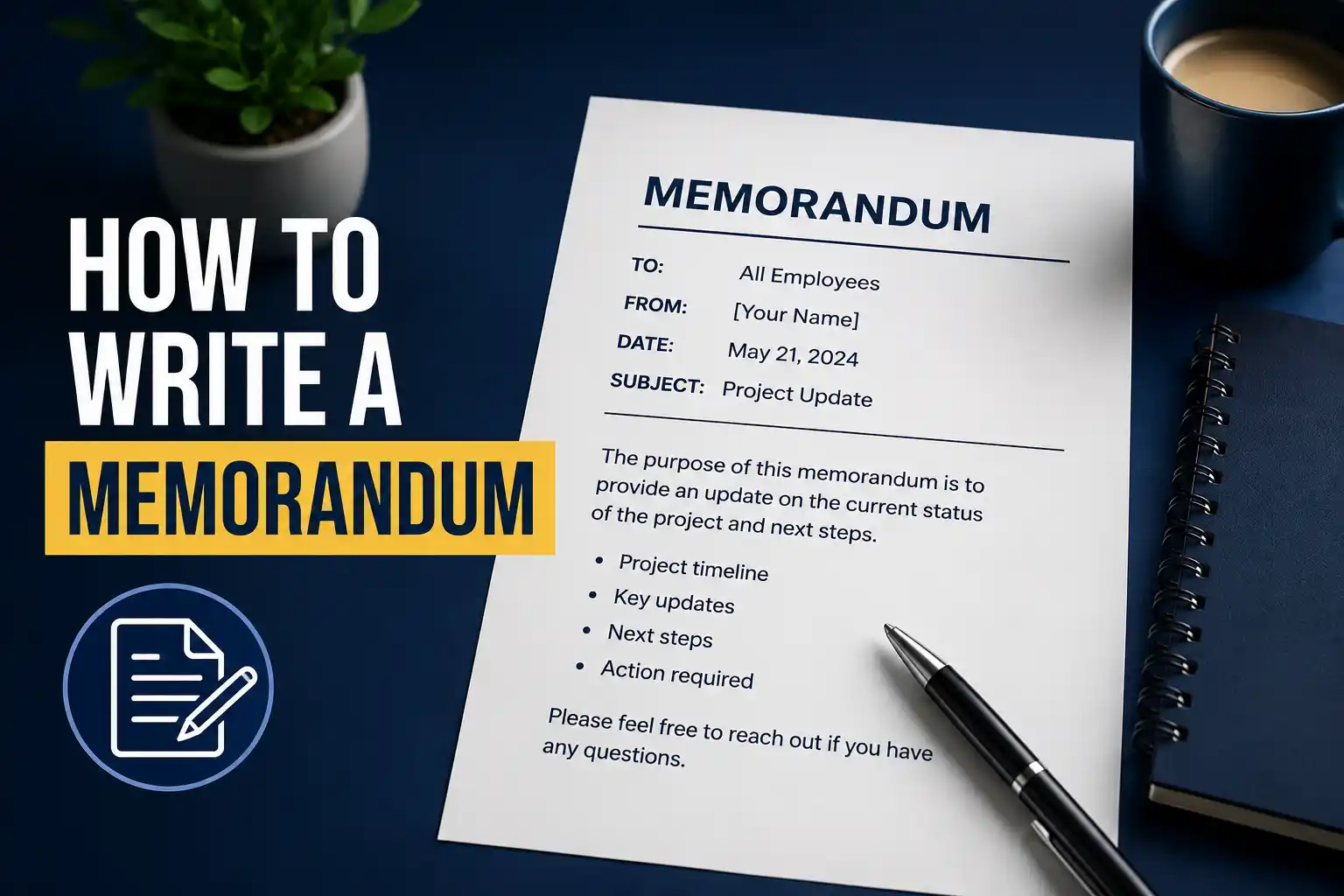
Header
The header includes four key elements:
- TO: The recipient(s) of the memo. Use full names and titles.
- FROM: Your name and title.
- DATE: The date the memo is sent.
- SUBJECT: A brief, specific description of the memo's topic.
Opening Paragraph
The opening paragraph states the purpose of the memo. Why are you writing? What is the context? What do you want the reader to know or do? This should be clear and direct.
Body Paragraphs
The body provides the details, evidence, and supporting information. Use clear headings and bullet points to organise your content. Each paragraph should focus on a single idea.
Closing
The closing summarises the key points and states any required action. It may also include a thank you or an offer of further assistance.
Standard Memo Format
- TO: [Recipient Name and Title]
- FROM: [Your Name and Title]
- DATE: [Date]
- SUBJECT: [Brief, Specific Topic]
- Opening paragraph: State the purpose
- Body paragraphs: Provide details and supporting information
- Closing paragraph: Summarise and state action required
4 What to Include in a Memorandum
Every memo should include certain essential elements. Here is what to include, section by section.
Clear Subject Line
Your subject line should be brief and specific. It tells the reader what the memo is about at a glance. Avoid vague subjects like "Update" or "Important." Instead, use "Policy Update: New Remote Work Guidelines" or "Project X: Q3 Progress Report."
Purpose Statement
The first paragraph should state the purpose of the memo clearly. Why are you writing? What do you want the reader to know or do? Be direct. Do not make the reader guess.
Supporting Details
Provide the details that support your purpose. This could include background information, data, analysis, or explanations. Use headings and bullet points to organise this information and make it easy to scan.
Call to Action
What do you want the reader to do? Make your call to action clear and specific. For example: "Please review the attached policy and provide feedback by Friday." or "Please update your team on these changes at your next meeting."
Attachments or References
If you are referencing or attaching other documents, list them at the end of the memo. This ensures that the reader knows what additional materials are available.
5 How to Write a Memorandum: Step-by-Step
Here is a step-by-step process for writing a memorandum.
Step 1: Define Your Purpose
Before you write anything, be clear about why you are writing. What is your goal? What do you want the reader to know or do? This will guide everything you write.
Step 2: Know Your Audience
Who is your memo for? What do they need to know? What is their level of knowledge about the topic? Tailor your content and language to your audience.
Step 3: Choose Your Format
Use the standard memo format with the TO, FROM, DATE, and SUBJECT header. This is expected and makes your memo look professional.
Step 4: Write the Opening
State your purpose clearly and directly in the first paragraph. This is the most important part of your memo.
Step 5: Write the Body
Provide the details and supporting information. Use headings and bullet points to organise your content. Be clear and concise.
Step 6: Write the Closing
Summarise the key points and state any required action. Make your call to action clear.
Step 7: Revise and Proofread
Review your memo for clarity, accuracy, and professionalism. Check for spelling, grammar, and punctuation errors. A polished memo reflects well on you and your organisation.
Sample Memorandum
TO: All Staff
FROM: Jane Smith, Director of Operations
DATE: June 29, 2026
SUBJECT: Updated Remote Work Policy
Effective July 1, 2026, the company will implement a new remote work policy that allows employees to work remotely up to three days per week. This change is designed to support work-life balance while maintaining productivity and collaboration.
Key Changes:
- Employees may work remotely on Mondays, Wednesdays, and Fridays.
- Tuesdays and Thursdays are in-office days for team collaboration.
- Managers must approve remote work schedules in advance.
Please review the attached policy document for full details. If you have any questions, please speak with your manager or contact HR.
Thank you for your cooperation.
6 Common Mistakes to Avoid
Even experienced professionals make mistakes. Here are the most common errors and how to avoid them.
Being Too Vague
Failing to state your purpose clearly or leaving the reader guessing about what action to take.
Fix: State your purpose in the first paragraph. Make your call to action clear and specific.
Including Too Much Detail
Overloading the reader with unnecessary information or overly complex explanations.
Fix: Focus on what the reader needs to know. Use attachments for detailed information.
Using Poor Formatting
Inconsistent formatting, missing header information, or cluttered layout.
Fix: Use the standard memo format. Use headings and bullet points to organise content.
Using Jargon
Using technical terms or acronyms that the reader may not understand.
Fix: Use clear, plain language. Define any necessary terms.
Forgetting the Call to Action
Not telling the reader what to do next.
Fix: Always include a clear call to action. What do you want the reader to do?
Poor Proofreading
Sending a memo with spelling or grammar errors. This undermines your credibility.
Fix: Proofread carefully. Ask someone else to review it.
7 Types of Memorandums
There are several types of memorandums, each with a specific purpose. Here are the most common types.
Policy Memo
Announces or explains a new policy or procedure. Provides clear instructions and rationale for the policy.
Key trait: Clear policy statement and implementation instructions.
Project Update Memo
Provides an update on a project's progress. Includes accomplishments, challenges, and next steps.
Key trait: Status update and forward-looking plan.
Information Memo
Shares important information with the organisation. Could be a reminder, a notification, or a general update.
Key trait: Informative and clear.
Request Memo
Requests action, information, or resources from the reader. Includes a clear call to action.
Key trait: Clear request and justification.
Report Memo
Presents findings, data, or analysis. Often includes recommendations based on the findings.
Key trait: Data-driven with actionable recommendations.
Directive Memo
Gives instructions or orders to staff. Often used for operational or procedural matters.
Key trait: Clear instructions and expectations.
8 Tone and Language in Memorandums
The tone and language of your memo are just as important as the content. Here is how to get them right.
Be Professional
Use a professional, respectful tone. Avoid overly casual language or slang. Even if you are writing to colleagues you know well, maintain a professional tone in formal memos.
Be Direct
Get straight to the point. Avoid hedging or weak language. Use declarative statements and active voice.
Be Positive
Frame your message positively where possible. Even when announcing difficult news, focus on solutions and next steps.
Use Inclusive Language
Use language that is inclusive and respectful of all readers. Avoid gendered language or terms that could be exclusionary.
Strong and Direct Language
"Please review the attached policy and provide your feedback by Friday."
Weak Language
"If you could possibly review the policy and get back to me when you have a chance, that would be great."
9 How to Revise Your Memorandum
A great memo is not written; it is rewritten. Revision is where your memo goes from good to great. Here is a step-by-step process for revising your memo.
Step 1: Check for Clarity
Is your purpose clear? Is the memo easy to read and understand? If not, revise for clarity.
Step 2: Check for Conciseness
Is your memo too long? Cut unnecessary words and repetition. Focus on what the reader needs to know.
Step 3: Check for Completeness
Have you included all the essential information? Is your call to action clear?
Step 4: Check the Tone
Is the tone professional and appropriate? Is it respectful and inclusive?
Step 5: Check for Errors
Proofread carefully for spelling, grammar, and punctuation errors.
Step 6: Get Feedback
Ask a colleague to review your memo. Fresh eyes can catch issues you have missed.
10 Practice Exercises to Improve Your Memorandums
The best way to get better at writing memorandums is to practice. Here are some exercises to help you sharpen your skills.
Exercise 1: Write a Policy Memo
Write a policy memo announcing a new dress code or attendance policy. Include the rationale, the key changes, and implementation details.
Exercise 2: Write a Project Update Memo
Write a project update memo for a fictional project. Include accomplishments, challenges, and next steps.
Exercise 3: The "Vague to Clear" Rewrite
Take a vague memo and rewrite it to be clear and direct. Compare the two versions.
Exercise 4: Peer Review Swap
Swap memos with a colleague. Review each other's memos and provide honest feedback. What is working? What could be improved?
Final Thoughts
Writing a memorandum is an essential professional skill. A well-crafted memo communicates your message clearly, builds trust, and drives action. It is a tool that every professional should master.
Remember that a memo is not just about conveying information. It is about communicating effectively with your audience. Focus on what they need to know, be clear and concise, and make it easy for them to take action.
Keep these principles in mind as you write:
- Be clear and concise. State your purpose directly.
- Know your audience. Tailor your content and tone to your readers.
- Be action-oriented. Make your call to action clear.
- Be professional. Use a respectful and businesslike tone.
- Be polished. Proofread carefully and format your memo correctly.
Memo writing is a skill that can be learned and improved. With practice, you will become more confident and effective. Your memos will reflect your professionalism and help you achieve your goals.
Now go write a memorandum that gets results.