How to Write a Formal Letter: The Complete Guide with Examples
You need to write a formal letter. Perhaps it is a job application, a complaint, a request, or an official notification. You know it should be professional and polished, but you are unsure about the format, the tone, or the conventions. You worry it might come across as too informal or miss important details.
You are not alone. Writing a formal letter is a skill that many people find intimidating. But a well-crafted formal letter can make a powerful impression. It conveys professionalism, respect, and attention to detail. It is an essential tool in business, academia, and official communication.
This guide will teach you everything you need to know about how to write a formal letter that is professional, clear, and effective. We will cover the structure, the formatting, the tone, and the common mistakes to avoid. By the end, you will have the confidence to write formal letters that command respect and get results.
Formal Letter at a Glance
1 What Is a Formal Letter and Why Does It Matter?
A formal letter is a written communication used in professional, official, or academic contexts. It follows a specific format and uses formal language. Unlike informal letters or emails, formal letters are structured, polished, and often printed on letterhead.
Formal letters matter because they represent your professionalism and credibility. A well-written formal letter creates a positive impression of you and your organisation. It demonstrates that you are serious, detail-oriented, and respectful of the recipient. A poorly written letter can damage relationships and harm your reputation.
In an age of instant digital communication, a formal letter still carries weight and significance. It signals that the matter is important and that you have taken the time to communicate carefully and professionally.
Professional Image
A well-crafted formal letter projects a professional image and builds trust with clients, partners, and institutions.
Clear Communication
Formal letters follow a standard format that makes them easy to read and understand. This ensures your message is clear.
Official Record
Formal letters create a permanent written record of communications, which can be important for legal and administrative purposes.
Builds Credibility
A thoughtful, professional letter can strengthen relationships and show that you value the recipient and the matter at hand.
2 The Fundamentals of Writing a Formal Letter
Before you start writing, you need to understand the foundational principles that underpin every effective formal letter.
Be Clear and Concise
Formal communication should be direct and to the point. State your purpose clearly in the first paragraph. Avoid unnecessary words or fluff. Your reader is busy — respect their time by getting straight to the point.
Use Formal Language and Tone
Your tone should be polite, respectful, and businesslike. Avoid contractions, slang, or overly casual language. Use formal salutations and closings. Even when addressing a complaint, maintain a professional and measured tone.
Follow the Correct Format
Formal letters follow a specific structure that includes your contact information, the date, the recipient's information, a salutation, the body, a closing, and your signature. Following the correct format shows attention to detail and professionalism.
The "BLUF" Principle
In formal writing, use the BLUF (Bottom Line Up Front) approach. State your main point or request in the first paragraph. Then provide supporting details. This respects the reader's time and ensures your message is understood even if they only scan the letter.
3 How to Format a Formal Letter
Proper formatting is essential for a professional appearance. Here are the standard formatting rules for a formal letter.
Use Standard Business Letter Format
The most common format is block format, where all text is left-aligned and single-spaced with a double space between paragraphs. This is clean, professional, and easy to read.
Font and Margins
Use a clean, professional font like Arial, Calibri, or Times New Roman in 10–12 point size. Maintain margins of 1 inch on all sides.
Use Letterhead When Possible
If you are writing on behalf of an organisation, use company letterhead. This includes your company's logo, name, address, and contact information.
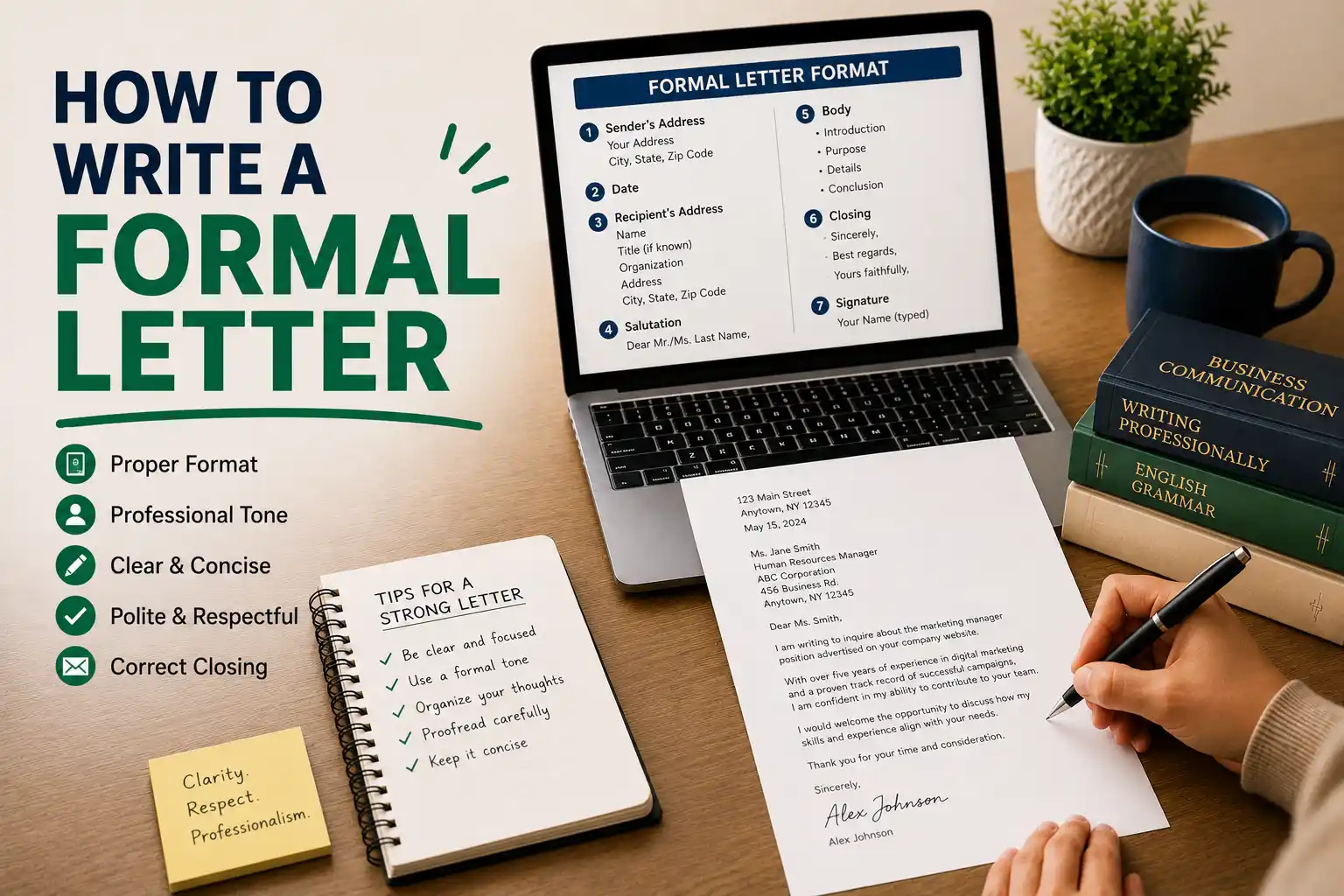
Standard Formal Letter Structure
- Sender's contact information (if not on letterhead)
- Date
- Recipient's contact information (name, title, company, address)
- Subject line (optional but recommended)
- Salutation: "Dear [Title] [Last Name]:" or "Dear Sir/Madam:"
- Opening paragraph: State your purpose
- Body paragraphs: Provide details and supporting information
- Closing paragraph: Summarise and state any follow-up action
- Closing: "Yours sincerely," "Yours faithfully," or "Sincerely,"
- Signature block: Your signature (for printed letters) and typed name
- Enclosure notation (if applicable)
4 What to Include in a Formal Letter
Every formal letter should include certain essential elements. Here is what to include, section by section.
Sender's Information
Include your full name, title, company name (if applicable), address, phone number, and email address. If using company letterhead, this information is already printed.
Date
Include the date you are writing the letter. Use the full date format (e.g., "June 29, 2026").
Recipient's Information
Include the recipient's full name, title, company name, and address. Ensure the spelling and title are correct. If you do not know the recipient's name, use "To Whom It May Concern" or "Dear Sir/Madam."
Subject Line
A subject line summarises the purpose of the letter (e.g., "Subject: Application for Marketing Manager Position"). It helps the reader understand the content at a glance.
Opening Paragraph
State your purpose clearly and directly. Why are you writing? What do you want the reader to know or do? Get straight to the point.
Body Paragraphs
Provide the details, evidence, or supporting information. Use clear, concise language. Organise your thoughts logically. Each paragraph should focus on a single idea.
Closing Paragraph
Summarise your main point and state any follow-up action you expect. Thank the reader for their time and consideration.
Signature Block
Include a professional closing ("Yours sincerely," "Yours faithfully," or "Sincerely,") followed by your signature (if printed) and your typed name and title.
5 How to Write a Formal Letter: Step-by-Step
Here is a step-by-step process for writing a formal letter.
Step 1: Identify Your Purpose
Before you write, be clear about why you are writing. What is your goal? What do you want the reader to know or do? This will guide everything you write.
Step 2: Know Your Audience
Consider who you are writing to. What is their role? What do they need to know? What is their relationship to you? Tailor your letter accordingly.
Step 3: Choose Your Format
Decide whether you are using block format or another standard format. Set up your document with the correct margins, font, and spacing.
Step 4: Write the Opening
State your purpose clearly and directly in the first paragraph. This is the most important part of your letter.
Step 5: Write the Body
Provide the details and supporting information. Be clear, concise, and logical. Use bullet points for lists if appropriate.
Step 6: Write the Closing
Summarise your main point and state any follow-up action. Thank the reader for their time.
Step 7: Revise and Proofread
Check for clarity, tone, and errors. A polished letter demonstrates professionalism.
Sample Formal Letter
[Your Name]
[Your Title]
[Company Name]
[Address]
[Date]
[Recipient Name]
[Recipient Title]
[Company Name]
[Address]
Subject: Application for Marketing Manager Position
Dear Mr. Smith,
I am writing to apply for the position of Marketing Manager at [Company Name], as advertised on your website. With over five years of experience in digital marketing and a proven track record of driving engagement, I am confident that I would be a valuable addition to your team.
In my current role at [Current Company], I have successfully led campaigns that increased online engagement by 35% and generated a 20% increase in revenue. I am particularly drawn to [Company Name]'s commitment to innovation and customer-centric approach, and I would welcome the opportunity to contribute to your continued success.
I have attached my CV for your review and would welcome the opportunity to discuss my application further at your convenience. Thank you for considering my application.
Yours sincerely,
[Your Signature]
[Your Typed Name]
[Your Title]
6 Common Mistakes to Avoid
Even experienced professionals make mistakes. Here are the most common errors and how to avoid them.
Using Incorrect Salutation
Using "To Whom It May Concern" when you know the recipient's name, or using the wrong title (e.g., "Ms." instead of "Mrs.").
Fix: Always use the recipient's name and correct title if known. If unsure, "Dear [Full Name]" is a safe option.
Being Too Informal
Using contractions, slang, or casual language in a formal letter.
Fix: Use formal language and avoid contractions (e.g., "do not" instead of "don't").
Poor Formatting
Inconsistent formatting, incorrect margins, or poor spacing.
Fix: Use a standard formal letter format and check your formatting carefully.
Being Too Vague
Failing to state your purpose clearly. The reader should know exactly why you are writing.
Fix: State your purpose in the first paragraph. Be direct.
Using Overly Complex Language
Using long, complicated words or sentences to sound more professional. This makes your letter hard to read.
Fix: Use clear, simple language. Short sentences are easier to understand.
Forgetting to Proofread
Sending a letter with spelling or grammar errors. This suggests a lack of attention to detail.
Fix: Proofread carefully. Ask someone else to review it.
7 Types of Formal Letters
There are many types of formal letters, each with a specific purpose. Here are the most common types.
Cover Letters
Sent with a CV or application. Introduces you, highlights your qualifications, and expresses interest in a position.
Key trait: Highlights relevant experience and shows interest.
Letters of Inquiry
Used to ask for information, request a meeting, or enquire about opportunities.
Key trait: Clear request for information or action.
Complaint Letters
Used to express dissatisfaction and seek resolution. Should be professional and constructive.
Key trait: Clear description of the issue and desired resolution.
Thank You Letters
Used to express appreciation for a gift, favour, or professional opportunity.
Key trait: Sincere expression of gratitude.
Recommendation Letters
Used to endorse someone's qualifications for a job or program.
Key trait: Specific examples of the candidate's abilities.
Sales Letters
Used to promote a product or service. Focuses on benefits and calls the reader to action.
Key trait: Persuasive and focused on benefits.
Letters of Request
Used to formally request something — information, permission, a meeting, or a favour.
Key trait: Clear and polite request.
Official Notification Letters
Used to formally notify someone of a decision, a change, or an important update.
Key trait: Clear and official communication.
8 Tone and Language in Formal Letters
The tone and language of your formal letter are just as important as the content. Here is how to get them right.
Be Polite and Respectful
Use courteous language. "Please," "thank you," and "I would appreciate" go a long way. Even when addressing a complaint, maintain respect.
Use Formal Language
Avoid contractions (e.g., use "do not" instead of "don't"). Use formal vocabulary. Avoid slang and colloquialisms.
Use Active Voice
Active voice is clearer and more direct than passive voice. "We will review your application" is stronger than "Your application will be reviewed."
Be Positive and Constructive
Focus on solutions and positive outcomes. Even when discussing problems, frame them constructively.
Formal vs. Informal Language
Formal: "I would like to request your assistance with this matter."
Informal: "Can you help me with this?"
Positive Language
"We look forward to working with you to resolve this issue."
9 How to Revise Your Formal Letter
A great formal letter is not written; it is rewritten. Revision is where your letter goes from good to great. Here is a step-by-step process for revising your formal letter.
Step 1: Check for Errors
Check for spelling, grammar, and punctuation errors. Read it aloud to catch awkward phrasing.
Step 2: Check the Clarity
Is your purpose clear? Is the letter easy to read and understand? If not, revise for clarity.
Step 3: Check the Tone
Is the tone professional and respectful? Is it appropriate for the recipient and the situation?
Step 4: Check the Formatting
Is the letter properly formatted? Are the margins correct? Is the font consistent?
Step 5: Check the Salutation and Closing
Is the salutation correct? Is the closing appropriate? Have you used the correct titles?
Step 6: Get Feedback
Ask a colleague or friend to review your letter. Fresh eyes can catch issues you have missed.
10 Practice Exercises to Improve Your Formal Letters
The best way to get better at writing formal letters is to practice. Here are some exercises to help you sharpen your skills.
Exercise 1: Write a Formal Complaint Letter
Write a formal complaint letter about a product or service. Focus on being clear, professional, and constructive.
Exercise 2: Write a Cover Letter
Write a formal cover letter for a job you are interested in. Highlight your relevant experience and skills.
Exercise 3: The "Formal to Informal" Rewrite
Take an informal email and rewrite it as a formal letter. Notice the differences in language, tone, and structure.
Exercise 4: Peer Review Swap
Swap formal letters with a colleague. Review each other's letters and provide honest feedback.
Final Thoughts
Writing a formal letter is an essential professional skill. A well-crafted letter communicates your message clearly, builds trust, and projects professionalism. It is a tool that can open doors and create opportunities.
Remember that a formal letter is not just about conveying information. It is also a reflection of you and your organisation. Take the time to write letters that are clear, professional, and thoughtful.
Keep these principles in mind as you write:
- Be clear and concise. State your purpose directly.
- Be professional. Use formal language and a respectful tone.
- Be accurate. Check names, dates, and details carefully.
- Be polished. Proofread carefully and format your letter correctly.
- Be action-oriented. Make it clear what you want the reader to do.
Formal communication is a skill that can be learned and improved. With practice, you will become more confident and effective. Your formal letters will reflect your professionalism and help you achieve your goals.
Now go write a formal letter that makes an impression.