How to Write Dates in English: The Complete Guide with Examples
You are writing an email to a colleague in the UK. You schedule a meeting for 06/07/2026. They show up on June 7th. You meant July 6th. The confusion could have been avoided if you had known how to write dates correctly.
Writing dates in English seems simple enough, but it can actually be quite tricky. The format varies depending on whether you are using American or British English, the context (formal or informal), and the country you are writing in. Get it wrong, and you could miss a meeting, misunderstand a deadline, or look unprofessional.
This guide will teach you everything you need to know about how to write dates in English correctly. We will cover the differences between American and British formats, the rules for punctuation and commas, how to write dates in formal and informal contexts, and the most common mistakes to avoid. By the end, you will be able to write dates with confidence and clarity.
Date Writing at a Glance
1 Why Does Writing Dates Correctly Matter?
Writing the date correctly in English is more important than you might think. In the IELTS test and many real-world situations, writing the date correctly (and in a consistent way) helps avoid confusion. Whether you are filling out a form, booking a ticket, writing a formal letter, or putting a report together, the way you write the date can affect how clear and professional your message is.
The difference in international, British, and American date formats can lead to confusion , even among native speakers of English. For example, if a British person writes to someone in the US with a date like 02/03/2026, the British person means 2 March, while the American reads it as February 3. This kind of misunderstanding can have serious consequences in business, travel, and legal contexts.
Knowing how to write dates correctly will make your writing more accurate and easier to understand. It is also important for academic tests like IELTS , mixing styles may lower your marks for accuracy in the Academic Writing test.
Avoids Confusion
Using the correct format ensures that your reader understands exactly which date you mean, preventing costly misunderstandings.
Demonstrates Professionalism
Correct date formatting shows attention to detail and makes your writing look polished and credible.
Ensures Consistency
Following a consistent date format throughout your document makes it easier to read and follow.
Meets Academic Standards
In tests like IELTS, using the correct date format is part of the marking criteria for accuracy.
2 American vs. British Date Formats
The most important distinction in writing dates is between American English and British English. The order of the day, month, and year is different in each.
American English: Month/Day/Year
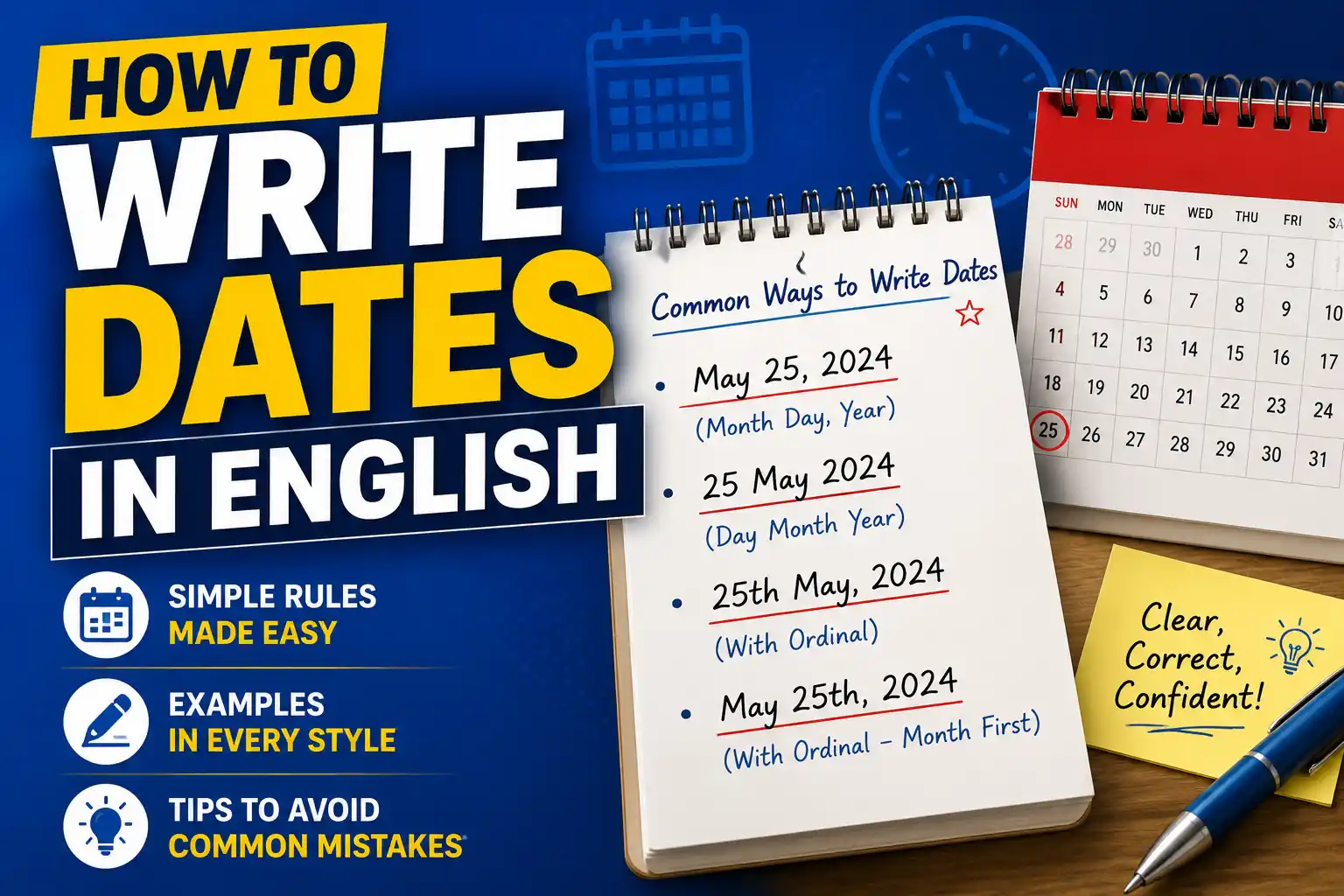
In the United States, dates are formatted as month/day/year. The month comes first, followed by the day, and then the year. For example, 03/04/2026 refers to March 4, 2026.
Common ways to write the date in American English include:
- February 1, 2023
- Feb. 1, 2023
- 2/1/23 or 2-1-23
- Wednesday, February 1, 2023
British English: Day/Month/Year
In the UK and most other English-speaking countries (Australia, New Zealand, South Africa), dates are formatted as day/month/year. The day comes first, followed by the month, and then the year. For example, 03/04/2026 refers to the 3rd of April, 2026.
Common ways to write the date in British English include:
- 1 February 2023
- 1/2/23 or 1-2-23
- Wednesday, 1 February 2023
- 1st February 2023
- 1st of February, 2023
The International Standard: Year/Month/Day
There is another format used for more technical purposes and by some countries in Asia (e.g., Japan, China, South Korea, Iran): the year/month/day format. This is the ISO 8601 international standard and is often used in computing and data sorting. Example: 2024/07/02 or 2024-07-02.
Date Format Comparison
Top Tip: Know Your Audience
When choosing which format to follow, the most important thing to keep in mind is your audience. If you are writing to someone in the US, use the American format. If you are writing to someone in the UK or Australia, use the British format. If you are unsure or writing to an international audience, consider spelling out the month to avoid confusion (e.g., "3 April 2026" or "April 3, 2026").
3 How to Write Dates with Commas
Comma placement depends on which date format you are using. Here are the rules.
American Format: Month/Day/Year
In the month-day-year format (used in the United States), place commas after the day and after the year if the date is in the middle of a sentence.
- At the end of a sentence: "Jaws was released in the United States on June 20, 1975."
- In the middle of a sentence: "Jaws was released in the United States on June 20, 1975, and overseas in December 1975."
- With the day of the week: "On Wednesday, February 1, 2023, the meeting was held."
- When the date is at the end of the sentence, you only need a period after the year (not a comma).
British Format: Day/Month/Year
In the day-month-year format (used in the UK and other countries), do not use commas at all.
- "The meeting was held on 1 February 2023."
- "The meeting was held on Wednesday, 1 February 2023." (Note: The comma after the day of the week is optional in British English, and often omitted.)
Month and Year Only
If you are writing only a month and a year, do not use a comma.
- "Jaws was released in the United States in June 1975."
- Incorrect: "Jaws was released in the United States in June, 1975."
Quick Comma Checklist
- American (Month/Day/Year): Comma after the day and after the year (if in middle of sentence).
- British (Day/Month/Year): No commas.
- Month and Year only: No comma.
- Day of the week: Comma after the day of the week in American English (e.g., Wednesday, February 1, 2023). In British English, the comma is often omitted (e.g., Wednesday 1 February 2023).
4 How to Write Dates with Ordinal Numbers
When you are writing the date or telling someone what the date is, you will need to use ordinal numbers (first, second, third, etc.) to do so. However, there are different rules for when to use ordinal numbers in writing.
In Formal Writing
In formal writing, do not use ordinal numbers (1st, 2nd, 3rd) with dates. Use cardinal numbers instead.
- Correct: "Reservations are due July 27."
- Incorrect: "Reservations are due July 27th."
- Correct: "They were married on Feb. 19."
- Incorrect: "They were married on Feb. 19th."
In Informal Writing and Speech
In informal writing and when speaking, ordinal numbers are commonly used.
- "Today is the 1st of January, 2020."
- "The date is January 1st, 2020."
- "It is Monday, January 1st, 2020."
Using "The" + Ordinal + "of"
A common formal way to write the date is: "The" + Ordinal Number + "of" + Month, Year.
- "The 21st of September, 1990"
- "The 1st of January, 2020"
Formal Writing
- July 2 (not July 2nd)
- 1 February 2023
- February 1, 2023
Informal Writing
- July 2nd
- 1st February 2023
- the 1st of January
5 How to Write Numerical Dates
Numerical dates are common in informal writing, forms, and when space is limited. However, they are the most likely to cause confusion due to the different formats used in American and British English.
American Numerical Dates
In American English, numerical dates follow the month/day/year order.
- 02/07/2024 = February 7, 2024
- 07/02/2024 = July 2, 2024
- 3/15/2025
- 3-15-25
British Numerical Dates
In British English, numerical dates follow the day/month/year order.
- 02/07/2024 = 2 July 2024
- 07/02/2024 = 7 February 2024
- 25/03/2019
- 25-03-2019
- 25.03.2019
ISO International Standard
The international standard (ISO 8601) is year-month-day and is often used in computing and data sorting.
- 2024-07-02
- 2024/07/02
Top Tip: Avoid Numerical Dates in Formal Writing
In formal writing, such as business letters or legal documents, always spell out the month's full name. This eliminates any ambiguity. For example, write "April 5, 2025" or "5 April 2025" rather than 04/05/2025.
6 How to Write Dates with Days of the Week
Including the day of the week makes your date more specific and clear. Instead of just writing "July 2, 2024," add the day: "Tuesday, July 2, 2024." It helps to avoid errors or confusion in planning.
American Format with Day of the Week
In American English, when including the day of the week, place a comma after the day of the week.
- "Tuesday, July 2, 2024"
- "Meeting on Wednesday, June 12, 2023."
- "Report due by Friday, August 9, 2023."
British Format with Day of the Week
In British English, the comma after the day of the week is often omitted.
- "Tuesday 2 July 2024"
- "Meeting on Wednesday 12 June 2023."
Abbreviated Days of the Week
In tables or lists, it is common to shorten the day names to three letters followed by a comma. Examples include:
- Mon, July 1, 2024
- Tue, July 2, 2024
- Wed, July 3, 2024
Capitalization Rules
The days of the week and months must always start with a capital letter if included. For example: "Tuesday" not "tuesday", "January" not "january".
7 How to Abbreviate Months
Abbreviating months is acceptable in some instances, such as tables, charts, or informal writing where space matters. In such cases, write only the first three letters followed by a period (except for May).
Month Abbreviations
- Jan. - January
- Feb. - February
- Mar. - March
- Apr. - April
- May - May (no period, as it is only 3 letters)
- Jun. - June
- Jul. - July
- Aug. - August
- Sep. or Sept. - September
- Oct. - October
- Nov. - November
- Dec. - December
When to Use Abbreviations
- Tables and charts: Abbreviations save space and improve readability.
- Informal writing: "Feb. 8th, 1983"
- Formal writing: Always spell out the month in full (e.g., "February").
Month Abbreviation Examples in Dates
- American: "Feb. 1, 2023"
- British: "1 Feb. 2023"
- With day of week: "Wed, July 1, 2024"
8 Prepositions: "In" vs. "On" with Dates
Choosing the right preposition when writing dates is important for grammatical correctness.
Use "In" for General Dates
In is used when writing about general dates like months and years.
- Correct: "Jaws was released overseas in December 1975."
- Incorrect: "Jaws was released overseas on December 1975."
- "I was born in 1990."
- "We will launch the product in September."
Use "On" for Specific Dates
On is used when writing about specific days, dates, and holidays.
- Correct: "Jaws was released in the United States on June 20, 1975."
- Correct: "Jaws was released in the United States on Friday."
- "The meeting is on Tuesday."
- "We will meet on July 4th."
"In" Examples
- in December
- in 2026
- in the 1990s
- in summer
"On" Examples
- on June 20
- on Tuesday
- on July 4th
- on Christmas Day
9 Common Mistakes to Avoid
Even native speakers make mistakes when writing dates. Here are the most common errors and how to avoid them.
Confusing Month and Day
Writing 06/07/2026 when you mean July 6 (US) or 6 July (UK).
Fix: Spell out the month in formal writing to avoid ambiguity. Write "6 July 2026" or "July 6, 2026".
Using "th," "nd," or "rd" in Formal Writing
Writing "July 27th" in a formal document.
Fix: Use cardinal numbers in formal writing: "July 27".
Incorrect Comma Placement
Using a comma in the day-month-year format (British) or forgetting the comma in the month-day-year format (American).
Fix: Remember: American = comma after day and year; British = no commas.
Mixing Formats in the Same Document
Using "July 4, 2026" in one place and "4 July 2026" in another.
Fix: Be consistent. Choose one format and stick to it throughout your document.
Using an Apostrophe with Decades
Writing "1990's" instead of "1990s".
Fix: Write "1990s" for the decade. Use an apostrophe only when shortening: "the '90s".
Forgetting to Capitalize Months and Days
Writing "january" or "monday" instead of "January" or "Monday".
Fix: Months and days of the week are proper nouns and must be capitalised.
10 Practice Exercises to Improve Your Date Writing
The best way to get better at writing dates in English is to practice. Here are some exercises to help you sharpen your skills.
Exercise 1: Convert Between Formats
Take a date written in American format (e.g., "March 15, 2026") and rewrite it in British format. Then write it numerically in both American and British styles.
Exercise 2: Add Commas Correctly
Write the sentence "The conference will be held on June 5 2026 in London." Add the correct commas. Then rewrite it in British format without commas.
Exercise 3: Choose the Right Preposition
Fill in the blanks with "in" or "on": "The meeting is ___ Monday." "The event will take place ___ July." "She was born ___ 1995."
Exercise 4: Identify the Errors
Find and correct the mistakes in these sentences: "The deadline is January 31st, 2026." "The party is on Saturday, 15 June." "We met in June 15, 2025."
Final Thoughts
Writing dates in English is a skill that every English speaker needs to master. Whether you are writing a formal letter, sending an email, or filling out a form, using the correct date format is essential for clear communication.
Remember that the key to writing dates correctly is to know your audience and be consistent. Choose the format that is appropriate for your reader , American English for US audiences, British English for UK and Commonwealth audiences, and the international standard for global technical communication.
Keep these principles in mind as you write:
- Know your audience. Use American (month/day/year) or British (day/month/year) format accordingly.
- Be consistent. Use the same format throughout your document.
- Use commas correctly. American = comma after day and year; British = no commas.
- Avoid ordinal numbers in formal writing. Write "July 2" not "July 2nd".
- Spell out months in formal writing. Avoid numerical dates that can cause confusion.
- Capitalize months and days. They are proper nouns.
Writing dates correctly is a small detail that makes a big difference. It shows that you are careful, professional, and respectful of your reader. Take the time to get it right, and your writing will be clearer and more effective.
Now go write some dates with confidence.