How to Write an Annotated Bibliography: Complete Guide with Examples
You've been assigned an annotated bibliography. Maybe you're not entirely sure what that means. Or maybe you know what it is, but you're not sure how to write one that will impress your professor.
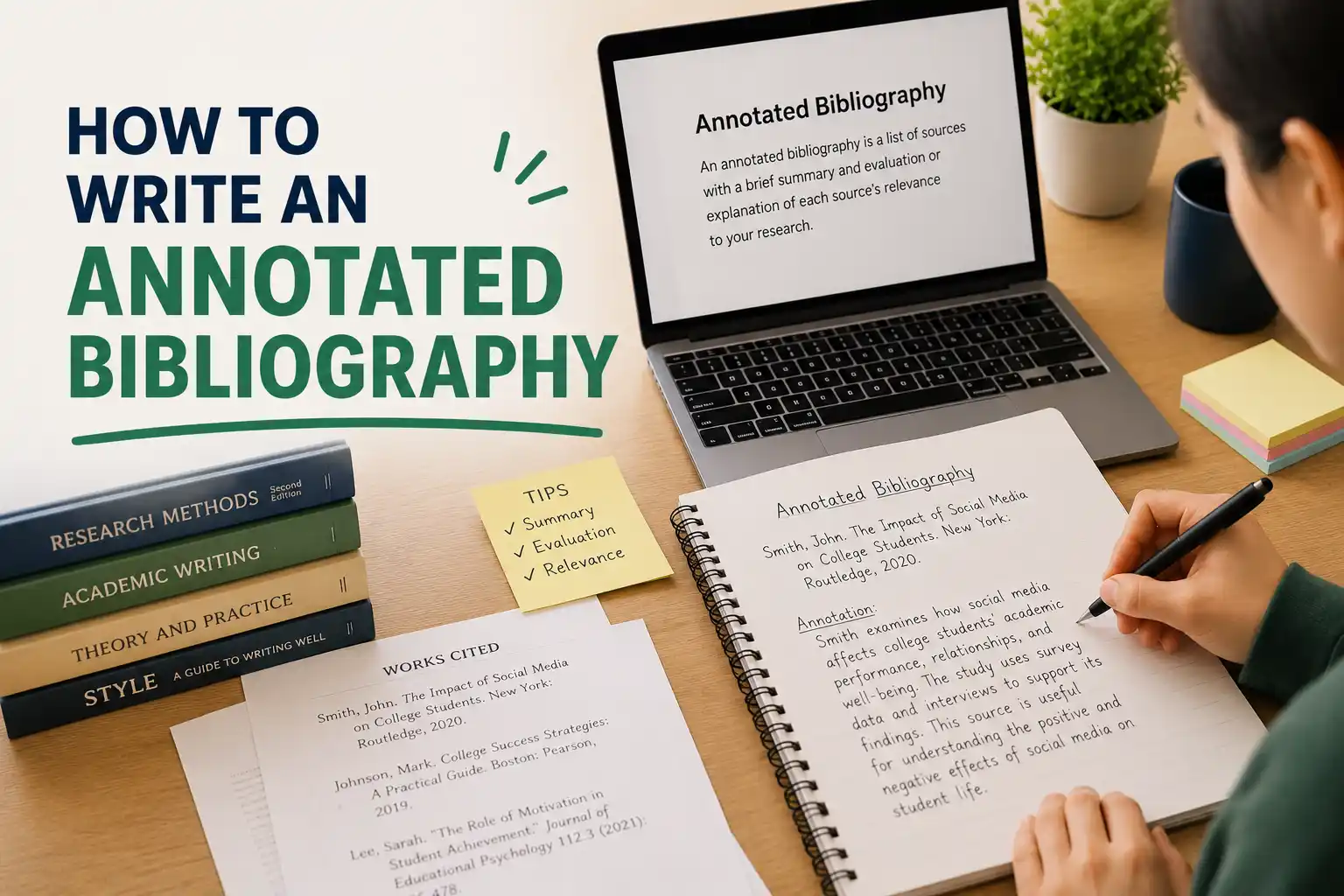
Here's the good news: an annotated bibliography isn't as complicated as it sounds. It's simply a list of citations followed by a brief summary and evaluation of each source. Think of it as a research roadmap that shows your professor what you've found and why it matters.
This guide walks you through everything you need to know: formatting rules for APA, MLA, and Chicago styles, how to write strong annotations, real examples, and common mistakes to avoid.
Annotated Bibliography at a Glance
Pro tip: Start with sources that seem most relevant to your thesis. You can always add more later.
1 What Is an Annotated Bibliography?
An annotated bibliography is more than just a list of sources. Each citation is followed by a concise paragraph the annotation that describes and evaluates the source.
The Citation
Follows standard formatting rules (APA, MLA, Chicago). Includes author, title, publication date, publisher, etc. Alphabetized by author's last name.
The Annotation
A 100-300 word paragraph that includes:
• Summary of main arguments
• Evaluation of credibility and bias
• Reflection on relevance to your research
Why Do Professors Assign Annotated Bibliographies?
2 Types of Annotations
Depending on your assignment, you may need different types of annotations. Here are the three most common:
Descriptive (Informative)
Summarizes the source's main arguments, topics, and conclusions. Does NOT evaluate or critique.
Example: "This article examines the impact of social media on teenage mental health, analyzing survey data from 1,000 participants."
Evaluative (Critical)
Summarizes AND evaluates the source's strengths, weaknesses, bias, and credibility.
Example: "While the study's sample size is impressive, the author's affiliation with a tech company introduces potential bias."
Reflective (Combined)
Summarizes, evaluates, AND explains how the source will be used in your research.
Example: "This source provides key historical context for my argument about educational reform in the 1960s."
3 Formatting by Style: APA, MLA, Chicago
Each citation style has specific formatting rules. Here's what you need to know for each:
APA Style (7th Edition)
Used in: Education, Psychology, Sciences, Social Sciences
Author, A. A. (Year). Title of work: Capital letter also for subtitle. Publisher.
Smith, J. A. (2020). Digital literacy in the 21st century classroom. Routledge.
Annotation format: Indent the entire annotation 0.5 inches. No extra line between citation and annotation.
MLA Style (9th Edition)
Used in: Humanities, Literature, Arts, Cultural Studies
Author Last Name, First Name. Title of Book. Publisher, Year.
Smith, Jane A. Digital Literacy in the 21st Century Classroom. Routledge, 2020.
Annotation format: Indent the entire annotation 1 inch. No extra line between citation and annotation.
Chicago Style (17th Edition)
Used in: History, Fine Arts, Business, some Humanities
Author Last Name, First Name. Title of Book. Place of publication: Publisher, Year.
Smith, Jane A. Digital Literacy in the 21st Century Classroom. New York: Routledge, 2020.
Annotation format: Single-spaced with a blank line between entries. No indentation on the first line of the annotation.
4 How to Write a Strong Annotation
A strong annotation answers three key questions. Use this framework:
The 3-part annotation structure:
Summarize
What is this source about? What are the main arguments? What topics does it cover? What conclusions does it reach?
Evaluate
Is this source credible? What are its strengths and weaknesses? Does the author have bias? How does it compare to other sources?
Reflect
How will you use this source? Is it useful for your argument? Does it support or contradict other sources? What unique perspective does it offer?
Need to Track Your Word Count?
Most annotations are 100-300 words. Use our free word counter to make sure you're hitting the right length for each entry.
Track Your Word Count5 Real Examples by Style
APA Example
Lee, S. H., & Kim, J. Y. (2021). The impact of remote work on employee productivity and well-being. Journal of Organizational Psychology, 45(3), 212-235.
Lee and Kim surveyed 1,500 remote workers to examine productivity changes during the transition to remote work. Their findings indicate that productivity increased by 15% in the first six months but then plateaued. The authors identify isolation and blurred work-life boundaries as significant well-being concerns. The study's large, diverse sample strengthens its generalizability, though the longitudinal data only covers 12 months. This source will support my argument about the long-term sustainability of remote work policies and provide evidence for both productivity benefits and well-being challenges.
MLA Example
Garcia, Maria. "Representation Matters: Diversity in Young Adult Literature." Children's Literature Association Quarterly, vol. 47, no. 2, 2022, pp. 156-178.
Garcia analyzes fifty YA novels published between 2015 and 2021, tracking the frequency and quality of representation across race, gender, and sexuality. She argues that while numerical representation has increased, stereotypical portrayals persist. Garcia, a professor of children's literature, brings scholarly authority to her analysis. However, her focus on award-winning books may not represent the broader YA market. This article provides valuable historical context for my research on contemporary YA publishing and will help me argue that representation statistics alone don't ensure authentic storytelling.
Chicago Example
Williams, David K. The Myth of the Lost Cause: Civil War Memory in the American South. Chapel Hill: University of North Carolina Press, 2019.
Williams traces how the "Lost Cause" narrative was constructed in the decades after the Civil War, examining speeches, monuments, and textbooks. He argues that this myth was deliberately created to justify white supremacy and resist Reconstruction reforms. Williams's archival research is thorough, drawing on previously unexamined documents. While his political analysis is persuasive, his focus on elite actors downplays grassroots movements. This book will serve as foundational context for my thesis about how historical memory shapes contemporary racial politics in the South.
6 Step-by-Step Writing Process
Find Your Sources
Use your library database, Google Scholar, or subject-specific databases. Aim for a mix of books, peer-reviewed articles, and credible websites.
Read and Take Notes
As you read, note the thesis, methodology, evidence, and conclusions. Highlight quotes and passages you might use.
Create the Citation
Format the citation according to your required style. Use citation generators, but always double-check for accuracy.
Write the Annotation
Follow the SER framework: Summarize, Evaluate, Reflect. Keep it concise (100-300 words).
Alphabetize Entries
Arrange all entries alphabetically by the author's last name. Ignore "A," "An," or "The" at the beginning of titles.
Proofread
Check citation formatting, spelling, grammar, and consistency. Have someone else review your work if possible.
7 Common Mistakes to Avoid
DO This
✅ Write in complete sentences (no bullet points)
✅ Use your own words (avoid quoting directly from the source)
✅ Be specific about how you'll use the source
✅ Evaluate credibility (author credentials, publisher, date)
✅ Compare sources to each other
✅ Proofread citation formatting carefully
DON'T Do This
❌ Just summarize the abstract (read the whole source)
❌ Copy the author's own language without quotation marks
❌ Write annotations that are too short or too long
❌ Forget to evaluate—summaries alone aren't enough
❌ Mix citation styles within one bibliography
❌ Submit without proofreading citations
8 Final Checklist Before Submission
The Bottom Line
An annotated bibliography is more than just a requirement to check off. It's a valuable research tool that helps you engage deeply with your sources before you start writing your paper.
Remember the 3-part formula: Summarize what the source says, evaluate its credibility and usefulness, and reflect on how it fits into your research.
Take it one source at a time. Read carefully. Write clearly. And don't forget to proofread your citations—that's where most points are lost.
With this guide, you're ready to create an annotated bibliography that demonstrates critical thinking and research depth. Good luck with your assignment!