How to Write a DBQ: Complete Guide to Document-Based Questions
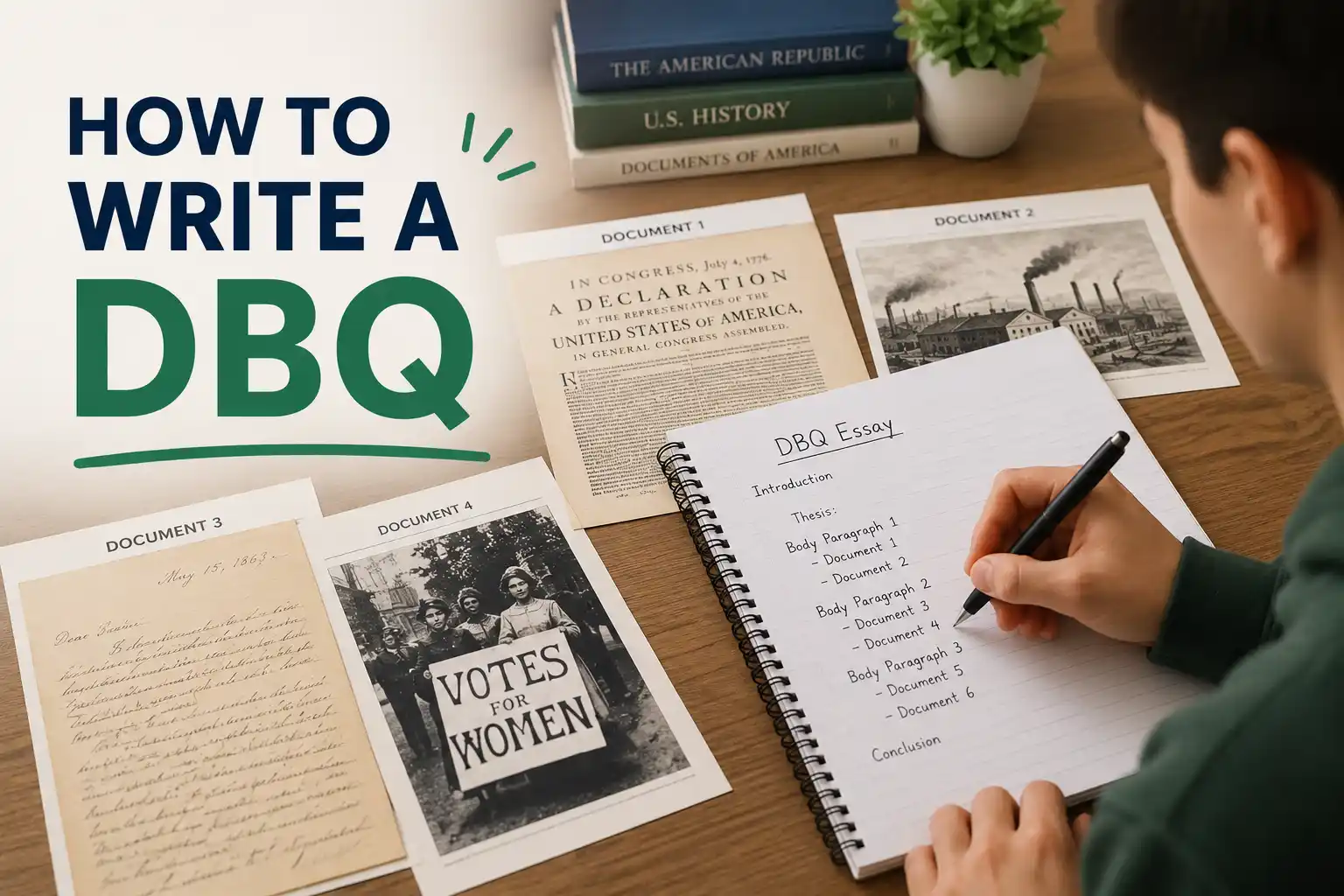
The Document-Based Question (DBQ) can feel overwhelming. You're staring at 7-10 historical documents, the clock is ticking, and you need to write a coherent, evidence-based essay in 60 minutes.
But here's the truth: the DBQ isn't about memorizing every fact. It's about a skill you can learn: analyzing documents, building arguments, and writing under pressure. Thousands of students have mastered it. You can too.
This guide breaks down exactly how to write a DBQ that earns top scores. We'll cover the 7-step process, document analysis strategies, thesis writing, and common mistakes to avoid.
DBQ at a Glance: Key Facts
Pro tip: Use the first 15 minutes wisely, it's the difference between a scattered response and a focused essay.
1 What Is a DBQ? Understanding the Basics
A Document-Based Question (DBQ) is an essay question that requires you to analyze and synthesize historical documents to support an argument. It tests your ability to:
- Analyze primary and secondary sources — Understand author bias, purpose, and context
- Develop a thesis — Create an argument that responds to the prompt
- Use evidence effectively — Cite and explain documents to support your claims
- Situate documents in historical context — Connect sources to broader events
- Show complexity — Acknowledge nuance, contradiction, and different perspectives
Which Exams Include DBQs?
• AP U.S. History
• AP World History
• AP European History
• Some IB History exams
• Many college-level history courses
What AP Scorers Look For
• A clear, defensible thesis
• Evidence from most or all documents
• Analysis of point of view, purpose, audience
• Contextualization (broader historical situation)
• Complexity (nuance, contradiction)
2 The 7-Step DBQ Writing Process
Step 1: Read the Prompt (2 min)
Read the prompt carefully. Underline key terms. Identify the task: compare, analyze causes, evaluate change over time?
Step 2: Scan All Documents (5 min)
Quickly read each document. Note the source, date, author, and main idea. Start grouping documents that support similar arguments.
Step 3: Group Documents (3 min)
Create 2-3 categories or buckets. Which documents support similar claims? This becomes your body paragraph structure.
Step 4: Write Your Thesis (3 min)
Your thesis must directly answer the prompt and state your argument. Include the categories you'll discuss.
Step 5: Outline Your Essay (2 min)
Sketch a quick outline: thesis, three body paragraphs with document groupings, conclusion. Note which documents go where.
Step 6: Write the Essay (40 min)
Follow your outline. Introduce the context, state your thesis, write body paragraphs using documents, and include one paragraph showing complexity.
Step 7: Proofread (5 min)
Read through your essay. Check for clarity, spelling, grammar, and ensure you've cited enough documents.
3 How to Analyze Documents Like a Pro
The key to a high-scoring DBQ is analyzing documents, not just describing them. Use the SOAPSTone method:
For each document, ask: What's the topic? When was it created? Who's the intended audience? Why was it written? Who's the author? What's the tone?
Point of View (POV) Analysis
✓ Why does the author hold this opinion?
✓ How does their social class, religion, or nationality shape their view?
✓ What's their occupation or position?
✓ How might their audience affect what they say?
Purpose Analysis
✓ Why was this document created?
✓ Is it a letter, speech, diary, political cartoon, chart?
✓ Is it public or private?
✓ What is the author trying to achieve?
Example: Document Analysis
Need to Track Your Essay Length?
Keep your DBQ within the ideal 5-7 paragraph structure. Use our word counter to monitor your progress as you write.
Track Your Word Count4 The Secret to a Strong DBQ Thesis
Your thesis is the most important sentence in your essay. A weak thesis = a weak score. Here's how to write a strong one:
Weak Thesis (Avoid This)
Strong Thesis (What to Aim For)
This format immediately shows complexity and organization, earning you points for both thesis and structure.
5 Body Paragraphs: The P.E.E.L. Method
Each body paragraph needs a clear structure. Use the P.E.E.L. method:
P - Point (Topic Sentence)
E - Evidence (Cite Documents)
E - Explain (Analysis)
L - Link (Connect to Thesis)
Adding Outside Evidence (Outside Knowledge)
To earn full points, you need at least one piece of outside evidence—information not in the documents. This shows deeper historical knowledge.
Examples of outside evidence: Specific events, people, laws, or trends from your textbook knowledge. "Beyond the documents, the Factory Act of 1833 attempted to regulate child labor, showing government response to these documented conditions."
6 How to Earn the Complexity Point
The complexity point is the hardest to earn but possible with the right strategies. Here's how:
Show Complexity By:
• Acknowledging nuance and contradiction between documents
• Connecting to a different historical period or theme
• Analyzing multiple perspectives on the same event
• Discussing causation and effects (not just description)
• Using a counter-argument in your thesis
Contextualization (Earn 1 Point)
Situate the prompt's topic in the broader historical context. What was happening before? What larger trends or events shaped this period?
Example: "Before the Industrial Revolution, most production occurred in homes through the putting-out system. The shift to factory production fundamentally changed not just work but society itself."
Complexity Example
7 Common DBQ Mistakes to Avoid
DO This
✅ Write a clear, argumentative thesis
✅ Use 6+ of the 7 documents
✅ Analyze point of view (POV)
✅ Add outside historical evidence
✅ Contextualize the period
✅ Show complexity and nuance
✅ Cite documents by number (Doc 2)
DON'T Do This
❌ Summarize documents without analysis
❌ Write a descriptive, non-argumentative thesis
❌ Ignore document sourcing (who, when, why)
❌ Forget outside evidence
❌ Run out of time for a conclusion
❌ Use first-person ("I think," "in my opinion")
❌ Quote extensively from documents
8 DBQ Scoring Checklist
Use this checklist before submitting your DBQ to ensure you've hit all the scoring requirements:
AP DBQ Scoring Breakdown (7 points possible)
The Bottom Line
The DBQ isn't about knowing everything—it's about using what you're given. The documents provide the evidence. Your job is to build an argument around them.
Remember the 3 pillars: a clear thesis, strong document analysis, and historical context. Master these, and you'll write DBQs with confidence.
Practice with sample prompts. Time yourself. Review the scoring rubrics. With preparation, the DBQ becomes your opportunity to demonstrate historical thinking—not a hurdle to fear.
You've got this. Now go write that essay.