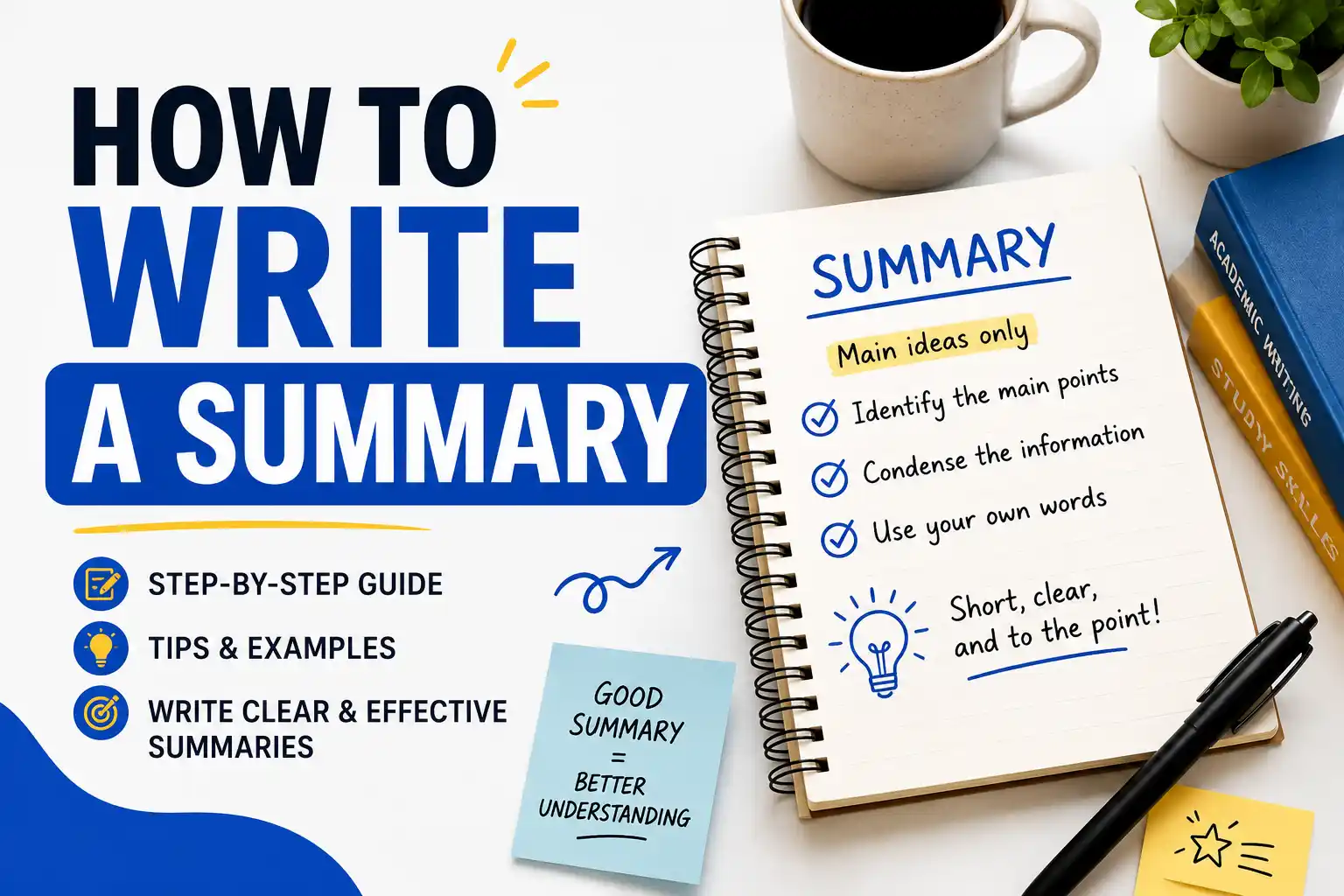
How to Write a Summary: The Complete Guide with Examples
You have read a long article, a research paper, or a book chapter. You need to condense it into a brief, clear summary. But you are not sure what to include or how to structure it. You worry about missing key points or making your summary too long.
You are not alone. Writing a summary is a fundamental skill that many people find challenging. But it is also one of the most useful skills you can develop , whether you are a student, a professional, or a researcher. A well-written summary captures the essence of a text, saves time for your readers, and demonstrates your understanding.
This guide will teach you everything you need to know about how to write a summary that is clear, concise, and accurate. We will cover the purpose of summaries, the step-by-step process, the essential elements, and the common mistakes to avoid. By the end, you will have the tools to write summaries that effectively communicate the key ideas of any text.
Summary Writing at a Glance
1 What Is a Summary and Why Does It Matter?
A summary is a concise restatement of the main ideas and key points of a longer text. It condenses the original content while preserving its essential meaning, structure, and tone. A good summary is shorter than the original but still conveys the core message.
Summaries matter because they save time and clarify understanding. In academic and professional contexts, summaries allow readers to quickly grasp the key points of a complex document without reading the entire text. They also demonstrate that you have understood the material and can communicate it effectively to others.
Writing a summary is also a powerful learning tool. The process of summarising forces you to engage deeply with the text, identify the most important ideas, and articulate them in your own words. This deepens your understanding and retention of the material.
Saves Time
A summary allows readers to understand the key points of a text without reading the entire thing , ideal for busy professionals and students.
Demonstrates Understanding
Writing a summary shows that you have understood the material and can articulate it clearly and concisely.
Enhances Learning
The process of summarising forces you to engage deeply with the text, improving comprehension and retention.
Supports Research
Summaries are essential for literature reviews, research papers, and any work that synthesises multiple sources.
2 The Fundamentals of Summary Writing
Before you start writing, it is essential to understand the core principles that guide effective summary writing.
Be Objective
A summary should be objective and neutral. It should accurately reflect the author's ideas without adding your own opinions, interpretations, or evaluations. Save your analysis for a separate section.
Be Accurate
Your summary must accurately represent the original text. Do not distort the author's meaning or leave out essential information. Every claim in your summary should be supported by the original text.
Be Concise
A summary should be significantly shorter than the original text. Aim to condense the material to 10–25% of its original length. Every word should count. Cut unnecessary details, examples, and repetition.
Use Your Own Words
In a summary, you should paraphrase the author's ideas in your own words. Avoid copying long phrases or sentences directly from the original unless you are using a brief quotation. Summarising in your own words demonstrates your understanding.
Summary vs. Paraphrase vs. Quotation
- Summary: Condenses the main ideas of a text in your own words. Much shorter than the original.
- Paraphrase: Restates a specific passage in your own words. Similar length to the original.
- Quotation: Uses the exact words from the original text, enclosed in quotation marks.
3 Types of Summaries
There are several types of summaries, each with a specific purpose and audience. Understanding the type of summary you need to write will help you tailor your approach.
Executive Summary
Used in business and professional contexts. Summarises a report, proposal, or business document for busy decision-makers. Emphasises key findings, recommendations, and conclusions.
Key trait: Action-oriented, concise, and focused on business implications.
Academic Summary
Used in academic writing to summarise research articles, book chapters, or other scholarly texts. Focuses on the research question, methodology, findings, and conclusions.
Key trait: Objective, precise, and follows academic conventions.
Abstract
A type of summary used in academic research papers. It provides a brief overview of the entire paper, including the research question, methods, results, and conclusions.
Key trait: Self-contained, structured, and written in the past tense.
Literature Review Summary
Used to synthesise multiple sources in a literature review. Each source is summarised concisely, and the summaries are organised thematically or chronologically.
Key trait: Synthesises multiple sources, shows relationships between them.
News Summary
Used in journalism to summarise news articles or reports. Focuses on the who, what, when, where, why, and how of the story.
Key trait: Inverted pyramid structure, factual and concise.
Student Summary
Written by students to demonstrate understanding of a text. Often includes the main idea, key supporting points, and the author's conclusion.
Key trait: Demonstrates comprehension, follows assignment guidelines.
4 How to Write a Summary: Step-by-Step
Here is a step-by-step process for writing a clear, concise, and accurate summary.
Step 1: Read the Text Carefully
Read the original text multiple times to ensure you fully understand it. The first time, read for an overall understanding. The second time, read more carefully, taking notes and identifying the main ideas, key supporting points, and the author's conclusion.
Step 2: Identify the Main Idea
What is the central argument or thesis of the text? This is the most important idea that everything else supports. Look for the thesis statement in the introduction or conclusion.
Step 3: Identify Key Supporting Points
What are the most important supporting points that develop the main idea? These are the major arguments, evidence, or examples that the author uses to support their thesis. Ignore minor details and examples.
Step 4: Write a Draft in Your Own Words
Using your notes, write a draft of the summary in your own words. Start with the main idea, then present the key supporting points in a logical order. Be concise , every sentence should add value.
Step 5: Compare to the Original
Compare your summary to the original text. Does it accurately represent the author's ideas? Did you miss any essential information? Did you add any personal opinions? Revise as needed.
Step 6: Revise for Clarity and Conciseness
Read your summary aloud. Is it clear and easy to understand? Is it concise? Cut unnecessary words and phrases. Ensure that your summary flows smoothly from one idea to the next.
Summary Writing Checklist
- Read the text multiple times
- Identify the main idea and key supporting points
- Write in your own words
- Be objective , no personal opinions
- Be concise , aim for 10–25% of the original length
- Compare to the original for accuracy
- Revise for clarity and conciseness
5 What to Include in a Summary
Every summary should include certain essential elements. Here is what to include.
The Main Idea or Thesis
Your summary should begin with the main idea or thesis of the original text. This is the central argument that the author is making. It should be stated clearly and accurately.
Key Supporting Points
Include the most important supporting points that the author uses to develop their argument. These are the major ideas that provide evidence or elaboration for the thesis. Do not include minor details or examples.
The Author's Conclusion
Include the author's conclusion or final position. What does the author ultimately conclude about the topic? This should be reflected in your summary.
Logical Order
Your summary should follow the logical order of the original text. Present the ideas in the same sequence as the author, or group them thematically if that makes more sense.
Conciseness
Every word in your summary should earn its place. Cut unnecessary details, examples, and repetition. Aim for 10–25% of the original length.
What to Include vs. What to Avoid
6 Common Mistakes to Avoid
Even experienced writers make mistakes. Here are the most common errors and how to avoid them.
Adding Personal Opinions
Including your own thoughts, evaluations, or interpretations in the summary. A summary should be objective.
Fix: Stick to the author's ideas. Save your analysis for a separate section.
Being Too Long
Writing a summary that is almost as long as the original text. This defeats the purpose of a summary.
Fix: Aim for 10–25% of the original length. Cut unnecessary details and repetition.
Copying Language from the Original
Using the author's words without quotation marks or paraphrasing. This can be plagiarism.
Fix: Paraphrase the author's ideas in your own words. Use brief quotations only when necessary.
Including Too Many Details
Including minor details, examples, or tangential information that does not support the main idea.
Fix: Focus on the main idea and key supporting points. Ignore minor details.
Misrepresenting the Author's Ideas
Accidentally or intentionally distorting the author's meaning or argument.
Fix: Compare your summary to the original to ensure accuracy. Be faithful to the author's intent.
Not Revising
Submitting your first draft without revision. First drafts are rarely polished.
Fix: Revise for clarity, conciseness, and accuracy. Read your summary aloud.
7 Summary Examples
Here are some sample summaries to illustrate how to apply the principles of summary writing.
Example 1: Summary of a Research Article
Original Text (Excerpt): "This study investigated the effects of mindfulness meditation on stress reduction in college students. A sample of 100 students participated in an 8-week mindfulness program. Stress levels were measured using the Perceived Stress Scale before and after the intervention. Results showed a statistically significant reduction in stress scores, suggesting that mindfulness meditation is an effective intervention for reducing stress in college students."
Summary: "A study of 100 college students found that an 8-week mindfulness meditation program significantly reduced stress levels, as measured by the Perceived Stress Scale. The results indicate that mindfulness meditation is an effective stress-reduction intervention for college students."
Example 2: Summary of a Business Report
Original Text (Excerpt): "Our analysis of the current market trends indicates a 15% growth in the organic food sector over the past year. Consumer demand for sustainable and healthy products continues to rise, driven by increased awareness of environmental and health issues. Our company's organic product line has experienced a 20% increase in sales, outperforming our conventional product line. We recommend expanding our organic product offerings to capitalise on this growing market."
Summary: "The report finds that the organic food sector has grown 15% in the past year, driven by rising consumer demand for sustainable and healthy products. The company's organic product line has outperformed conventional products, with a 20% sales increase. The report recommends expanding organic product offerings to capture further market growth."
Example 3: Summary of a Book Chapter
Original Text (Excerpt): "In Chapter 3, the author explores the concept of emotional intelligence and its role in leadership. The author argues that emotional intelligence , the ability to recognise, understand, and manage one's own emotions and those of others , is a more reliable predictor of leadership success than IQ. The author presents evidence from multiple studies showing that leaders with high emotional intelligence are more effective at motivating teams, resolving conflicts, and building trust."
Summary: "Chapter 3 examines the role of emotional intelligence in leadership. The author argues that emotional intelligence is a more reliable predictor of leadership success than IQ, supported by studies showing that emotionally intelligent leaders are more effective at motivating teams, resolving conflicts, and building trust."
8 How to Revise Your Summary
A great summary is not written; it is rewritten. Revision is where your summary goes from good to great. Here is a step-by-step process for revising your summary.
Step 1: Check for Accuracy
Compare your summary to the original text. Does it accurately represent the author's ideas? Is anything missing? Is anything misrepresented?
Step 2: Check for Objectivity
Have you added any personal opinions or evaluations? If so, remove them. A summary should be objective and neutral.
Step 3: Check for Conciseness
Is your summary as concise as possible? Cut unnecessary words, phrases, and details. Aim for 10–25% of the original length.
Step 4: Check for Clarity
Is your summary clear and easy to understand? Read it aloud. Does it flow smoothly? Revise any awkward or unclear sentences.
Step 5: Check Your Language
Have you paraphrased the author's ideas in your own words? Avoid copying long phrases or sentences directly from the original.
Step 6: Get Feedback
Ask someone else to read your summary. Can they understand the main ideas without reading the original? Use their feedback to refine your summary.
9 Summary Writing Tips and Techniques
Here are some advanced tips and techniques to help you write even better summaries.
Use the "Who, What, When, Where, Why, How" Framework
For news or narrative summaries, ask yourself: Who is involved? What happened? When and where did it happen? Why did it happen? How did it happen? Answering these questions helps you capture the essential information.
Use Signal Phrases
Use signal phrases to introduce the author's ideas. Examples include: "The author argues that...", "According to Smith...", "The study found that...". This makes it clear that you are summarising someone else's ideas.
Focus on the Structure
Pay attention to the structure of the original text. How does the author organise their argument? Use the same structure in your summary to help readers follow the logic.
Write in the Present Tense
In academic summaries, it is common to write in the present tense (e.g., "The author argues...", "The study shows..."). This gives the summary a sense of immediacy and relevance.
Signal Phrases for Summaries
- Introducing ideas: "The author argues that...", "According to Smith...", "The study found that..."
- Showing agreement: "Smith confirms that...", "The research supports..."
- Showing contrast: "However, Jones contends that...", "In contrast, the study suggests..."
- Concluding: "Ultimately, the author concludes that...", "The research suggests..."
10 Practice Exercises to Improve Your Summaries
The best way to get better at writing summaries is to practice. Here are some exercises to help you sharpen your skills.
Exercise 1: Summarise a News Article
Choose a news article and write a one-paragraph summary. Focus on the who, what, when, where, why, and how. Aim for 3–5 sentences.
Exercise 2: Summarise a Research Abstract
Find a research paper abstract and write a summary of it in your own words. Focus on the research question, methodology, findings, and conclusion.
Exercise 3: The "Cut 50%" Challenge
Take a piece of your own writing and try to summarise it in 50% of the original length. What can you cut? What is essential?
Exercise 4: Peer Review Swap
Swap summaries with a classmate or colleague. Review each other's summaries for accuracy, clarity, and conciseness.
Final Thoughts
Writing a summary is an essential academic and professional skill. A well-written summary captures the essence of a text, saves time for your readers, and demonstrates your understanding. It is a skill that will serve you well in any field.
Remember that a summary is not just about condensing information. It is about understanding and communicating the core ideas of a text. Approach it as a process of discovery and learning, and your summaries will be all the better for it.
Keep these principles in mind as you write:
- Be objective. Stick to the author's ideas without adding your own opinions.
- Be accurate. Ensure that your summary faithfully represents the original text.
- Be concise. Cut unnecessary words and details. Aim for 10–25% of the original length.
- Use your own words. Paraphrase the author's ideas to demonstrate your understanding.
- Revise carefully. A great summary is the result of careful revision.
Summary writing is a skill that improves with practice. Each summary you write will be better than the last. With time and effort, you will become a confident and effective summariser.
Now go write a summary that captures the essence.