How to Write a Speech: The Complete Guide with Examples
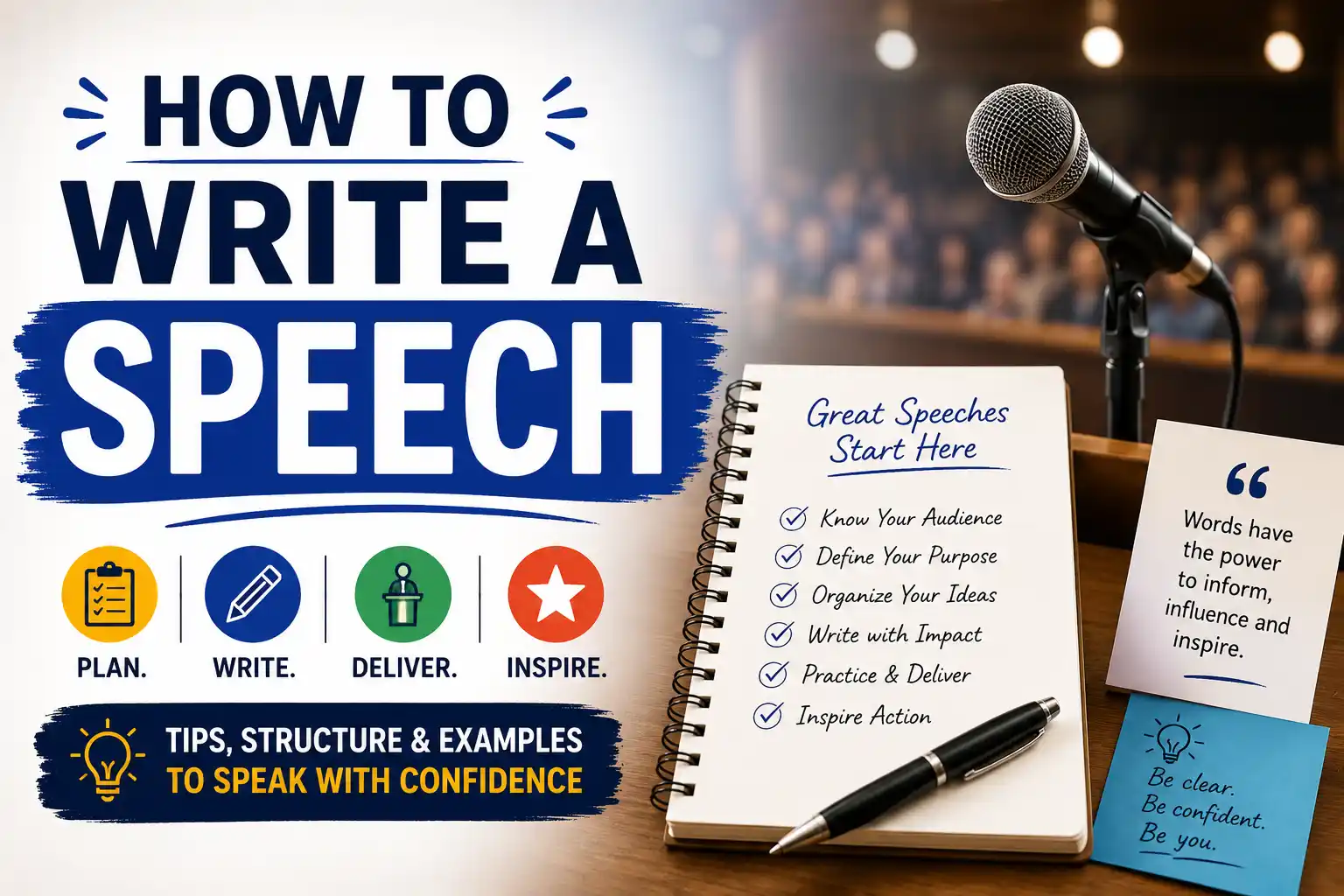
You have been asked to give a speech. Maybe it is a wedding toast, a business presentation, or a keynote address. You know what you want to say, but you are not sure how to structure it. You worry about boring your audience, losing your place, or saying the wrong thing.
You are not alone. Writing a speech is one of the most common , and most intimidating , communication tasks. But a well-crafted speech can inspire, persuade, inform, and entertain. It can change minds, move hearts, and leave a lasting impression.
This guide will teach you everything you need to know about how to write a speech that captivates your audience. We will cover the structure, the content, the delivery, and the common mistakes to avoid. By the end, you will have the tools to write speeches that people will remember.
Speech Writing at a Glance
1 What Is a Speech and Why Does It Matter?
A speech is a formal address delivered to an audience. It is a structured piece of spoken communication designed to inform, persuade, entertain, or inspire. Speeches are a fundamental part of public life , from political rallies and business meetings to weddings and graduations.
Speeches matter because they are one of the most powerful forms of communication. A well-delivered speech can change the course of history, inspire social movements, or simply make someone's day. As the ancient Greek philosopher Aristotle observed, "The spoken word is the most powerful tool of leadership."
Writing a speech is also a deeply practical skill. Whether you are presenting to your team, speaking at a conference, or toasting a friend, the ability to write and deliver a compelling speech is invaluable in both professional and personal life.
Connects with Audiences
A speech is a direct, personal form of communication. It allows you to connect with your audience in real time.
Persuades and Inspires
Speeches have the power to change minds, motivate action, and inspire change.
Builds Credibility
Delivering a well-written speech demonstrates expertise, confidence, and leadership.
Creates Lasting Impact
A memorable speech can stay with an audience for years, shaping how they think and feel.
2 The Fundamentals of Speech Writing
Before you start writing, you need to understand the core principles that guide effective speech writing.
Know Your Audience
This is the single most important rule of speech writing. Who are you speaking to? What do they care about? What do they already know? What do they need to hear? A speech for a room of executives will be very different from a speech for a room of students.
Know Your Purpose
Why are you speaking? What do you want your audience to think, feel, or do after hearing your speech? Your purpose should guide every word you write. Are you informing, persuading, entertaining, or inspiring?
Write for the Ear, Not the Eye
A speech is meant to be heard, not read. Use shorter sentences, simpler language, and more repetition than you would in writing. Read your speech aloud as you write it , if it sounds awkward, rewrite it.
Have a Clear Structure
As the Roman orator Cicero advised, a speech should have a clear beginning, middle, and end. Your audience needs to know where you are taking them. A clear structure helps them follow your argument and remember your message.
The Three Pillars of Rhetoric
Aristotle identified three pillars of effective persuasion: Ethos (credibility), Pathos (emotion), and Logos (logic). A great speech balances all three. You must establish your credibility, appeal to your audience's emotions, and support your arguments with logic and evidence.
3 How to Structure a Speech
A well-structured speech is easy to follow and remember. Here is the classic speech structure that has stood the test of time.
Opening
Your opening is the most important part of your speech. It must grab the audience's attention and make them want to listen. Start with a hook , a question, a story, a surprising fact, or a bold statement. Then, state your purpose and preview what you will cover.
Body
The body is where you develop your main points. Most speeches have 2–4 key points. Each point should be supported by evidence, examples, or stories. Use clear transitions to move from one point to the next. As the ancient Greek rhetorician Hermogenes advised, "A speech should be like a journey , the audience should always know where they are and where they are going."
Conclusion
Your conclusion should summarise your main points, reinforce your message, and leave a lasting impression. End with a call to action, a memorable statement, or a powerful story. As the Roman orator Quintilian said, "The conclusion is the most important part of a speech , it is what the audience will remember."
Classic Speech Structure
- Opening: Hook, purpose, preview
- Point 1: Main argument with evidence
- Point 2: Supporting argument with evidence
- Point 3: Supporting argument with evidence
- Conclusion: Summary, reinforcement, call to action
4 How to Write a Strong Opening
Your opening determines whether your audience will listen to the rest of your speech. Here is how to write a strong opening.
Start with a Hook
Your first sentence should grab attention. Options include:
- A question: "Have you ever wondered what it takes to change the world?"
- A story: "When I was twelve years old, my grandfather told me something I have never forgotten."
- A surprising fact: "Every day, 3,000 people make a decision that will change their lives forever."
- A bold statement: "The way we think about success is completely wrong."
State Your Purpose
After your hook, tell the audience why you are speaking and what you hope to achieve. This gives them a reason to listen.
Preview Your Points
Briefly preview the main points you will cover. This gives the audience a road map and helps them follow your speech.
Opening Example
"Have you ever felt like you were meant for something more? I used to feel that way every single day. But I did not know how to change it , until I discovered the power of one simple question. Today, I want to share with you three lessons that transformed my life."
5 How to Write the Body of Your Speech
The body is where you develop your argument and engage your audience. Here is how to write an effective body.
Use the Rule of Three
The rule of three is a powerful rhetorical device. Three points are more memorable and persuasive than two or four. Think of famous examples: "Life, liberty, and the pursuit of happiness." "Government of the people, by the people, for the people."
Support with Stories and Evidence
Each point should be supported by stories, examples, and evidence. Stories are particularly powerful , they create emotional connection and make abstract ideas concrete. As the writer Maya Angelou said, "People will forget what you said, but they will never forget how you made them feel."
Use Transitions
Transitions help your audience follow your argument. Use phrases like "First," "Second," "Finally," or "Now let's turn to..." to signal where you are in your speech.
Body Paragraph Example
"The first lesson I learned is that courage is not the absence of fear , it is the willingness to act despite fear. I saw this in my grandmother, who left everything she knew to build a new life in a new country. She was terrified, but she did it anyway. That is courage."
6 How to Write a Powerful Conclusion
Your conclusion is your last chance to make an impression. Here is how to write a powerful conclusion.
Summarise Your Points
Briefly summarise the main points of your speech. This reinforces your message and helps the audience remember what you said.
Reinforce Your Message
Restate your core message in a memorable way. This is the takeaway you want the audience to carry with them.
End with a Call to Action
What do you want the audience to do? End with a clear, inspiring call to action. As the Roman orator Cicero advised, "The conclusion should move the audience to action."
End with a Strong Final Line
Your final line should be memorable and impactful. It is what the audience will remember most. As the writer E.M. Forster said, "The final sentence is the most important sentence of any speech , it is the one the audience will take home with them."
Conclusion Example
"So remember: courage is acting despite fear. Connection is the foundation of a meaningful life. And contribution is how we find purpose. These three lessons changed my life , and they can change yours too. So I ask you: what will you do with what you have learned today? The choice is yours."
7 How to Make Your Speech Memorable
A memorable speech is one that stays with the audience long after it is over. Here is how to make your speech unforgettable.
Use Vivid Language
Use concrete, specific language that creates vivid images in the audience's mind. Instead of saying "The company grew," say "The company tripled its revenue in two years." Instead of "She was a good leader," say "She led her team through the most difficult period in the company's history."
Use Repetition
Repetition is a powerful rhetorical device. It reinforces your message and makes it more memorable. Think of Martin Luther King Jr.'s "I have a dream" or Winston Churchill's "We shall fight on the beaches."
Use Rhetorical Devices
Rhetorical devices like alliteration, parallelism, and metaphor make your speech more engaging and memorable. For example: "We must work together, we must stand together, we must win together."
Weak Language
"We need to work hard to achieve our goals."
Memorable Language
"Success is not a gift , it is earned through sweat, sacrifice, and unwavering determination."
8 Common Speech Writing Mistakes to Avoid
Even experienced speakers make mistakes. Here are the most common errors and how to avoid them.
Trying to Say Too Much
Packing too many points into your speech. This overwhelms the audience and dilutes your message.
Fix: Focus on 2–4 key points. Less is more.
Starting with a Weak Opening
Beginning with "Thank you for having me" or "I am honoured to be here." These openings are forgettable.
Fix: Start with a hook , a question, a story, or a surprising fact.
Reading Your Speech
Reading directly from a script. This makes you sound robotic and disconnects you from your audience.
Fix: Use notes or cue cards. Practice until you know your main points by heart.
Using Jargon
Using technical terms or acronyms that your audience may not understand.
Fix: Use plain, accessible language. Define any necessary terms.
Forgetting the Audience
Writing a speech that is about you, not about the audience. Your speech should serve the audience, not your ego.
Fix: Keep the audience at the centre of your speech. What do they need to know? What do they care about?
Not Practicing
Writing a speech but not practicing it. This leads to a stiff, awkward delivery.
Fix: Practice your speech aloud. Time yourself. Record yourself and listen back.
9 How to Deliver Your Speech
Writing a great speech is only half the battle. Delivery is just as important. Here is how to deliver your speech with confidence.
Practice, Practice, Practice
Practice your speech out loud until you know it inside out. Time yourself to make sure you are within your allotted time. Practice in front of a mirror or record yourself to see how you look and sound.
Make Eye Contact
Eye contact builds connection with your audience. Look at different people in the room, not just at your notes or the back wall.
Use Your Voice
Vary your pace, volume, and tone to keep your audience engaged. Speak more slowly for emphasis. Pause before important points. Let your voice reflect the emotion of your words.
Use Body Language
Your body language communicates as much as your words. Stand tall, use open gestures, and move purposefully. Nervous habits like fidgeting or pacing distract from your message.
The "6 Ps" of Speech Delivery
- Preparation: Know your material inside out
- Practice: Rehearse until it feels natural
- Pacing: Speak at a comfortable, varied pace
- Pause: Use pauses for emphasis
- Presence: Be fully present with your audience
- Passion: Let your enthusiasm show
10 Practice Exercises to Improve Your Speeches
The best way to get better at writing speeches is to practice. Here are some exercises to help you sharpen your skills.
Exercise 1: Write a Short Speech
Write a 3-minute speech on a topic you care about. Focus on a clear structure: opening, 2–3 points, and a conclusion.
Exercise 2: Analyse a Famous Speech
Choose a famous speech (e.g., Martin Luther King Jr.'s "I Have a Dream"). Analyse its structure, rhetorical devices, and use of language.
Exercise 3: Practice Delivery
Record yourself delivering a speech. Watch the recording and identify areas for improvement. Practice until you feel confident.
Exercise 4: Peer Feedback
Share your speech with a friend or colleague. Ask for honest feedback on content, structure, and delivery.
Final Thoughts
Writing a speech is a skill that can be learned and mastered. A well-crafted speech can inspire, persuade, and move your audience. It is a powerful tool for communication and leadership.
Remember that a speech is not just about the words you say , it is about connecting with your audience. Focus on what they need to hear, speak from the heart, and deliver with confidence. As the writer Maya Angelou said, "I have learned that people will forget what you said, but they will never forget how you made them feel."
Keep these principles in mind as you write:
- Know your audience. Write for the people in front of you.
- Know your purpose. What do you want them to think, feel, or do?
- Structure your speech. A clear beginning, middle, and end.
- Start strong. Your opening determines whether they will listen.
- Write for the ear. Short sentences, simple language, repetition.
- Practice, practice, practice. Great delivery requires practice.
Every great speaker started somewhere. With practice and persistence, you can become a confident and effective speaker. The audience is waiting. The stage is set. Your words matter.
Now go write a speech that makes a difference.