How to Write a Script: The Complete Guide with Examples
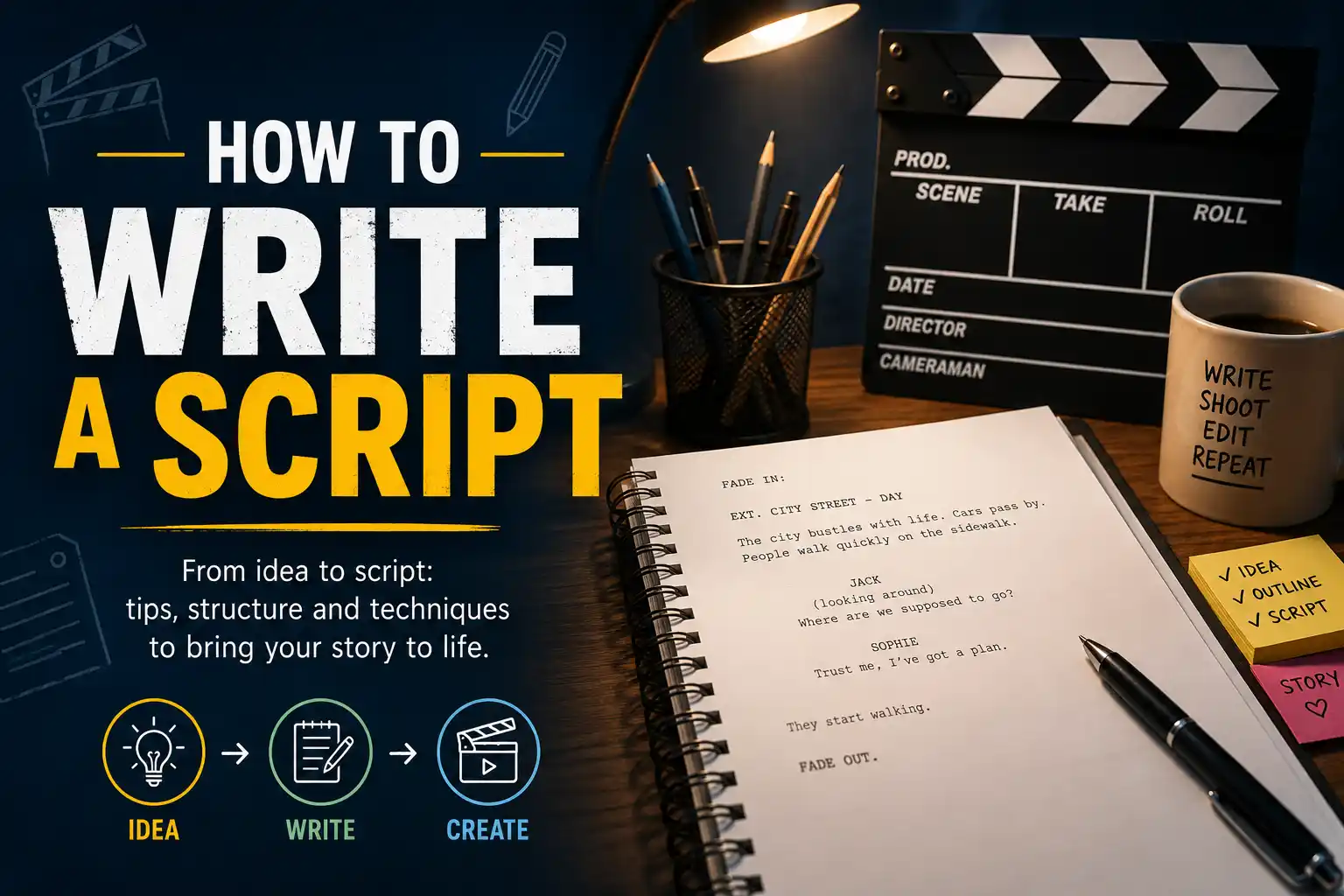
You have a story to tell. Characters are speaking in your head. Scenes are playing out like a movie. But when you sit down to write your script, you are staring at a blank page, unsure of the format, the structure, or even where to begin.
You are not alone. Writing a script is a unique and challenging form of storytelling. It requires a combination of creative vision, technical knowledge, and an understanding of visual storytelling. But with the right approach, you can transform your ideas into a professional script ready for the screen or stage.
This guide will teach you everything you need to know about how to write a script , from the fundamentals of formatting and structure to character development and dialogue. We will cover the essential elements of screenwriting, the common mistakes to avoid, and the techniques used by professional writers. By the end, you will have the tools to write a script that brings your story to life.
Scriptwriting at a Glance
1 What Is a Script and Why Does It Matter?
A script is a written document that serves as the blueprint for a film, television show, play, or other visual media. It contains the dialogue, character actions, scene descriptions, and technical directions that guide directors, actors, and the production crew.
Scripts matter because they are the foundation of visual storytelling. Before a film can be shot, before actors can perform, before a director can visualise a scene , there is a script. It is the essential bridge between an idea and a finished production.
A well-written script is both a blueprint and a work of art. It must communicate the story in a way that is clear, compelling, and visually engaging. It must give actors something to perform and directors something to visualise. It is the starting point for every great film and television show.
Visual Storytelling
A script is a blueprint for a visual medium. Every scene must be written with the camera in mind , what the audience will see and hear.
Collaboration Tool
A script is the foundation for collaboration among directors, actors, cinematographers, and editors. It gives everyone a shared vision.
Industry Standard
Professional scripts follow a strict format that is recognised throughout the industry. Mastering this format is essential for anyone serious about screenwriting.
Creative Expression
Scriptwriting is a unique art form. It combines narrative structure, visual thinking, and dialogue in a way that no other medium does.
2 The Fundamentals of Scriptwriting
Before you start writing, you need to understand the foundational principles that guide effective scriptwriting.
Write Visually
Film and television are visual mediums. Instead of telling the audience what a character is feeling, show it through their actions and expressions. Instead of describing internal thoughts, create scenes that reveal character through what they do. "Show, don't tell" is the golden rule of screenwriting.
Every Scene Must Advance the Story
In a script, there is no room for filler. Every scene should either advance the plot, reveal character, or both. If a scene does neither, it does not belong in your script. This discipline is what makes screenwriting unique and challenging.
Write in the Present Tense
Scripts are written in the present tense. This creates immediacy and reflects the fact that film is a present-tense medium. Instead of "John walked to the door," write "John walks to the door."
Formatting Is Not Optional
In screenwriting, formatting matters. Professional scripts follow a strict format that is recognised throughout the industry. This includes using 12-point Courier font, specific margins, and standard elements like scene headings, action lines, and dialogue blocks.
The "Rule of Three"
In screenwriting, the "rule of three" suggests that the first act sets up the story, the second act develops conflict, and the third act resolves it. Many successful films follow this structure. It is a useful framework for new writers to understand before they experiment with more complex structures.
3 How to Format a Script
Proper script formatting is essential for professionalism and readability. Here are the key elements of standard script format.
Scene Heading (Slugline)
A scene heading tells the reader where and when the scene takes place. It has three parts: INT./EXT., location, and time of day. For example: "INT. COFFEE SHOP - DAY" or "EXT. CITY STREET - NIGHT".
Action Lines
Action lines describe what is happening in the scene. They are written in the present tense and should be concise and visual. Avoid directing the camera or telling the actor how to deliver a line. Describe only what can be seen and heard.
Character Names
Character names are written in all caps when they first appear and in standard case thereafter. In dialogue, the character's name is centered above their lines. Example: "JOHN" centered, followed by his dialogue.
Dialogue
Dialogue is what the characters say. It is centered on the page and formatted with specific margins. Each character's lines should sound distinct and reveal their personality.
Parentheticals
Parentheticals are used to indicate how a line should be delivered or to describe a small action within the dialogue. They should be used sparingly. Example: "(sarcastically)" or "(whispering)".
Transitions
Transitions like "CUT TO:" or "FADE IN:" are used sparingly in modern scripts. They indicate how one scene moves to the next.
Sample Script Format
INT. COFFEE SHOP - DAY
A bustling coffee shop in downtown LA. SARAH (30s), a woman in a business suit, sits alone at a table, staring at her phone.
She looks up as MARK (30s), a man in a casual jacket, approaches.
MARK
Sarah? You're here.
SARAH
(without looking up)
I am. But I'm not sure I should be.
Mark slides into the chair across from her.
4 How to Structure a Script
A well-structured script follows a dramatic arc that keeps the audience engaged. Here is the standard structure used in most successful films.
Three-Act Structure
The three-act structure is the foundation of most screenplays.
- Act I: Setup (25–30 pages) , Introduces the characters, the world, and the central conflict. Ends with the inciting incident that sets the story in motion.
- Act II: Confrontation (55–60 pages) , The protagonist faces obstacles and escalating conflict. The stakes rise. The character grows and changes.
- Act III: Resolution (25–30 pages) , The climax of the story. The protagonist faces their biggest challenge and either succeeds or fails. The story is resolved.
The Inciting Incident
The inciting incident is the event that sets the story in motion. It disrupts the protagonist's normal life and forces them to take action. It typically occurs within the first 10–15 pages of a feature script.
The Turning Points
Turning points are key moments that change the direction of the story. They occur at the end of Act I (the protagonist commits to the journey), the midpoint (the stakes get higher), and the end of Act II (the lowest point).
The Climax
The climax is the moment of highest tension in the story. The protagonist faces their greatest challenge and either succeeds or fails. It is the emotional and dramatic peak of the script.
Three-Act Structure Overview
5 How to Develop Characters
Character development is the heart of great screenwriting. Here is how to create characters that audiences care about.
Give Your Characters Desire and Conflict
Every protagonist needs a desire , something they want more than anything. And they need conflict , obstacles that stand in their way. The tension between desire and conflict is what drives the story.
Make Characters Flawed and Relatable
Perfect characters are boring. Give your characters flaws , fears, weaknesses, blind spots. These flaws make them human and relatable. The character's journey often involves confronting and overcoming these flaws.
Use Dialogue to Reveal Character
Dialogue should reveal character. What a character says and how they say it tells us who they are. A character's word choices, speech patterns, and what they choose to say (or not say) all reveal their personality and background.
Show Character Through Action
In a script, character is revealed through action. What a character does in a crisis tells us more than what they say. Show your characters making difficult choices and taking meaningful actions.
Strong Character Example
"Sarah is a brilliant lawyer who is terrified of public speaking. She would rather lose a case than step into a courtroom."
Weak Character Example
"Sarah is a lawyer. She is a good person who cares about her clients."
6 How to Write Dialogue
Dialogue in a script serves multiple purposes: it reveals character, advances the plot, and conveys information. Here is how to write effective dialogue.
Make Each Character Sound Different
Every character should have a distinct voice. Consider their background, education, personality, and emotional state. A teenager speaks differently than a professor. A character under stress speaks differently than one who is relaxed.
Cut the Small Talk
Real-life conversation is full of filler and small talk. In a script, every word counts. Cut the "ums," "uhs," and meaningless exchanges. Dialogue should be purposeful and engaging.
Use Subtext
Subtext is what characters mean but do not say directly. The best dialogue has layers. Characters say one thing while meaning another. This creates tension and realism.
Read It Aloud
Dialogue should sound natural when spoken aloud. Read your dialogue out loud or ask someone to read it with you. If it sounds awkward or stilted, rewrite it.
Dialogue Example: Good vs. Bad
Weak: "I am so angry that you forgot my birthday. It really hurt my feelings."
Strong: "Oh, you remembered. How nice." (said with sarcasm and hurt)
7 Common Mistakes to Avoid
Even experienced screenwriters make mistakes. Here are the most common errors and how to avoid them.
Overwriting Action Lines
Writing action lines that are too long or too detailed. The script should be a blueprint, not a novel.
Fix: Keep action lines short and visual. Describe only what can be seen and heard.
On-the-Nose Dialogue
Characters saying exactly what they mean. This lacks subtext and feels unrealistic.
Fix: Use subtext. Let characters say one thing while meaning another.
Telling Instead of Showing
Using dialogue to explain emotions or backstory instead of showing through action and visual storytelling.
Fix: Show character and emotion through action, not exposition.
Weak Structure
Writing a script that lacks a clear dramatic arc. The story wanders and loses momentum.
Fix: Use the three-act structure. Ensure each scene advances the plot or reveals character.
Unoriginal Characters
Characters who are stereotypes or clichés. They lack depth and originality.
Fix: Give your characters unique desires, flaws, and voices. Make them feel like real people.
Not Reading Your Script Aloud
Dialogue that looks good on the page but sounds awkward when spoken.
Fix: Read your script aloud. Better yet, do a table read with actors.
8 Advanced Scriptwriting Techniques
Once you have mastered the basics, you can use advanced techniques to elevate your scriptwriting.
The Hero's Journey
Many great scripts follow the hero's journey , a narrative pattern identified by Joseph Campbell. It includes stages like the call to adventure, crossing the threshold, facing trials, and returning with wisdom. Understanding this pattern can help you structure your story.
Non-Linear Storytelling
Some scripts use non-linear structures , flashbacks, flash-forwards, or parallel timelines. This can create mystery, reveal character, and keep the audience engaged. Use it sparingly and with clarity.
Theme and Subtext
Great scripts often have a theme , a central idea or message. The theme is not stated directly but emerges through the story and characters. Subtext , the hidden meaning beneath the surface , is what gives a script depth and resonance.
Rewriting and Polishing
Professional screenwriters know that writing is rewriting. The first draft is just the beginning. Revise, get feedback, and revise again. Polishing your script is what makes it ready for production.
Give yourself permission to write a messy first draft. The magic happens in the revision.
9 How to Revise Your Script
Revision is where your script goes from good to great. Here is a step-by-step process for revising your script.
Step 1: Take a Break
Step away from your script for a few days. This gives you fresh eyes and helps you see your work more objectively.
Step 2: Read It Aloud
Read your script aloud. Does the dialogue sound natural? Are there any awkward transitions? Reading aloud helps you catch issues you might miss when reading silently.
Step 3: Check the Structure
Does your script follow a clear dramatic arc? Is there a strong inciting incident? Does the climax deliver? Ensure the structure is solid before you worry about details.
Step 4: Strengthen Your Characters
Are your characters well-developed? Do they have clear desires and flaws? Are their voices distinct? Revise to deepen your characters.
Step 5: Polish the Dialogue
Go through each line of dialogue. Does it sound natural? Does it reveal character? Is there subtext? Rewrite any weak lines.
Step 6: Get Feedback
Share your script with trusted readers. Ask them what works and what does not. Be open to constructive criticism. Feedback is essential for growth.
10 Practice Exercises to Improve Your Scriptwriting
The best way to get better at writing scripts is to practice. Here are some exercises to help you sharpen your skills.
Exercise 1: Write a Short Script
Write a 5-page script. It does not have to be a full story , just a scene that reveals character and conflict. Focus on formatting and visual storytelling.
Exercise 2: Rewrite a Scene
Take a scene from a film or TV show and rewrite it in your own words. Then compare your version to the original. What did you do differently? What can you learn?
Exercise 3: Dialogue-Only Scene
Write a scene using only dialogue , no action lines. Focus on creating distinct voices and using subtext. Then add action lines to see how the scene comes to life.
Exercise 4: Table Read
Gather a few friends and do a table read of your script. Hearing it read aloud will reveal what works and what does not. It is one of the most valuable exercises for any screenwriter.
Final Thoughts
Writing a script is a unique and rewarding form of storytelling. It combines the discipline of structure with the creativity of character and dialogue. It is the foundation of every great film and television show.
Remember that scriptwriting is a craft that takes time to master. Do not expect your first script to be perfect. Write, revise, get feedback, and write again. Every draft brings you closer to the story you want to tell.
Keep these principles in mind as you write:
- Show, don't tell. Film is a visual medium , let the images tell the story.
- Every scene must advance the story. If it does not, cut it.
- Give your characters desire and conflict. Desire drives the story; conflict creates drama.
- Write dialogue that reveals character. Each character should have a distinct voice.
- Revise, revise, revise. Great scripts are the result of rewriting.
The story you want to tell is waiting to be written. The characters in your head are waiting to speak. The audience is waiting to be moved. Pick up your pen , or open your screenwriting software , and start writing.
Now go write a script that comes to life on the screen.