How to Write a Scientific Paper: The Complete Guide with Examples
You have conducted the research. You have analysed the data. You have made a discovery. Now comes the hardest part: writing the scientific paper. You stare at a blank screen, unsure how to structure it, what to include, or how to make it compelling enough to get published.
You are not alone. Writing a scientific paper is one of the most challenging tasks in academia. It requires clarity, precision, and a deep understanding of your field. A well-written paper can advance your career, contribute to knowledge, and make a real impact. A poorly written one may never be read.
This guide will teach you everything you need to know about how to write a scientific paper that gets published. We will cover the IMRAD structure, the formatting, the content, and the common mistakes to avoid. By the end, you will have the tools to write papers that editors and reviewers will want to publish.
Scientific Paper Writing at a Glance
1 What Is a Scientific Paper and Why Does It Matter?
A scientific paper is a formal document that reports original research, reviews existing knowledge, or presents a new theory. It is the primary means by which scientists communicate their findings to the wider community. Scientific papers are published in peer-reviewed journals and form the foundation of scientific knowledge.
Scientific papers matter because they are the currency of science. They allow researchers to share their discoveries, build on each other's work, and advance human knowledge. A well-written paper can influence policy, inspire new research, and change the way we understand the world.
Publishing a scientific paper is also a key requirement for academic career advancement. It demonstrates that you can conduct rigorous research and communicate your findings effectively. In many fields, your publication record is the primary measure of your success.
Advances Knowledge
Scientific papers are how we share new discoveries and build on existing knowledge. They are the foundation of scientific progress.
Builds Your Career
Publications are essential for academic career advancement. They demonstrate your research capabilities and expertise.
Establishes Credibility
Publishing in peer-reviewed journals establishes your credibility as a researcher and expert in your field.
Creates a Permanent Record
Scientific papers create a permanent, citable record of your research that can be referenced by others for years to come.
2 The Fundamentals of Writing a Scientific Paper
Before you start writing, you need to understand the foundational principles that underpin every effective scientific paper.
Follow the IMRAD Structure
Most scientific papers follow the IMRAD structure: Introduction, Methods, Results, And Discussion. This structure is standard across most scientific disciplines and helps readers find information quickly.
Be Clear and Concise
Scientific writing should be clear, concise, and precise. Avoid unnecessary words, jargon, and complex sentences. Your goal is to communicate your findings as effectively as possible.
Be Objective and Accurate
Scientific writing is objective. Present your findings without bias or interpretation — that belongs in the discussion section. Be accurate in your reporting of methods, results, and references.
The IMRAD Structure
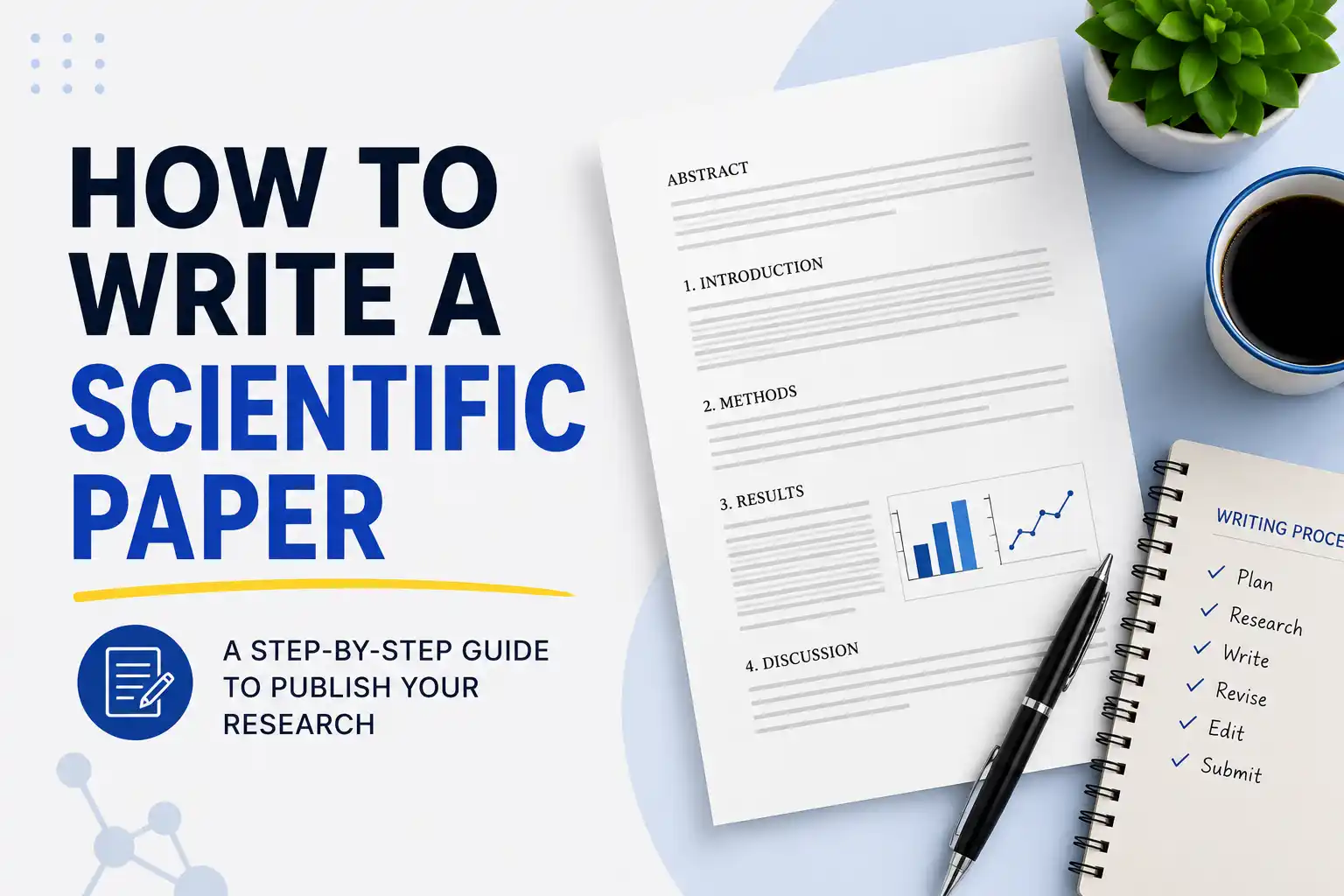
The IMRAD structure is the standard format for scientific papers: Introduction — What did you study and why? Methods — How did you study it? Results — What did you find? Discussion — What does it mean? This structure is logical and helps readers understand your work quickly.
3 How to Structure a Scientific Paper
A well-structured scientific paper follows a standard format that readers expect. Here is the essential structure.
Title
Your title should be descriptive, concise, and informative. It should tell readers what the paper is about and grab their attention. Include key keywords for searchability.
Abstract
The abstract is a concise summary of the entire paper — typically 150–250 words. It should cover the purpose, methods, key results, and main conclusions. Write the abstract last.
Introduction
The introduction sets the context for your research. It should:
- Provide background information and relevant literature
- Identify the gap or problem your research addresses
- State your research question or hypothesis
- Briefly describe your approach
Methods
The methods section describes exactly what you did. It should include:
- Study design and setting
- Participants or samples
- Materials and equipment
- Procedures and protocols
- Statistical analysis
Results
The results section presents your findings objectively, without interpretation. Use:
- Text to summarise key findings
- Tables for precise data
- Figures for visual trends
Discussion
The discussion interprets your results and explains their significance. Address:
- Whether your hypothesis was supported
- Comparison with previous research
- Limitations and sources of error
- Implications and future research
Conclusion
The conclusion summarises the main findings and their significance. It should be brief and reinforce the key takeaways.
References
List all sources cited in the paper using the required citation style (e.g., APA, MLA, or specific journal style).
Standard Scientific Paper Format
- Title: Descriptive and concise
- Abstract: Summary of the entire paper
- Introduction: Background and objectives
- Methods: Materials and procedures
- Results: Objective presentation of data
- Discussion: Interpretation and significance
- Conclusion: Summary of key findings
- References: List of cited sources
4 What to Include in Each Section
Here is a detailed breakdown of what to include in each section of your scientific paper.
Title
Keep it short, specific, and informative. Use keywords that describe the research. Example: "The Effect of Temperature on the Rate of Photosynthesis in Spinach Leaves."
Abstract
Include the purpose, methods, key results, and conclusion. Write it in a single paragraph. Use the past tense. Keep it to 150–250 words.
Introduction
Start with broad background and narrow to your specific research question. Include:
- Relevant theories and previous research
- The research gap or problem
- Your hypothesis or research question
- Objectives of the study
Methods
Describe your study in enough detail for replication. Use the past tense. Include:
- Study design and setting
- Participants or samples (with characteristics)
- Materials and equipment (with specifications)
- Step-by-step procedures
- Statistical methods
Results
Present your data objectively. Do not interpret — just report. Use:
- Text: Summarise key trends and findings
- Tables: For precise numerical data
- Figures: Graphs, charts, or images
Discussion
Interpret your results. Address:
- Whether your hypothesis was supported
- How your results compare to previous research
- Potential sources of error and limitations
- Implications and suggestions for future research
Conclusion
Summarise the main findings and their significance. Keep it brief and focused.
References
List all sources cited in the text. Follow the required citation style exactly.
5 How to Write a Scientific Paper: Step-by-Step
Here is a step-by-step process for writing a scientific paper.
Step 1: Choose Your Target Journal
Before you write, choose a target journal. Read their author guidelines carefully. Each journal has specific requirements for format, length, and style. Tailoring your paper to a specific journal from the start will save you time later.
Step 2: Organise Your Data and Materials
Gather all your data, figures, tables, and references. Organise them logically. This will make the writing process much smoother.
Step 3: Create an Outline
Create a detailed outline following the IMRAD structure. This will help you organise your thoughts and ensure you cover all essential sections.
Step 4: Write the Methods
Start with the methods section, as it is the most straightforward. Describe what you did in the past tense. Be precise and detailed.
Step 5: Write the Results
Present your findings objectively. Use text, tables, and figures. Do not interpret — just report.
Step 6: Write the Discussion
Interpret your results. Explain what they mean, how they relate to your hypothesis, and their significance. Be honest about limitations.
Step 7: Write the Introduction
Write the introduction after you have written the methods, results, and discussion. This ensures that you know exactly what you are introducing.
Step 8: Write the Abstract and Title
Write the abstract and title last. The abstract should summarise the entire paper. The title should be descriptive and engaging.
Step 9: Revise and Proofread
Review your paper for clarity, accuracy, and completeness. Check for grammar and spelling errors. Ask colleagues to review it.
Sample Abstract
"This study investigated the effect of temperature on the rate of photosynthesis in spinach leaves (Spinacia oleracea). Leaf discs were exposed to temperatures ranging from 15°C to 45°C, and the rate of oxygen production was measured as an indicator of photosynthetic activity. Results showed that the rate of photosynthesis increased with temperature up to 30°C, after which it declined sharply. The optimum temperature for photosynthesis was found to be 30°C. These findings suggest that temperature plays a critical role in photosynthetic efficiency and that temperatures above 35°C may cause irreversible damage to the photosynthetic apparatus."
6 Common Mistakes to Avoid
Even experienced researchers make mistakes. Here are the most common errors and how to avoid them.
Confusing Results and Discussion
Including interpretation in the results section or presenting raw data in the discussion.
Fix: Keep results objective. Save interpretation for the discussion.
Writing in the Wrong Tense
Using present tense for methods or past tense for established facts.
Fix: Use past tense for methods and results. Use present tense for established knowledge and conclusions.
Being Too Vague
Not providing enough detail in the methods section or being unclear about the hypothesis.
Fix: Be specific and precise. Provide enough detail for replication.
Overlooking Journal Guidelines
Submitting a paper that does not follow the journal's formatting or style requirements.
Fix: Read the journal's author guidelines carefully and follow them exactly.
Misinterpreting Results
Overstating conclusions or ignoring results that contradict the hypothesis.
Fix: Be honest and objective. Discuss all results, including unexpected ones.
Poor Reference Formatting
Using incorrect citation styles or missing references.
Fix: Use a reference manager and check the journal's citation style carefully.
7 How to Present Data Effectively
Data presentation is a critical part of your scientific paper. Here is how to present your data effectively.
Use Tables for Precise Data
Tables are ideal for presenting precise numerical data. Make sure your tables are:
- Numbered sequentially (Table 1, Table 2, etc.)
- Given a descriptive title
- Clearly labelled with units
- Referenced in the text
Use Figures for Visual Trends
Figures (graphs, charts, diagrams) are best for showing trends and relationships. Make sure your figures are:
- Numbered sequentially (Figure 1, Figure 2, etc.)
- Given a descriptive caption
- Clearly labelled (axes, units, legend)
- Referenced in the text
Choose the Right Type of Graph
Different graphs are suited for different types of data:
- Line graphs: For continuous data showing trends over time or conditions
- Bar graphs: For comparing discrete categories
- Scatter plots: For showing relationships between two variables
Data Presentation Tips
8 How to Write a Strong Discussion
The discussion is where you interpret your results and demonstrate your understanding. Here is how to write a strong discussion.
Start with the Hypothesis
Begin by stating whether your results supported or refuted your hypothesis. Be clear and direct.
Interpret Your Results
Explain what your results mean. What do they tell you about the phenomenon you were investigating? Connect your findings to the background information you presented in the introduction.
Compare with Previous Research
How do your results compare to those of other studies? Do they agree or disagree? What might explain any differences?
Address Limitations
Be honest about the limitations of your study. This could include sample size, measurement errors, or uncontrolled variables. Discuss how these limitations might have affected your results.
Suggest Future Research
Based on your findings, what questions remain? What future experiments could address these questions? This shows critical thinking and a forward-looking approach.
Sample Discussion Excerpt
"The results support the hypothesis that increasing temperature accelerates the rate of photosynthesis, at least up to 30°C. This is consistent with previous studies that have shown optimal enzyme activity at moderate temperatures. However, the decline in activity at 35°C suggests enzyme denaturation, which has been reported in similar studies. The relatively small sample size and the use of a single light source are limitations that should be addressed in future research."
9 How to Revise Your Scientific Paper
A great scientific paper is not written; it is rewritten. Revision is where your paper goes from good to great. Here is a step-by-step process for revising your paper.
Step 1: Check for Clarity
Is your paper clear and easy to follow? Does each section flow logically? If not, revise for clarity.
Step 2: Check for Consistency
Are your results and discussion consistent? Does the conclusion align with the findings?
Step 3: Check for Completeness
Have you included all the essential sections? Is there any missing information?
Step 4: Check the Data Presentation
Are your tables and figures clear and properly labelled? Do they effectively communicate your results?
Step 5: Check for Errors
Proofread carefully for spelling, grammar, and punctuation errors. Check your calculations and data.
Step 6: Get Feedback
Ask colleagues, mentors, or co-authors to review your paper. Fresh eyes can catch issues you have missed.
10 Practice Exercises to Improve Your Scientific Papers
The best way to get better at writing scientific papers is to practice. Here are some exercises to help you sharpen your skills.
Exercise 1: Write a Methods Section
Take a simple experiment you have performed (e.g., measuring pH, growing plants) and write a detailed methods section. Focus on precision and clarity.
Exercise 2: Create Data Visualisations
Take a set of experimental data and create appropriate tables and figures. Practice choosing the right type of graph.
Exercise 3: Write a Discussion
Given a set of results, write a discussion section. Practice interpreting the data and addressing limitations.
Exercise 4: Peer Review
Swap papers with a colleague. Provide constructive feedback on structure, clarity, and content.
Final Thoughts
Writing a scientific paper is an essential skill for any researcher. A well-written paper communicates your work clearly, contributes to knowledge, and advances your career. It is the culmination of your research efforts.
Remember that a scientific paper is not just about presenting data. It is about telling the story of your research — from the initial question to the final conclusion. Focus on clarity, precision, and logical flow. Be honest about your findings and their limitations.
Keep these principles in mind as you write:
- Follow the IMRAD structure. This is the standard format for scientific papers.
- Be clear and concise. Use precise language and avoid unnecessary words.
- Be objective. Present your findings without bias.
- Present data effectively. Use tables and figures appropriately.
- Interpret thoughtfully. Show that you understand the significance of your results.
Scientific writing is a skill that improves with practice. Each paper you write will be better than the last. With time and effort, you will become a confident and effective scientific communicator.
Now go write a scientific paper that advances knowledge.