How to Write a Press Release: The Complete Guide with Examples
You have an announcement. You have news to share. You want journalists and media outlets to cover your story. But when you sit down to write a press release, you are not sure where to start. What should you include? How do you make it newsworthy? How do you get journalists to actually read it?
You are not alone. Writing a press release is a skill that many people find challenging. But a well-crafted press release is one of the most effective ways to get media attention. It is the standard format for sharing news with journalists and can be the key to earning valuable media coverage.
This guide will teach you everything you need to know about how to write a press release that gets noticed. We will cover the structure, the formatting, the content, and the common mistakes to avoid. By the end, you will have the tools to write press releases that journalists want to read and share.
Press Release at a Glance
1 What Is a Press Release and Why Does It Matter?
A press release is a written communication that announces something newsworthy to the media. It is a formal document that provides journalists with the information they need to write a story. Press releases are used to announce product launches, company news, events, awards, partnerships, and other newsworthy developments.
Press releases matter because they are the primary tool for public relations professionals to communicate with journalists. A well-written press release can generate media coverage, increase brand awareness, and shape public perception. It is your direct line to the media and, through them, to your target audience.
In a crowded media landscape, a strong press release can help you cut through the noise and get your story told. A poorly written one will be ignored. Learning how to write an effective press release is an essential skill for anyone in PR, marketing, or communications.
Generates Media Coverage
A well-crafted press release provides journalists with all the information they need to write a story. It makes their job easier and increases your chances of getting coverage.
Builds Brand Awareness
Every press release is an opportunity to get your brand in front of a wider audience. Media coverage builds credibility and visibility.
Controls the Narrative
A press release allows you to tell your story in your own words. It ensures that your key messages are communicated accurately.
Establishes Authority
Being featured in the media positions you as an expert and authority in your field. Press releases are a key tool for thought leadership.
2 The Fundamentals of Writing a Press Release
Before you start writing, you need to understand the foundational principles that underpin every effective press release.
Focus on Newsworthiness
This is the single most important rule of press release writing. Your announcement must be genuinely newsworthy. Why would a journalist care? Why would their audience want to know? If you cannot answer these questions, you need to rethink your angle.
Use the Inverted Pyramid
Journalists use the inverted pyramid structure: the most important information first, followed by supporting details, and the least important information last. This allows busy journalists to quickly understand your story and decide if it is worth covering. It also helps them cut your release from the bottom if they need to save space.
Be Objective and Factual
A press release is not an advertisement. It is a news document. Write in a neutral, objective tone. Avoid hype, exaggeration, and overly promotional language. Let the facts speak for themselves.
The "So What?" Test
For every press release you write, ask yourself: "So what?" Why would anyone care? What is the news here? If you cannot answer that question immediately, your press release is not ready to send. Every press release should have a clear, compelling news angle.
3 How to Structure a Press Release
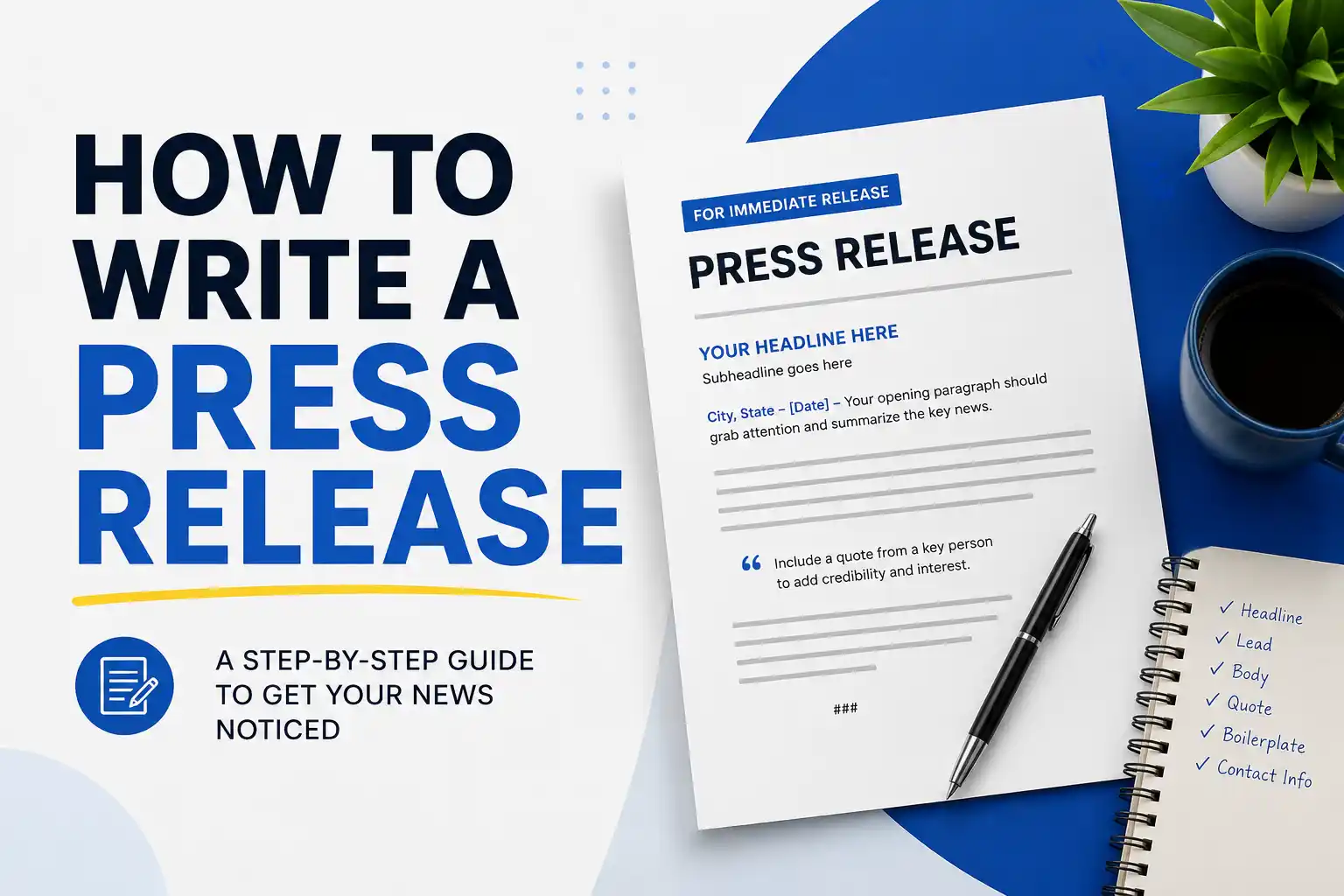
A well-structured press release follows a standard format that journalists expect. Here is the essential structure.
Headline
Your headline is the most important part of your press release. It must grab the journalist's attention and summarise the news in a clear, compelling way. Keep it short (10 words or fewer) and use active verbs.
Dateline
The dateline tells journalists where and when the news is happening. It includes the city, state, and the date of the release. For example: "NEW YORK, NY — June 29, 2026 —"
Lead Paragraph
The lead paragraph answers the who, what, when, where, why, and how of your story. It should summarise the most important information in 1–2 sentences. This is where you hook the journalist and make them want to read more.
Body Paragraphs
The body provides the details, quotes, and supporting information. Each paragraph should add new information and build on the lead. Use quotes from key stakeholders to add human interest and credibility.
Boilerplate
The boilerplate is a short paragraph at the end of the press release that describes your company or organisation. It provides context and background for journalists who may not be familiar with you. Keep it to 2–3 sentences.
Contact Information
Include contact details for a media contact person. Provide their name, title, phone number, and email address. This makes it easy for journalists to follow up if they have questions.
Standard Press Release Format
- FOR IMMEDIATE RELEASE (or embargo instructions)
- Headline: Compelling, action-oriented, 10 words or fewer
- Dateline: CITY, State — Date —
- Lead paragraph: Summary of the news (who, what, when, where, why)
- Body paragraphs: Details, quotes, supporting information
- Boilerplate: 2–3 sentence company description
- Media contact: Name, title, phone, email
- ### (indicating the end of the release)
4 What to Include in a Press Release
Every press release should include certain essential elements. Here is what to include, section by section.
Compelling Headline
Your headline should grab attention and summarise the news. Use strong verbs and active language. Avoid jargon. Think like a journalist — what would make you want to read this story?
Strong Lead Paragraph
The lead should answer the most important questions immediately. Journalists should be able to understand the news just from reading the lead. Include a clear news angle and the most important information first.
Quotes from Key Stakeholders
Quotes add human interest and credibility. Use quotes from company leadership, partners, or other relevant people. Make sure quotes are genuine and add value. Avoid generic statements that could be said by anyone.
Supporting Details
Provide specific details that support your announcement. Include facts, figures, and examples. This gives journalists the material they need to write a full story.
Boilerplate About Your Company
Include a brief description of your company or organisation. This provides context and background for journalists. Keep it concise and focused on your mission, history, and key differentiators.
Clear Contact Information
Make it easy for journalists to follow up. Include a media contact person's name, title, phone number, and email address. Ensure that your contact is actually available to take calls and answer questions.
5 How to Write a Press Release: Step-by-Step
Here is a step-by-step process for writing a press release.
Step 1: Identify Your News Angle
What is your news? Why would anyone care? Be clear about what you are announcing and why it matters. Your news angle is the foundation of your entire press release.
Step 2: Write the Headline
Write a compelling headline that summarises the news and grabs attention. Use active verbs and keep it short. Test your headline by asking: "Would I read this story?"
Step 3: Write the Lead Paragraph
Write a lead paragraph that answers who, what, when, where, why, and how. Keep it tight — 1–2 sentences. Include the most important information first.
Step 4: Write the Body
Provide the details, quotes, and supporting information. Use the inverted pyramid structure: most important information first, then supporting details. Each paragraph should add new information.
Step 5: Include Quotes
Add quotes from key people. Quotes should be authentic and insightful. They should add value and provide a personal perspective on the news.
Step 6: Add Boilerplate and Contact Information
Include your company boilerplate and media contact information. Make it easy for journalists to learn more and get in touch.
Step 7: Review and Revise
Review your press release for clarity, accuracy, and newsworthiness. Proofread carefully. Have a colleague review it for errors and to confirm that the news angle is compelling.
Sample Press Release
FOR IMMEDIATE RELEASE
Tech Company Announces Groundbreaking AI Platform to Revolutionise Healthcare
NEW YORK, NY — June 29, 2026 — InnovateHealth, a leading technology company, today announced the launch of its new AI-powered diagnostic platform, which uses advanced machine learning to detect diseases earlier and more accurately than current methods.
"This platform represents a major breakthrough in medical diagnostics," said Dr. Sarah Chen, CEO of InnovateHealth. "We have developed a tool that can analyse medical images with unprecedented speed and accuracy, potentially saving countless lives."
The platform is currently being tested in five major hospitals across the United States, with plans for a national rollout in early 2027. Early results show a 40% increase in early detection rates for certain cancers.
About InnovateHealth
InnovateHealth is a New York-based technology company that develops innovative AI solutions for the healthcare industry. Founded in 2018, the company has raised over $50 million in funding and is committed to improving patient outcomes through advanced technology.
Media Contact:
John Smith
Director of Communications
(555) 123-4567
john.smith@innovatehealth.com
###
6 Common Mistakes to Avoid
Even experienced PR professionals make mistakes. Here are the most common errors and how to avoid them.
Not Having a News Angle
Writing a press release that is not actually newsworthy. Journalists will ignore it.
Fix: Only send press releases for genuine news. Be honest with yourself about whether your announcement is newsworthy.
Being Too Promotional
Using salesy language, hype, and exaggeration. A press release is news, not an advertisement.
Fix: Write in a neutral, objective tone. Let the facts speak for themselves.
Burying the Lead
Putting the most important information deep in the release instead of in the lead paragraph.
Fix: Use the inverted pyramid. Lead with the most important information first.
Poor Writing
Spelling errors, grammar mistakes, and awkward phrasing. This undermines your credibility.
Fix: Proofread carefully. Read it aloud. Have someone else review it.
Including Too Much Information
Making your press release too long or including irrelevant details.
Fix: Keep it to one page. Only include information that is relevant and newsworthy.
Forgetting Contact Information
Not including clear contact information for media inquiries.
Fix: Always include a media contact name, phone number, and email address.
7 Types of Press Releases
There are several types of press releases, each with a specific purpose. Here are the most common types.
Product Launch Press Release
Announces a new product or service. Focuses on the features, benefits, and availability of the product.
Key trait: Focus on product features, benefits, and availability.
Partnership or Merger Press Release
Announces a new partnership, merger, or acquisition. Focuses on the strategic rationale and benefits.
Key trait: Focus on strategic rationale and mutual benefits.
Award or Recognition Press Release
Announces an award or recognition. Focuses on the significance of the award and the achievement.
Key trait: Focus on the significance of the recognition.
Event Press Release
Announces an upcoming event. Includes details about the event, speakers, and how to attend.
Key trait: Focus on event details and call to action.
Hiring Press Release
Announces a new executive or key hire. Focuses on the new hire's experience and qualifications.
Key trait: Focus on the new hire's background and impact.
Financial Press Release
Announces financial results, funding, or investment news. Focuses on key financial metrics and growth.
Key trait: Focus on financial data and growth indicators.
8 How to Write a Newsworthy Press Release
A press release is only effective if it is newsworthy. Here is how to make your press release more newsworthy.
Find Your News Hook
What makes your announcement timely, relevant, and interesting? Is it a solution to a widespread problem? Is it a significant milestone? Is it relevant to a current trend? Your news hook is what makes journalists care.
Use Data and Statistics
Journalists love numbers. They provide evidence and make your story more compelling. Include data that supports your announcement and demonstrates its significance.
Provide a Unique Perspective
What is different about your story? Why should journalists choose to cover your announcement over all the others? A unique angle, a strong quote, or exclusive data can make your press release stand out.
Keep It Concise
Journalists are busy. They receive hundreds of press releases every day. A concise, well-written press release is more likely to be read and acted upon.
Newsworthy vs. Not Newsworthy
9 How to Distribute Your Press Release
Writing a great press release is only half the battle. You also need to get it in front of the right journalists. Here is how to distribute your press release effectively.
Build a Media List
Identify journalists and media outlets that cover your industry. A targeted media list is more effective than a generic blast. Research journalists who have covered similar stories and personalise your outreach.
Use a Distribution Service
Press release distribution services like PR Newswire, Business Wire, and PRWeb can broadcast your release to a wide network of journalists and media outlets. This is especially useful for major announcements.
Pitch Individual Journalists
Personalised pitches to individual journalists are often more effective than broad distribution. Research what each journalist covers and tailor your pitch to their beat. A short, personalised email with your press release attached can be very effective.
Follow Up
Following up with journalists can be effective, but do it respectfully. Wait a few days and then send a brief, polite follow-up. Do not pester. If they are not interested, move on.
10 Practice Exercises to Improve Your Press Releases
The best way to get better at writing press releases is to practice. Here are some exercises to help you sharpen your skills.
Exercise 1: Write a Product Launch Press Release
Choose a product you are familiar with. Write a press release announcing its launch. Include a compelling headline, lead paragraph, body, and boilerplate.
Exercise 2: Find the News Angle
Take a routine company announcement (e.g., a new hire, a website update) and find a newsworthy angle. Write a press release around that angle.
Exercise 3: The "Bury the Lead" Rewrite
Find a press release that buries the lead. Rewrite it using the inverted pyramid structure. Compare the two versions.
Exercise 4: Peer Review Swap
Swap press releases with a colleague. Review each other's releases and provide honest feedback. What is the news angle? Is the lead strong? Is the writing clear?
Final Thoughts
Writing a press release is an essential skill for anyone in public relations, marketing, or communications. A well-crafted press release can generate media coverage, build brand awareness, and help you control your narrative.
Remember that a press release is not just about announcing news — it is about telling a story that journalists and their audiences will find compelling. Focus on what makes your announcement newsworthy, write clearly and concisely, and follow the standard format that journalists expect.
Keep these principles in mind as you write:
- Focus on newsworthiness. If it is not news, do not send it.
- Lead with the most important information. Use the inverted pyramid.
- Be objective and factual. Avoid hype and promotion.
- Write clearly and concisely. Journalists are busy — make it easy for them.
- Include quotes and contact information. Make it easy for journalists to follow up.
Press release writing is a skill that can be learned and improved. With practice, you will become more confident and effective. Your press releases will get noticed, and your stories will be told.
Now go write a press release that makes headlines.