How to Write a Poem: A Complete Guide for Beginners
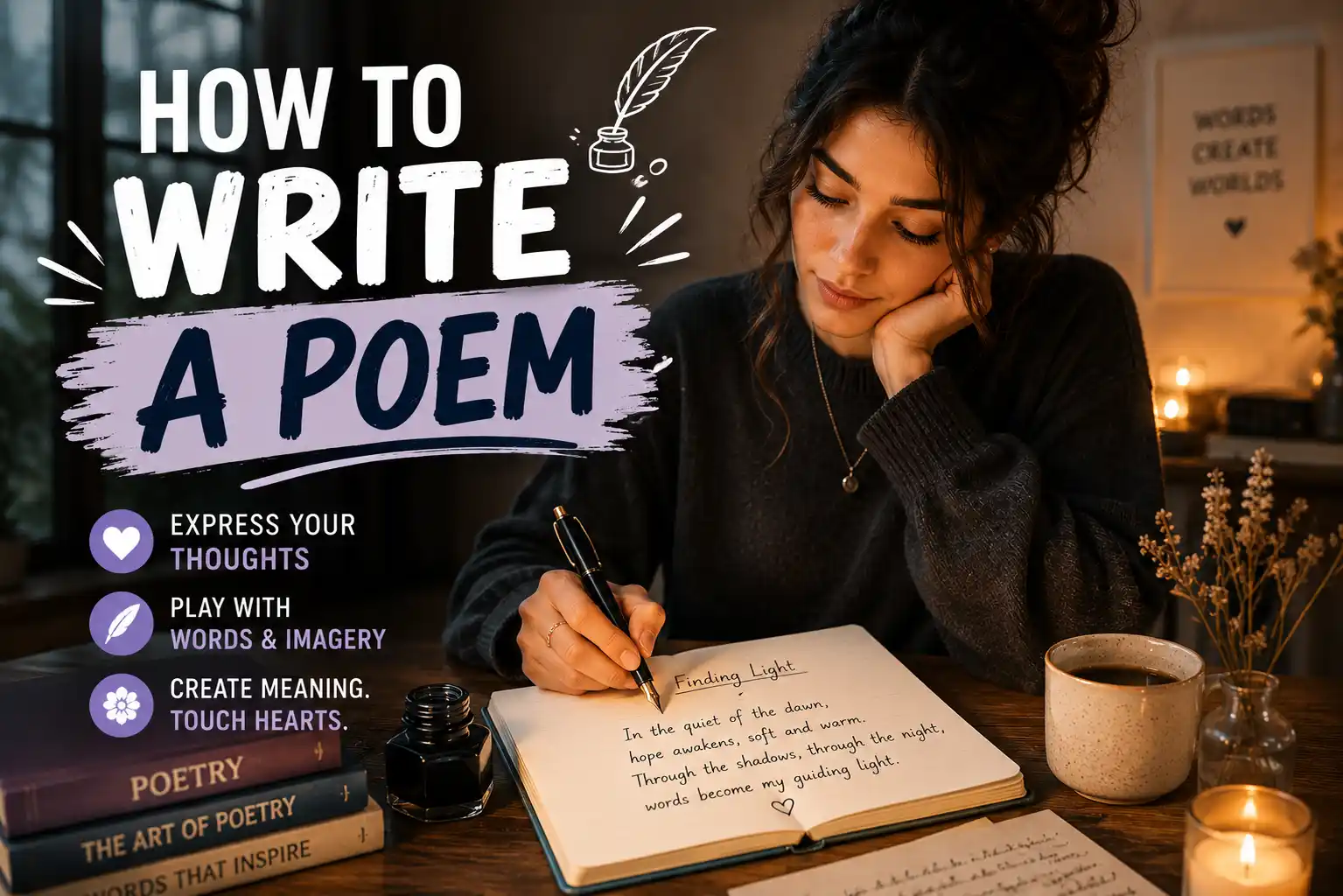
You have words inside you that want to become something more. A feeling too big for a sentence. A memory that won't let go. A question that needs to be asked in a different way.
Poetry is how you say the unsayable. And here's the truth: anyone can write a poem. You don't need a literature degree. You don't need to know what iambic pentameter means. You just need something to say and the courage to say it differently.
This guide will walk you through everything you need to know to write your first poem,from finding inspiration to choosing a form, crafting imagery, and revising your work. No rules. Just possibilities.
Poetry at a Glance
Remember: there are no poetry police. Your poem can be anything you want it to be.
1 Why Write Poetry? Finding Your Voice
Before you write a single line, understand why poetry matters to you and to the world.
Emotional Expression
Poetry captures feelings that prose can't quite reach. It's the language of the heart—raw, honest, and free.
Clarity Through Complexity
Sometimes the best way to understand a feeling is to write around it, not at it. Poetry lets you explore indirectly.
Connection
Your poem might help someone feel less alone. Poetry creates intimacy between strangers.
Skill Development
Poetry teaches you to choose every word carefully. That skill improves all your writing—emails, essays, stories, songs.
2 The 7-Step Poetry Writing Process
Step 1: Find Your Subject
What do you want to write about? A person? A place? A feeling? A question? Start with what moves you.
Step 2: Free Write
Write without stopping for 5-10 minutes. Don't edit. Don't judge. Just let words flow.
Step 3: Choose a Form
Decide on a structure. Will you rhyme? Use a specific meter? Write free verse? Follow a form like haiku or sonnet?
Step 4: Write the First Draft
Don't worry about perfection. Get the poem onto the page. You can't revise a blank page.
Step 5: Add Imagery
Go back through your draft. Replace abstract words with concrete images. Show, don't tell.
Step 6: Revise Ruthlessly
Cut unnecessary words. Strengthen weak lines. Read aloud and trust your ear.
Step 7: Share (or Don't)
Poems are meant to be read—but you get to decide who reads yours. Share it, keep it private, or set it free.
Count Your Words, Find Your Rhythm
Use our free word counter to track your poem's length and syllable patterns. Perfect for haiku, sonnets, and metered poetry.
Track Your Poem3 Poetic Forms: Finding Your Structure
You don't have to follow a form. But knowing the options helps you choose or break the rules deliberately.
Haiku
Structure: 3 lines. Syllable pattern: 5-7-5. Often about nature or a single moment.
A frog jumps in —
Sound of water.
Sonnet
Structure: 14 lines. Usually iambic pentameter. Rhyme scheme varies (Shakespearean: ABAB CDCD EFEF GG).
Thou art more lovely and more temperate...
Free Verse
Structure: No rules. No required rhyme or meter. Just your voice and your choices.
upon
a red wheel
barrow
glazed with rain
water
beside the white
chickens
Limerick
Structure: 5 lines. AABBA rhyme scheme. Usually humorous. Lines 1,2,5 have 8-9 syllables; lines 3,4 have 5-6.
Whose limericks stopped at line two
Villanelle
Structure: 19 lines. Two repeating rhymes and two refrains. Complex but beautiful. Known for "Do not go gentle into that good night."
Acrostic
Structure: The first letter of each line spells a word or phrase vertically. Great for name poems or hidden messages.
4 Rhyme and Meter: The Music of Poetry
Poetry isn't just about meaning—it's about sound. Rhyme and meter give your poem rhythm and flow.
Common Rhyme Schemes
AABB: The cat sat (A) / On a nice mat (A) / It looked at me (B) / So happily (B)
ABAB: The sun is bright (A) / The sky is blue (B) / What a lovely sight (A) / The whole day through (B)
ABBA (Enclosed rhyme): The day is done (A) / The night descends (B) / The darkness bends (B) / Around the sun (A)
No rhyme (Free verse): Your words create rhythm through line breaks and repetition instead of rhymes.
Understanding Meter
Iamb (da-DUM): "toDAY" — Most common in English poetry.
Trochee (DA-dum): "PICture" — Creates a falling rhythm.
Anapest (da-da-DUM): "in the NIGHT" — Galloping rhythm.
Dactyl (DA-da-da): "BEAUtiful" — Creates urgency.
Pro tip: Don't worry about perfect meter in your first poem. Focus on how it sounds when you read it aloud.
How to Find Your Poem's Rhythm
Read your poem aloud. Tap your hand or foot as you speak. Where do the natural stresses fall? Does the rhythm match the emotion? Sad poems often use slower, heavier rhythms. Happy poems might skip and bounce.
Experiment: Try reading the same line with different emphasis. "I NEVER said I loved you" means something different from "I never SAID I loved you." Each word carries weight.
5 Imagery and Figurative Language: Painting with Words
The best poems don't tell you how to feel—they show you something, and the feeling arrives on its own.
Show, Don't Tell: Examples
Types of Imagery
Visual: What you see (cracked pavement, gold light, wilted flowers)
Auditory: What you hear (rain on tin roof, distant train whistle)
Tactile: What you feel (rough wool, warm tea mug)
Olfactory: What you smell (coffee, woodsmoke, rain on hot asphalt)
Gustatory: What you taste (salt, bitter chocolate, summer strawberries)
Figurative Language Tools
Simile: Comparison using "like" or "as" (quiet as a mouse, cold like the space beside you)
Metaphor: Direct comparison (time is a thief, her voice is honey)
Personification: Giving human qualities to non-human things (the wind whispered, the house held its breath)
Hyperbole: Exaggeration for effect (I've told you a million times)
6 Poetry Prompts to Get You Started
15 Prompts for When You Feel Stuck
7 Common Poetry Mistakes (And How to Fix Them)
Watch Out For
❌ Forced rhymes (changing meaning just to rhyme)
❌ Clichés (heart of gold, broken heart, crying tears)
❌ Abstract language (love, pain, freedom—without concrete details)
❌ Too many adjectives (weaken your nouns instead)
❌ Telling instead of showing
❌ Over-explaining (leave room for the reader)
❌ Perfect first draft syndrome (it doesn't exist)
How to Fix Them
✅ Change the word order or find a near rhyme instead
✅ Ask: "What does this cliché actually look like?" Describe that
✅ Replace one abstract word with a concrete image
✅ Cut adjectives. Let strong nouns and verbs work harder
✅ Find the moment and paint it
✅ Trust your reader. Cut the last two lines. They were probably too much
✅ Finish the draft. You can't fix what doesn't exist
8 Example Poems (Short & Simple)
the cat curled
on my chest.
Barista doesn't ask.
Just pours.
I've become
a regular somewhere
and I'm not sure how.
The path is overgrown with weeds (B)
I used to know this place by heart (C)
But time has planted different seeds (B)
Every star was ours to name
And morning came too soon.
Don't you wish we had that back?
9 Your Poetry Writing Checklist
The Bottom Line
You don't need permission to write poetry. You don't need to be sad or dramatic or deep. You just need to be honest.
Your first poem might not be good. That's fine. Write it anyway. Then write another one. Then another one. That's how every poet you've ever admired started.
Poetry isn't about being perfect. It's about being true. Find the small moments. Notice the details others miss. Write down what you see, what you feel, what you remember.
The world needs your voice. However uncertain it might feel. Start now. Write one line. Then another. Then another.
You're a poet already. You just haven't written it down yet.