How to Write a Song: A Complete Guide for Beginners
You have a melody stuck in your head. Or maybe you have words that need music. You've been dreaming of writing your own song, but you're not sure where to start.
Here's the truth: every songwriter started exactly where you are. They didn't know all the rules. They just started. And with a little guidance, you can too.
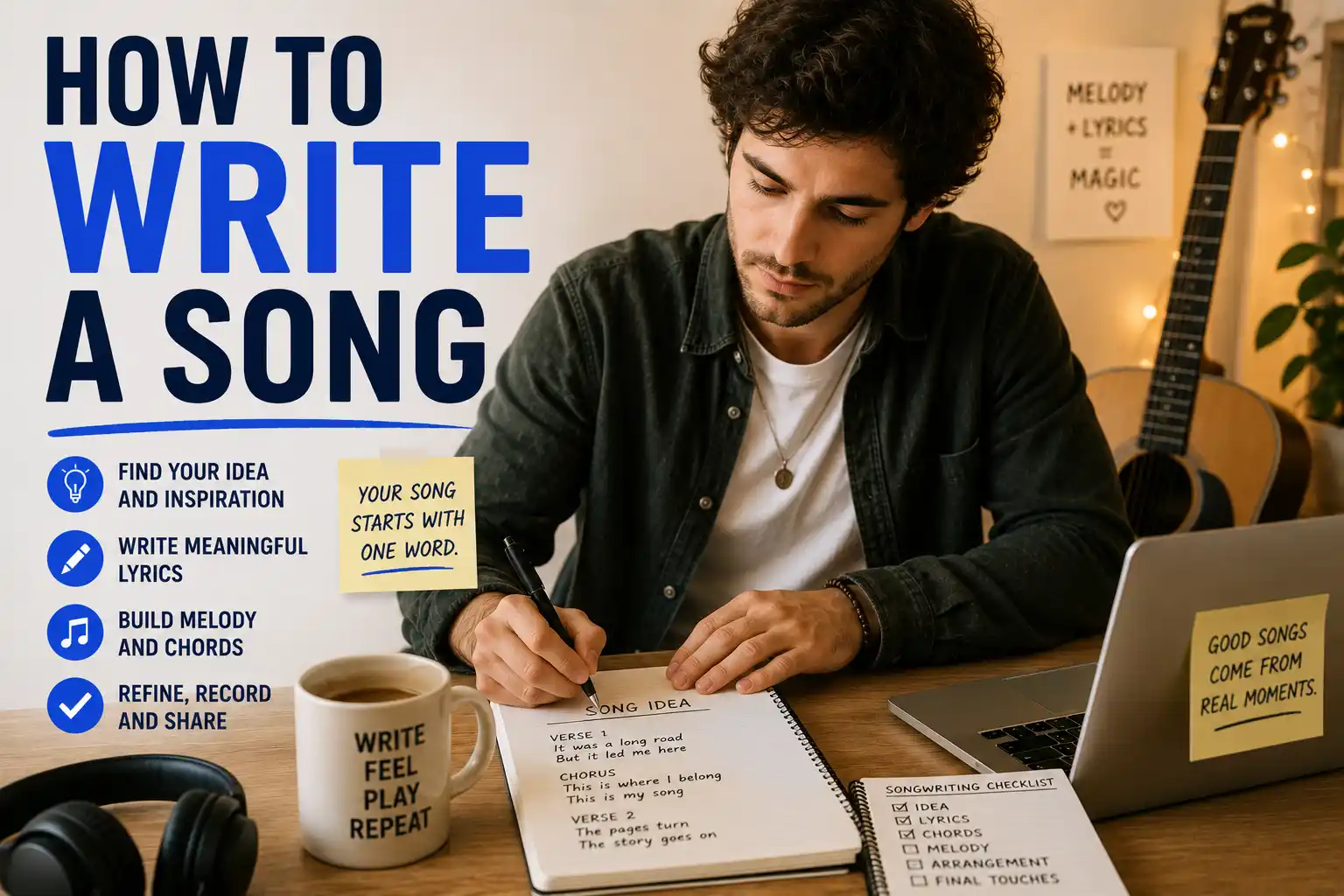
This guide walks you through everything you need to know to write your first song from finding inspiration to crafting lyrics, building melody, and structuring your song. No music theory degree required.
Songwriting at a Glance
Remember: your first song won't be perfect. That's fine. Every songwriter has written songs they'll never show anyone. That's called practice.
1 Why Write Songs? Finding Your "Why"
Before you write a single lyric, know why you're doing this. Your "why" will carry you through the hard parts.
Self-Expression
Songs capture emotions that words alone can't express. Writing songs helps you process feelings, tell your story, and share your perspective with the world.
Connection
Music connects people. Your song might help someone feel less alone, understand something new, or just dance in their kitchen.
Growth
Songwriting is a skill you can improve. Every song teaches you something. Even bad songs are good practice.
Joy
There's nothing like the feeling of finishing a song you're proud of. That moment when everything clicks? Pure magic.
2 The 8-Step Songwriting Process
Step 1: Find Your Idea
Every song starts with a spark , a feeling, a story, a phrase, a melody. Capture your idea immediately.
Step 2: Choose a Title/Hook
The hook is the most memorable part of your song—usually the chorus. Start with a strong title.
Step 3: Pick a Structure
Most popular songs follow a familiar pattern. Choose your song structure before you write.
Step 4: Write the Lyrics
Start with the chorus (the main message). Then write verses that tell the story leading to that chorus.
Step 5: Find the Melody
Hum or play notes that match the emotion of your words. Start simple. You can refine later.
Step 6: Add Chords
Basic chords (I, IV, V, vi) work for most songs. In C major: C, F, G, Am. Experiment and trust your ear.
Step 7: Revise and Refine
Step away for a day. Come back with fresh ears. Cut unnecessary words. Strengthen weak lines.
Step 8: Perform or Record
Songs are meant to be heard. Play it for someone. Record a demo. Share it with the world (or just your dog).
Track Your Lyrics
Use our free word counter to track your lyric length. Most songs have 150-300 words, perfect for a 3-4 minute song.
Count Your Lyrics3 Understanding Song Structure
Most popular songs follow this basic structure. Learn the rules so you can break them creatively:
Song Structure Breakdown
AABB: The cat sat (A) / On a nice mat (A) / It looked at me (B) / So happily (B)
ABAB: The sun is bright (A) / The sky is blue (B) / What a lovely sight (A) / The whole day through (B)
AAAA: I love to sing (A) / My heart takes wing (A) / Joy that I bring (A) / Let freedom ring (A)
No rhyme: Free verse works too. Not every song needs perfect rhymes.
4 Where to Find Song Ideas
Tap Your Life
✓ A breakup or falling in love
✓ A conversation you overheard
✓ A place that means something to you
✓ A childhood memory
✓ Something you're afraid of
✓ A dream you had
✓ Someone you miss
Look Outward
✓ A news story that moved you
✓ A character from a book or movie
✓ A historical event
✓ A photograph that tells a story
✓ Someone else's experience
✓ A painting or piece of art
✓ Nature or weather
Songwriting Prompts to Get Started
📝 Write a song from the perspective of an object (a forgotten letter, an old guitar, a city).
📝 Write a song that starts with the line "I remember..."
📝 Write a song that's a conversation between two people.
📝 Write a song about the last time you felt truly alive.
📝 Write a song using only one-syllable words.
📝 Write a song that's a list (things I've lost, places I've been, people I miss).
5 Lyric Writing: From Blank Page to Powerful Words
DO This
✅ Use concrete images (a rusty swing set, not just "childhood")
✅ Write what you know (authenticity beats cleverness)
✅ Read your lyrics aloud (if it's awkward to say, it's awkward to sing)
✅ Use repetition (choruses repeat for a reason)
✅ Leave room for the listener (don't over-explain)
✅ Keep a notebook of phrases and ideas
DON'T Do This
❌ Use clichés (broken heart, crying tears—find fresh ways)
❌ Force rhymes (if it doesn't fit, change the line)
❌ Write abstract (love, pain, freedom—show it instead)
❌ Say the same thing twice in different words
❌ Start with "I woke up this morning" (unless it's essential)
❌ Judge your first draft (just get it down)
Show vs. Tell: Examples
6 Melody and Chords: Making Your Song Sing
Finding the Melody
Start with your speaking voice: Speak your lyrics naturally. The rhythm and pitch changes of your speech are a built-in melody generator.
Hum while walking: Movement helps creativity. Hum as you pace around.
Play with intervals: Go up and down. Try big leaps for emotional moments.
Simple Chord Progressions
I-V-vi-IV (The "Axis"): C - G - Am - F (Used in thousands of hits)
I-IV-V (Classic rock): C - F - G
vi-IV-I-V (Pop punk): Am - F - C - G
I-vi-IV-V (Doo-wop): C - Am - F - G
Beginner-Friendly Keys
On guitar: C, G, D, A, E (open chords are easier)
On piano: C, G, D, F (fewer black keys)
Pro tip: Use a capo on guitar to change keys easily. Use the transpose button on keyboards.
7 Common Songwriting Mistakes (And How to Avoid Them)
Watch Out For
❌ Overwriting (too many words, too complex)
❌ Same melody for verse and chorus (no contrast = boring)
❌ Forcing rhymes that don't work naturally
❌ Starting every line on the same note
❌ Ignoring rhythm (lyrics need to fit the beat)
❌ Never finishing (perfectionism kills songs)
Quick Fixes
✅ Simplify. Cut your least favorite line from each verse.
✅ Raise the chorus melody higher than the verse.
✅ Change the rhyme scheme or use near rhymes.
✅ Add rests and syncopation for interest.
✅ Tap the beat while reading lyrics.
✅ Finish the song. Bad songs teach you more than perfect unfinished ones.
8 Song Length Examples from Famous Artists
Notice: most popular songs have 150-300 words. You don't need to write a novel. Say what needs to be said and move on.
9 Your Songwriting Checklist
The Bottom Line
You don't need a music degree. You don't need expensive equipment. You don't need permission.
You just need to start.
Write that first bad song. Then write another one. And another. Every songwriter you admire wrote dozens of terrible songs before they wrote a good one. That's the secret—they kept going.
Your song doesn't have to change the world. It just has to be yours. So pick up your guitar, sit at your piano, open your notebook, or pull out your phone.
The song is waiting. Go write it.