How to Write a Personal Statement: The Complete Guide with Examples
You have the grades. You have the qualifications. You have the ambition. But when you sit down to write your personal statement, your mind goes blank. You stare at a blank screen. You do not know where to start, what to include, or how to make yourself stand out.
You are not alone. Writing a personal statement is one of the most challenging parts of the university application process. It is your chance to show admissions tutors who you are beyond your grades. It is your opportunity to tell your story, demonstrate your passion, and make a compelling case for why you deserve a place.
This guide will teach you everything you need to know about how to write a personal statement that captivates admissions tutors and helps you stand out from the crowd. We will cover the structure, the content, the tone, and the common mistakes to avoid. By the end, you will have the tools to write a personal statement that truly reflects who you are.
Personal Statement at a Glance
1 What Is a Personal Statement and Why Does It Matter?
A personal statement is a written essay that you submit as part of your university or college application. It is your opportunity to introduce yourself to admissions tutors, explain why you want to study a particular course, and demonstrate your suitability for the program.
Think of it as your written interview. Your grades and qualifications show that you can handle the academic work. Your personal statement shows who you are as a person — your interests, your experiences, your motivations, and your potential. It is your chance to bring your application to life.
Admissions tutors read hundreds, sometimes thousands, of personal statements. A compelling one can make you memorable and tip the scales in your favour. A generic or poorly written one can make you blend in with the crowd.
Tells Your Story
Your personal statement is your chance to tell your unique story. It gives admissions tutors a sense of who you are beyond your grades.
Demonstrates Passion
It shows your genuine interest in and commitment to your chosen subject. Admissions tutors want to see that you are excited about the course.
Differentiates You
In a competitive applicant pool, a strong personal statement can set you apart. It provides a personal, human perspective that numbers cannot.
Showcases Your Potential
It demonstrates your academic potential, your critical thinking skills, and your ability to articulate your ideas clearly and persuasively.
2 The Fundamentals of Writing a Personal Statement
Before you start writing, you need to understand the foundational principles that underpin every effective personal statement.
Show, Don't Tell
This is the single most important rule of personal statement writing. Do not just tell the reader that you are passionate, hardworking, or curious. Show them through specific examples, experiences, and achievements. Let the evidence speak for itself.
Focus on Your Chosen Subject
Your personal statement should be subject-focused. Admissions tutors want to see that you are genuinely interested in and engaged with the course you are applying for. The majority of your statement should be about your academic interests and experiences related to your chosen subject.
Be Authentic and Personal
Your personal statement should sound like you. Do not try to impress with overly complex vocabulary or write what you think admissions tutors want to hear. Be honest, be specific, and let your genuine voice come through.
The "So What?" Test
For every statement you make in your personal statement, ask yourself: "So what?" Why does this matter? How does this demonstrate my suitability for the course? If you cannot answer that question, revise or remove the statement.
3 How to Structure Your Personal Statement
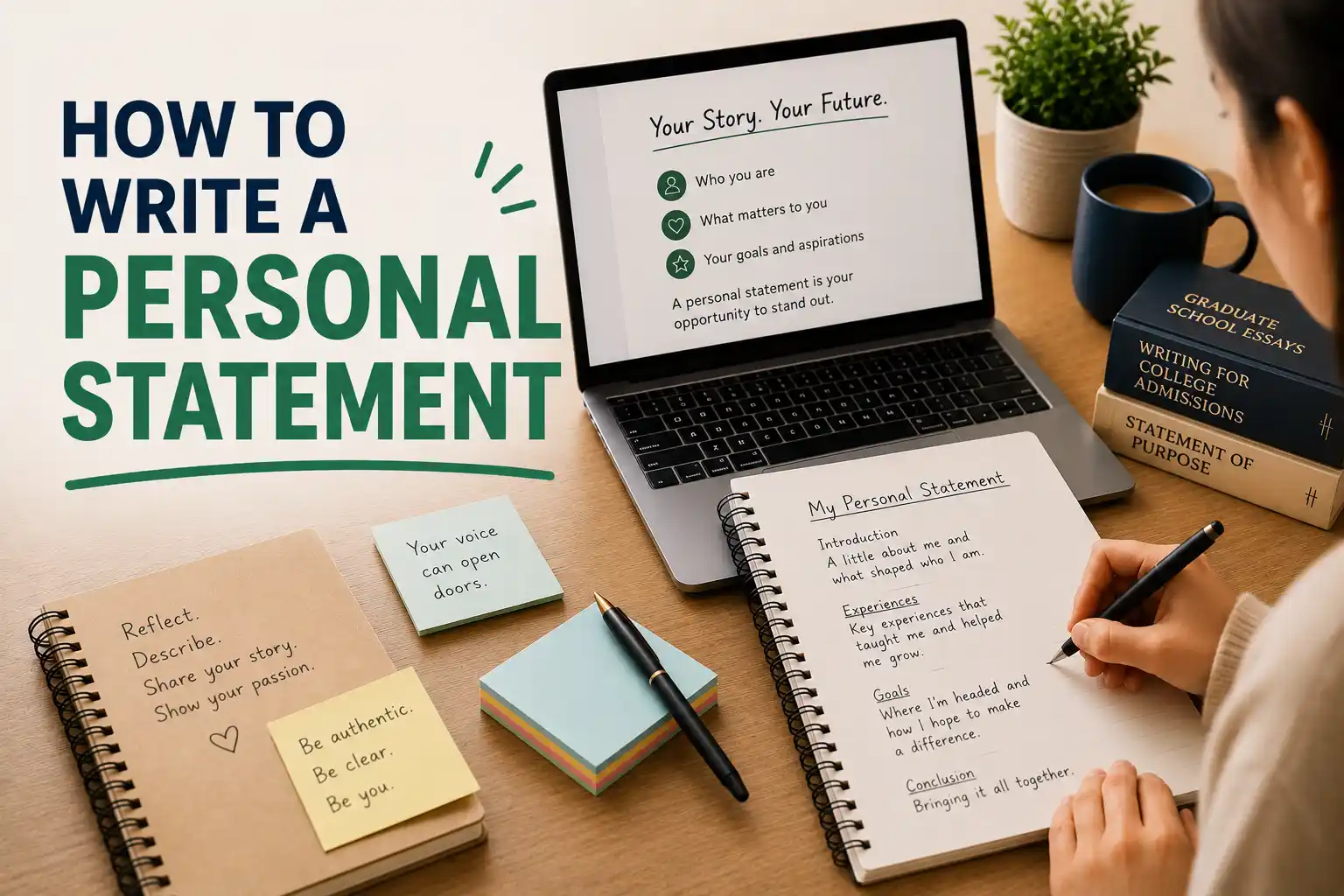
A well-structured personal statement is easy to read and presents your case clearly. Here is a recommended structure.
Opening Paragraph: The Hook
Your opening paragraph should grab the reader's attention. Start with a compelling hook — a specific moment, experience, or question that introduces your interest in the subject. Avoid clichéd openings like "I have always wanted to be a doctor" or "I am passionate about history."
Example
"The first time I held a scalpel in a medical simulation, I knew I wanted to study medicine. The precision, the focus, and the responsibility of making a difference — I felt it all in that moment."
Body Paragraphs: Your Story and Evidence
The body of your personal statement is where you provide evidence of your interest and suitability for the course. Use 2–3 paragraphs to cover:
- Academic interests: What aspects of the subject fascinate you? What have you read, studied, or explored outside of the curriculum?
- Relevant experiences: Work experience, volunteering, extracurricular activities, or projects that relate to your chosen subject.
- Skills and qualities: What skills do you have that make you a good fit for the course? (e.g., critical thinking, problem-solving, teamwork, leadership)
Closing Paragraph: Summary and Future Aspirations
Your closing paragraph should summarize your case and look to the future. Explain what you hope to achieve through studying the course and how it fits into your longer-term goals. End with a strong, positive statement.
Example
"Studying law at university will not only deepen my understanding of the legal system but also equip me with the skills to advocate for justice and make a meaningful contribution to society. I am excited about the journey ahead and the opportunity to develop my potential at your institution."
4 What to Include in Your Personal Statement
Every personal statement should include certain essential elements. Here is what to include, section by section.
Your Subject-Specific Interests
This is the most important part of your personal statement. Show that you are genuinely engaged with your chosen subject. Mention specific topics, theories, or debates that interest you. Reference books, articles, or podcasts that have shaped your understanding. This demonstrates intellectual curiosity and a genuine passion.
Relevant Experiences
Include experiences that are relevant to your chosen subject. This could be work experience, volunteering, internships, or even personal projects. Focus on what you learned from these experiences and how they confirmed or deepened your interest in the subject.
Transferable Skills
Highlight the skills you have developed that will help you succeed in the course and beyond. This could include communication, research, teamwork, problem-solving, leadership, or time management. Again, provide specific examples.
Extracurricular Activities
Include extracurricular activities that demonstrate your interests, character, or commitment. However, keep the focus on your subject. Only include extracurriculars if they are relevant or reveal important aspects of your character that support your application.
Future Aspirations
What do you hope to do after university? How will this course help you achieve your goals? Admissions tutors want to see that you have thought about your future and that their course is a meaningful step towards it.
What to Include vs. What to Avoid
5 How to Write a Personal Statement: Step-by-Step
Here is a step-by-step process for writing your personal statement.
Step 1: Brainstorm and Research
Before you start writing, spend time brainstorming. What are your genuine interests in the subject? What experiences have shaped your interest? What books, articles, or podcasts have influenced you? Jot down everything. Also, research the course and university to understand what they are looking for.
Step 2: Write a Rough Draft
Do not worry about perfection at this stage. Just get your ideas down on paper. Follow the structure outlined above. Write freely and do not worry about word count — you can trim later.
Step 3: Revise for Content
Read your draft critically. Does it show your passion for the subject? Does it provide specific evidence? Does it tell a coherent story? Revise to strengthen your arguments and add more specific details.
Step 4: Check the Word Count
If you are writing a UCAS personal statement, you have 4,000 characters (including spaces). Cut any unnecessary words or repetition. Make every sentence count.
Step 5: Proofread and Polish
Check for spelling, grammar, and punctuation errors. Read your statement aloud to catch awkward phrasing. Ask a teacher, mentor, or friend to review it. Fresh eyes will catch things you have missed.
The Writing Process
Writing a personal statement is a process, not a one-time event. Expect to write multiple drafts. Give yourself plenty of time. Do not leave it to the last minute. A great personal statement is the result of reflection, revision, and hard work.
6 Common Mistakes to Avoid
Even well-intentioned applicants make mistakes. Here are the most common errors and how to avoid them.
Being Too Generic
"I have always wanted to study law." "I am passionate about history." These statements are overused and meaningless without specific evidence.
Fix: Provide specific, personal examples that show your interest.
Using Clichés
"I have a thirst for knowledge." "I am a team player." "I am a natural leader." These phrases are empty without evidence.
Fix: Show these qualities through specific examples.
Not Focusing on the Subject
Spending too much time on extracurriculars or personal details that are not relevant to the course.
Fix: Keep the focus on your academic interests and suitability for the course.
Telling Instead of Showing
Stating qualities without providing evidence. "I am hardworking." "I am curious."
Fix: Show these qualities through specific experiences and examples.
Being Too Negative
Focusing on weaknesses or failures. This is not the place for that.
Fix: Focus on your strengths, achievements, and positive experiences.
Exaggerating or Lying
Making claims that are not true. Admissions tutors can often tell when you are not being genuine.
Fix: Be honest and authentic. Let your real experiences speak for themselves.
7 How to Write a Personal Statement for Different Courses
The content and emphasis of your personal statement will vary depending on the course you are applying for. Here are some specific considerations.
Sciences (Medicine, Engineering, Biology)
Focus on your scientific curiosity and practical skills. Mention specific topics or experiments that have fascinated you. Discuss relevant work experience or volunteering. Demonstrate a genuine passion for the subject.
Key trait: Evidence of scientific interest and practical experience.
Humanities (History, English, Philosophy)
Focus on your intellectual engagement and critical thinking. Mention specific books, authors, or historical periods that have shaped your interest. Demonstrate your ability to analyse and argue.
Key trait: Evidence of reading and intellectual curiosity.
Creative Arts (Fine Art, Music, Drama)
Focus on your creative practice and influences. Discuss your portfolio, performances, or creative projects. Mention artists, musicians, or movements that have inspired you.
Key trait: Evidence of creative engagement and practice.
Vocational Courses (Law, Education, Social Work)
Focus on your commitment to the profession and relevant experience. Discuss your motivations, your understanding of the profession, and any work experience or volunteering that has confirmed your interest.
Key trait: Evidence of commitment and practical experience.
8 How to Revise Your Personal Statement
A great personal statement is not written; it is rewritten. Revision is where your statement goes from good to great. Here is a step-by-step process for revising your personal statement.
Step 1: Read It Aloud
Read your personal statement aloud. Does it sound like you? Is it natural? Are there any awkward phrases? Reading aloud helps you catch issues you might miss when reading silently.
Step 2: Check the Content
Does your statement show your passion for the subject? Does it provide specific evidence? Does it tell a compelling story? Revise to strengthen your arguments.
Step 3: Check the Word Count
Are you within the word limit? Cut any unnecessary words or repetition. Make every sentence count. Be ruthless.
Step 4: Check for Clichés
Go through your statement and identify any clichéd phrases. Replace them with original, specific language.
Step 5: Get Feedback
Ask a teacher, mentor, or friend to review your statement. Fresh eyes will catch issues you have missed. Ask them: "Does this sound like me? Do I come across as passionate and genuine?"
Step 6: Polish and Proofread
Check for spelling, grammar, and punctuation errors. A polished statement demonstrates attention to detail.
9 Practice Exercises to Improve Your Personal Statement
The best way to get better at writing a personal statement is to practice. Here are some exercises to help you sharpen your skills.
Exercise 1: The "Hook" Challenge
Write five different opening sentences for your personal statement. Each one should try a different approach: a question, a specific moment, a surprising fact, a personal anecdote, or a statement of purpose. Choose the one that is most compelling.
Exercise 2: The "Show, Don't Tell" Rewrite
Write a list of statements about yourself (e.g., "I am hardworking"). Then rewrite each one as a specific example that demonstrates the quality. Compare the two versions. Which is more compelling?
Exercise 3: Peer Review Swap
Swap personal statements with a friend or classmate. Review each other's statements and provide honest feedback. What is working? What could be stronger? What surprised you?
Exercise 4: Write a Statement for a Different Subject
Write a personal statement for a subject you know nothing about. This forces you to think about how to convey interest and enthusiasm even without deep knowledge — a useful skill for any personal statement.
10 Personal Statement Examples and Analysis
Here is a sample personal statement with analysis to show you what works.
Sample Personal Statement (Medicine)
"The first time I witnessed a surgical procedure, I was transfixed. The precision, the focus, and the profound responsibility of saving a life — it was a moment that confirmed my calling. My fascination with medicine, however, began long before that day, rooted in a childhood curiosity about the human body and a desire to help others."
"My A-level studies in Biology and Chemistry deepened my understanding of the scientific principles underpinning medicine. I was particularly drawn to the complex interplay between genetics and disease, a topic I explored further through independent reading and a summer course at [University]."
"Beyond the classroom, I gained valuable insight into the realities of healthcare through volunteering at a local hospital. Assisting nurses on a busy ward taught me the importance of compassion, communication, and teamwork in patient care. I also learned to remain calm under pressure and adapt to rapidly changing situations."
"These experiences have solidified my commitment to a career in medicine. I am excited about the opportunity to study at your university and to develop the clinical skills and knowledge that will allow me to make a meaningful difference in patients' lives."
Why This Works
- Strong opening hook: The specific moment of witnessing surgery grabs attention.
- Subject focus: The statement is clearly about medicine and demonstrates genuine interest.
- Specific evidence: Mentions A-level subjects, independent reading, a summer course, and volunteering experience.
- Shows rather than tells: Qualities like compassion and teamwork are shown through the volunteering example.
- Future-focused: The closing paragraph looks ahead to university and a career in medicine.
Final Thoughts
Writing a personal statement is a significant undertaking. It is your chance to tell your story, demonstrate your passion, and make a compelling case for why you deserve a place on your chosen course.
Remember that your personal statement is not just a list of achievements. It is a reflection of who you are — your interests, your experiences, your motivations, and your potential. Take the time to write something that is genuinely you.
Keep these principles in mind as you write:
- Show, don't tell. Use specific examples to demonstrate your qualities and interests.
- Focus on your subject. The majority of your statement should be about your academic interests.
- Be authentic. Write in your own voice. Do not try to impress with overly complex language.
- Be specific. Provide concrete examples and details. Vague statements are forgettable.
- Revise, revise, revise. A great personal statement is the result of multiple drafts and careful polishing.
The university application process is competitive. But you have something unique to offer. Your personal statement is your opportunity to show that. Take the time to write something that reflects your genuine passion, your intellectual curiosity, and your potential. You can do this.
Now go write a personal statement that tells your story.