How to Write a CV: The Complete Guide with Examples
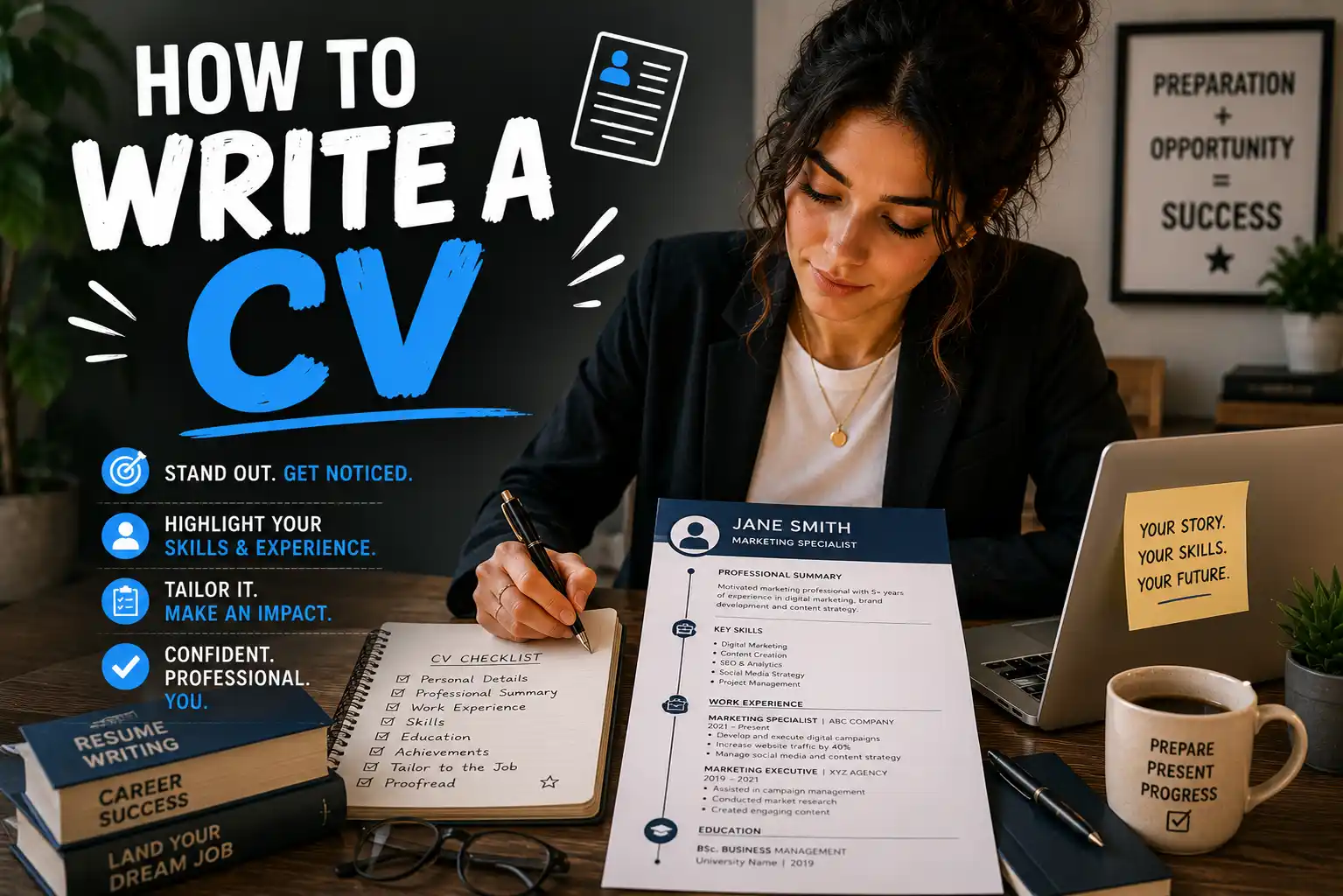
You have the skills. You have the experience. But when you sit down to write your CV, your mind goes blank. You do not know where to start. You are not sure what to include or how to format it. And you worry that your CV will end up in the "no" pile before anyone even reads it.
You are not alone. Writing a CV is one of the most daunting tasks in any job search. A great CV can open doors. A poor one can close them before you even get a chance. But with the right approach, you can create a document that showcases your value and gets you noticed.
This guide will teach you everything you need to know about how to write a CV that stands out. We will cover the structure, the content, the formatting, and the common mistakes to avoid. By the end, you will have the tools to craft a CV that gets you interviews and helps you land the job you want.
CV Writing at a Glance
1 What Is a CV and Why Does It Matter?
A CV — short for curriculum vitae, which translates to "course of life" — is a professional document that summarizes your education, work experience, skills, and achievements. It is your primary tool for getting noticed by employers and securing interviews.
Think of your CV as a marketing document. You are the product, and your CV is the advertisement. Its job is to convince a recruiter or hiring manager that you are worth meeting. A well-written CV highlights your strengths, demonstrates your value, and tells a compelling story about your career.
Your CV is often the first impression you make on a potential employer. In a competitive job market, it needs to be sharp, relevant, and mistake-free. A strong CV can be the difference between landing an interview and being overlooked.
First Impression
Your CV is often the first thing an employer sees. It creates an immediate impression of your professionalism, attention to detail, and suitability for the role.
Showcases Your Value
A great CV highlights your achievements and demonstrates the value you can bring to an organization. It is your chance to make a compelling case for why you are the right person for the job.
Opens Doors
A well-crafted CV gets you interviews. It is your entry ticket into the hiring process. Without a strong CV, you may never get the chance to make your case in person.
Tells Your Story
Your CV tells the story of your career. It shows how you have grown, what you have achieved, and where you are headed. A compelling narrative makes you memorable.
2 The Fundamentals of Writing a CV
Before you start writing, you need to understand the foundational principles that underpin every effective CV.
Tailor Every CV to the Job
This is the single most important rule of CV writing. Never send the same generic CV to every employer. Recruiters can spot a generic CV instantly. It shows a lack of effort and does not highlight how your skills match the specific role. Tailor your CV for each application by using keywords from the job description and highlighting relevant experience.
Focus on Achievements, Not Duties
Many people list only what they were "responsible for" instead of what they actually accomplished. Employers want to see impact, not just tasks. Use action verbs and quantify your results where possible. For example, instead of saying "Responsible for managing social media," say "Increased Instagram engagement by 40% over six months using a targeted content strategy".
Keep It Clean and Professional
Your CV should be easy to read and visually appealing. Use a clean, professional layout with clear headings, consistent formatting, and plenty of white space. Avoid overly creative designs, excessive colours, or graphics unless you are applying for a creative role. A messy CV is hard to read and may be rejected by an Applicant Tracking System (ATS).
The ATS Factor
Many companies use Applicant Tracking Systems (ATS) to screen CVs before a human ever sees them. These systems scan for keywords from the job description. To pass the ATS, use standard section headings (e.g., "Work Experience," "Education"), include relevant keywords, and avoid complex formatting like tables or graphics. Keep your CV clean and machine-readable.
3 CV Formats: Which One Should You Choose?
There are three main CV formats to choose from. The right one depends on your experience, career goals, and the job you are applying for.
Chronological CV
The chronological CV is the most common format. It lists your work experience and education in reverse chronological order, with your most recent experience first. This format highlights career progression and is ideal if you have a consistent work history.
Best for
Candidates with a strong, continuous work history in a single field. Employers expect this format and find it easy to scan.
Skills-Based (Functional) CV
A skills-based CV organizes your experience around skills rather than job titles. It focuses on what you can do, not where you did it. This format is useful if you are changing careers, have gaps in your employment, or have had many short-term jobs.
Best for
Career changers, people with employment gaps, or those with diverse experience that does not fit a linear narrative.
Combination (Hybrid) CV
A combination CV merges elements of the chronological and functional styles. It lists your education and work history in reverse chronological order but also includes a dedicated skills section that highlights your key competencies. This format works well when you want to emphasize particular skills for a job.
Best for
Most job seekers. It combines the clarity of the chronological format with the flexibility of the skills-based approach.
CV Format Comparison
4 How to Format Your CV
Proper CV formatting is essential for readability and professionalism. Here are the key formatting rules to follow.
Font and Size
Use a clean, sans-serif font that is easy to read. Good options include Arial, Calibri, Helvetica, Lato, and Verdana. Keep the font size between 10 and 11 points for body text, and use a larger size (14–16 points) for your name and section headings.
Margins and Spacing
Maintain margins between 0.5 and 1 inch. Margins that are too wide leave excessive white space, while margins that are too narrow make the page look crowded. Use white space strategically to separate sections and make the document easy to scan.
Length
In the UK, a two-page CV is standard. In the US, a resume is typically one page (or two for experienced professionals). Avoid half pages. If you are a student or recent graduate, aim for one page.
Use Your Name as the Heading
There is no need to write "CV" or "Curriculum Vitae" at the top of your document. Use your name as the heading, followed by your contact details.
Use Bullet Points
Use bullet points to list your responsibilities and achievements. This makes your CV easier to scan and digest. Keep bullet points concise — ideally one to two lines each.
Formatting Checklist
- Font: Sans-serif, 10–11pt (body), 14–16pt (headings)
- Margins: 0.5–1 inch
- Length: 1–2 pages (depending on experience and region)
- Headings: Clear, consistent, and bold
- Bullet points: Use for lists and achievements
- White space: Use to separate sections and improve readability
- File format: Save as PDF to preserve formatting
5 What to Include in Your CV
Every CV should include certain essential sections. Here is what to include, section by section.
Contact Details
Include your full name, phone number, and email address. You can also include your location (town or city) so employers know you are local. Optionally, add links to your LinkedIn profile, portfolio, or website. Do not include a photo, your date of birth, gender, or marital status.
Personal Statement (Profile)
A personal statement is a short section at the top of your CV that summarizes who you are and what you are looking for. It should be 2–4 sentences long and tailored to the role. Avoid generic statements like "I am hard-working". Instead, focus on what you can offer the employer.
Example
"Results-driven Marketing Professional with 5+ years of experience in digital strategy and brand management. Proven track record of increasing engagement by 40% and driving revenue growth. Seeking a senior marketing role in a fast-paced, innovative environment."
Work Experience
This is the most important section of your CV. List your jobs in reverse chronological order, with your most recent role first. For each role, include:
- Job title
- Company name and location
- Dates of employment
- Bullet points describing your responsibilities and achievements
Focus on achievements, not just duties. Use action verbs and quantify your results where possible.
Education
List your education in reverse chronological order. Include the name of the institution, the dates you attended, and the qualifications you achieved. If you are a recent graduate, you can include relevant modules, projects, or your dissertation.
Skills
List the key skills that are relevant to the job. These can be technical skills (e.g., software proficiency) or soft skills (e.g., communication, problem-solving). Look at the job description and match your skills to what the employer is looking for.
Additional Sections (Optional)
Depending on your experience and the job, you may also include:
- Hobbies and interests — only if they are relevant or demonstrate transferable skills
- Volunteering — shows commitment and community involvement
- Publications, presentations, or awards — especially for academic or research roles
- Professional memberships — shows engagement with your industry
- Languages — useful for international or multilingual roles
6 How to Write About Your Experience
The work experience section is the heart of your CV. Here is how to write it effectively.
Use the PAR Method
Structure each bullet point using the PAR (Problem-Action-Result) or STAR (Situation-Task-Action-Result) method:
- Problem/Situation: What was the challenge or context?
- Action: What did you do?
- Result: What was the outcome? (Quantify if possible)
Use Action Verbs
Start each bullet point with a strong action verb. Examples include: achieved, increased, led, managed, developed, improved, reduced, delivered, created, implemented, designed, and negotiated.
Quantify Your Achievements
Numbers make your achievements concrete and impressive. Whenever possible, include metrics:
- "Increased sales by 20% within six months"
- "Reduced customer complaints by 35% through a new training program"
- "Managed a budget of $500,000"
- "Led a team of 12 people"
Weak (Duties)
"Responsible for managing social media accounts."
"In charge of customer service."
Strong (Achievements)
"Increased Instagram engagement by 40% over six months using a targeted content strategy."
"Improved customer satisfaction scores from 82% to 94% within one year."
7 Common CV Mistakes to Avoid
Even experienced professionals make CV mistakes. Here are the most common errors and how to avoid them.
Using a Generic CV
Sending the same CV to every employer. Recruiters can spot this instantly.
Fix: Tailor your CV for each application. Use keywords from the job description.
Listing Duties, Not Achievements
Focusing on what you were "responsible for" rather than what you accomplished.
Fix: Use action verbs and quantify your results.
Spelling and Grammar Mistakes
Typos and grammatical errors suggest a lack of attention to detail.
Fix: Proofread carefully. Read it aloud. Ask someone else to review it.
Poor Formatting
Inconsistent fonts, cluttered layouts, or overly creative designs.
Fix: Keep it clean and professional. Use clear headings and consistent formatting.
Using Clichés
Generic terms like "team player," "hard worker," or "go-getter" without evidence.
Fix: Show, don't tell. Use examples to demonstrate your skills.
Including Irrelevant Information
Adding details that do not support your application.
Fix: Only include information that is relevant to the job you are applying for.
Exaggerating or Lying
Falsifying information on your CV.
Fix: Be honest. Employers may verify your claims.
Forgetting Transferable Skills
Thinking you do not have enough experience.
Fix: Include relevant examples from university, volunteering, or extracurricular activities.
8 Advanced CV Techniques
Once you have mastered the basics, you can use advanced techniques to make your CV stand out.
Use Keywords Strategically
Study the job description and identify keywords — the skills, qualifications, and experience the employer is looking for. Incorporate these keywords naturally throughout your CV. This helps you pass ATS screening and shows the recruiter you are a good match.
Tell a Story
Your CV should tell a coherent story about your career. Each section should build on the previous one, creating a narrative of growth and achievement. Think about the message you want to convey and structure your CV to support that message.
Quantify Everything
Wherever possible, use numbers to demonstrate your impact. Percentages, dollar amounts, and timeframes make your achievements concrete and impressive.
Add a "Key Achievements" Section
For senior roles, consider adding a key achievements section at the top of your CV. This highlights your most impressive accomplishments and grabs the reader's attention immediately.
Optimize for ATS
To pass Applicant Tracking Systems, use standard section headings, include relevant keywords, and avoid complex formatting like tables or graphics. Save your CV as a PDF or Word document, as specified in the job application.
The "So What?" Test
For every bullet point on your CV, ask yourself: "So what?" Why does this matter to the employer? If you cannot answer that question, rewrite or remove the bullet point. Every line should demonstrate value.
9 How to Revise Your CV
A great CV is not written; it is rewritten. Revision is where your CV goes from good to great. Here is a step-by-step process for revising your CV.
Step 1: Check for Typos and Errors
Proofread carefully. Read it aloud. Use spell-check. Ask a friend to review it. Spelling and grammar mistakes can be deal-breakers.
Step 2: Tailor It to the Job
Review the job description. Have you included the keywords and highlighted the most relevant experience? Ask yourself: could this exact CV be used for another role?
Step 3: Quantify Your Achievements
Go through each bullet point. Have you included numbers wherever possible? If not, add them. Quantified achievements are more impressive than vague claims.
Step 4: Cut the Clutter
Remove anything that does not support your application. Be ruthless. A shorter, more focused CV is better than a longer, unfocused one.
Step 5: Check Formatting
Is your CV easy to read? Are the fonts consistent? Are the margins appropriate? Does it look professional?
Step 6: Get Feedback
Ask a mentor, career advisor, or trusted colleague to review your CV. Fresh eyes will catch issues you have missed.
10 Practice Exercises to Improve Your CV
The best way to get better at writing a CV is to practice. Here are some exercises to help you sharpen your skills.
Exercise 1: The "Duties to Achievements" Rewrite
Take a list of your job duties. Rewrite each one as an achievement. Use action verbs and quantify the results. Compare the two versions. Which is more compelling?
Exercise 2: Tailor a CV to a Job Description
Find a job description online. Highlight the keywords. Now rewrite your CV to match that job description as closely as possible. Include the keywords and emphasize the most relevant experience.
Exercise 3: The One-Page Challenge
If your CV is more than one page, try to condense it to one page. What can you cut? What is absolutely essential? This forces you to prioritize the most important information.
Exercise 4: Peer Review Swap
Swap CVs with a friend or colleague. Review each other's CVs and provide honest feedback. What is working? What could be improved? What is missing?
Final Thoughts
Writing a CV is a skill that takes time and practice to master. Do not expect your first draft to be perfect. Great CVs come through revision, tailoring, and a willingness to put in the work.
Remember that your CV is not just a list of jobs and qualifications. It is a marketing document that tells your story and demonstrates your value. Every word should work to convince the employer that you are the right person for the job.
Keep these principles in mind as you write:
- Tailor every CV to the job. Generic CVs are easily spotted and ignored.
- Focus on achievements, not duties. Show the impact you have made.
- Quantify your results. Numbers make your achievements concrete.
- Keep it clean and professional. Good formatting makes a good impression.
- Proofread carefully. Typos suggest a lack of attention to detail.
- Get feedback. Fresh eyes catch what you have missed.
Your dream job is out there. Your skills and experience are valuable. A great CV is the key that opens the door. Take the time to write it well, and you will give yourself the best possible chance of success.
Now go write a CV that gets you noticed.