How to Write a Letter of Recommendation: The Complete Guide with Examples
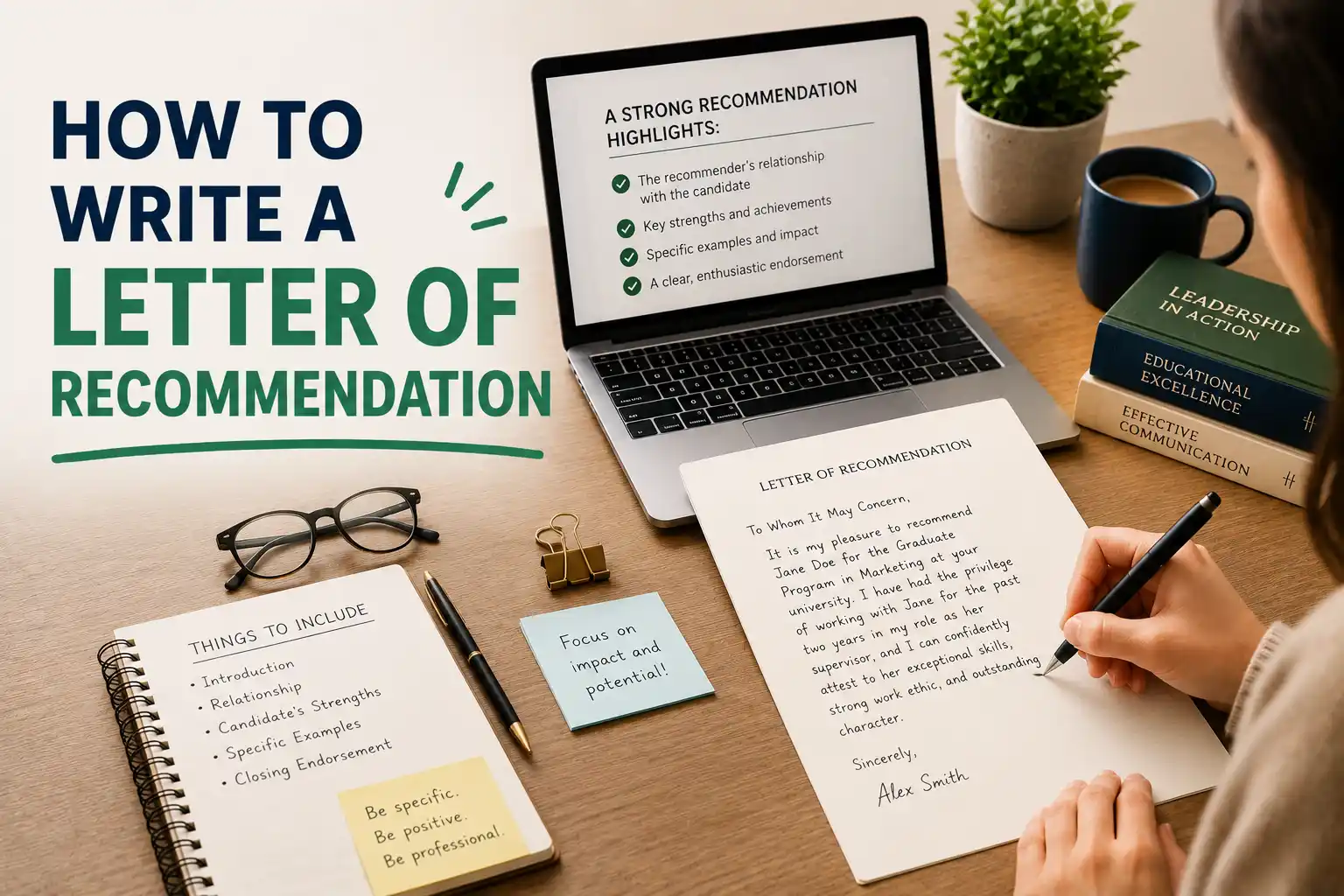
You have been asked to write a letter of recommendation. Maybe it is for a former employee, a student, or a colleague. You want to help them. You know they deserve it. But you are not sure what to say or how to say it effectively.
You are not alone. Writing a letter of recommendation is a significant responsibility. A well-written letter can open doors for someone. A poorly written or generic one can hurt their chances. But with the right approach, you can write a letter that is specific, persuasive, and genuinely helpful.
This guide will teach you everything you need to know about how to write a letter of recommendation that stands out. We will cover the structure, the content, the formatting, and the common mistakes to avoid. By the end, you will have the tools to write a letter that you can be proud of — and that will make a real difference for the person you are recommending.
Letter of Recommendation at a Glance
1 What Is a Letter of Recommendation and Why Does It Matter?
A letter of recommendation is a formal document in which you endorse someone's qualifications, character, and suitability for a specific opportunity — whether that is a job, a university program, a scholarship, or a professional position. It is your personal testimony on their behalf.
Think of it as a professional witness statement. You are vouching for the candidate based on your direct experience working with or observing them. Your credibility and the specificity of your examples are what give the letter its power.
Recommendation letters are often a critical factor in hiring and admissions decisions. They provide a third-party perspective that goes beyond what a CV or application can convey. A strong letter can tip the scales in a candidate's favor. A weak or generic letter can raise doubts.
Builds Credibility
Your endorsement lends credibility to the candidate. It shows that someone with firsthand knowledge believes in their abilities and character.
Provides Specific Evidence
A good letter goes beyond a CV by providing concrete examples of the candidate's skills, achievements, and work ethic in action.
Differentiates the Candidate
In a competitive pool, a strong recommendation can set a candidate apart. It provides a personal, human perspective that numbers and qualifications cannot.
Demonstrates Trust
By writing a letter, you are putting your own reputation on the line. This signals to the reader that you have genuine confidence in the candidate.
2 The Fundamentals of Writing a Letter of Recommendation
Before you start writing, you need to understand the foundational principles that underpin every effective recommendation letter.
Only Say Yes If You Can Be Enthusiastic
If you cannot honestly recommend the person, it is better to decline. A lukewarm or hesitant letter can do more harm than good. If you agree to write the letter, commit to writing a strong, positive endorsement.
Be Specific and Provide Examples
This is the single most important rule of writing a recommendation letter. Vague praise ("She is a hard worker") is meaningless. Specific examples ("She led the project that increased sales by 20%") are compelling. Use anecdotes and concrete details to illustrate your points.
Tailor the Letter to the Opportunity
A letter for a PhD program should emphasize different qualities than a letter for a corporate management role. Ask the candidate for details about the position or program and tailor your letter accordingly. Highlight the skills and experiences most relevant to the opportunity.
Ask the Candidate for Help
Good recommenders ask the candidate for a summary of their achievements, their CV, and a list of specific points they would like you to cover. This does not make you a lazy writer — it makes you an effective one. The candidate knows what is most relevant to the opportunity and can help you focus your letter.
3 How to Format a Letter of Recommendation
Proper formatting gives your letter a professional appearance and makes it easy to read. Here are the standard formatting rules.
Use Business Letter Format
A recommendation letter should follow standard business letter format. This includes your contact information, the date, the recipient's contact information, a formal salutation, and a professional closing.
Font and Margins
Use a clean, professional font like Arial, Calibri, or Times New Roman in 10–12 point size. Maintain standard margins of 1 inch on all sides.
Length
A recommendation letter is typically one to two pages. Shorter letters may seem perfunctory; longer letters may not be read in full. Aim for a concise, well-structured letter that covers the key points.
Standard Letter Format
- Your contact information (name, title, organization, address, phone, email)
- Date
- Recipient's contact information (if known)
- Salutation: "Dear [Name]" or "To Whom It May Concern"
- Opening paragraph: State your relationship and overall recommendation
- Body paragraphs: Provide specific examples and evidence
- Closing paragraph: Summarize and offer to provide more information
- Closing: "Sincerely" or "Yours faithfully"
- Your signature (if sending a physical letter) and typed name
4 What to Include in a Letter of Recommendation
Every recommendation letter should include certain essential elements. Here is what to include, section by section.
Opening Paragraph: Introduction and Relationship
Introduce yourself and explain your relationship to the candidate. How do you know them? In what capacity did you work with them? How long have you known them? This establishes your credibility and the context for your recommendation.
Example
"I am pleased to recommend Felicite TEDE for the position of Marketing Manager at ABC Corporation. I have had the pleasure of working with Felicite for the past three years at XYZ Company, where she served as a Senior Marketing Associate on my team."
Body Paragraphs: Specific Examples and Evidence
This is the heart of the letter. Provide specific examples of the candidate's skills, achievements, and character. Use the STAR method (Situation, Task, Action, Result) to structure your anecdotes. Focus on qualities that are relevant to the opportunity.
Example
"One of Felicite's most impressive achievements was her leadership of our company's digital transformation initiative. When we faced a 15% decline in online engagement, Felicite proposed and implemented a comprehensive content strategy. She led a team of five, coordinated with multiple departments, and within six months, we saw a 40% increase in engagement and a 25% boost in conversion rates."
Closing Paragraph: Summary and Endorsement
Summarize your recommendation and reaffirm your confidence in the candidate. Offer to provide additional information if needed. End with a strong, positive statement.
Example
"In summary, I believe Felicite would be an exceptional addition to your team. Her strategic thinking, leadership abilities, and commitment to excellence are truly outstanding. I recommend her without reservation and would be happy to discuss her qualifications further."
5 Types of Recommendation Letters
The content and emphasis of your letter will vary depending on the context. Here are the most common types of recommendation letters.
Professional Recommendation
For a job application or professional position. Focus on the candidate's work performance, skills, achievements, and professional conduct. Emphasize qualities like reliability, leadership, problem-solving, and teamwork.
Key trait: Emphasis on professional skills and work achievements.
Academic Recommendation
For university admissions, scholarships, or graduate programs. Focus on the candidate's intellectual abilities, academic performance, research potential, and personal qualities like curiosity and diligence.
Key trait: Emphasis on academic ability and intellectual promise.
Character or Personal Recommendation
For situations like adoption, housing applications, or legal matters. Focus on the candidate's character, integrity, and personal qualities. These letters are more personal and less formal.
Key trait: Emphasis on character, integrity, and personal qualities.
Letter of Reference
Similar to a recommendation but often more general. References are often requested as part of a background check and may focus on confirming employment history and basic qualifications.
Key trait: Confirmation of facts and general endorsement.
6 Common Mistakes to Avoid
Even well-intentioned recommenders make mistakes. Here are the most common errors and how to avoid them.
Being Too Vague
"John is a hard worker." "Sarah is a great team player." These statements are meaningless without specific examples.
Fix: Provide concrete examples and specific achievements.
Writing a Generic Letter
Using the same letter for every candidate or every opportunity. This shows a lack of effort and does not help the candidate.
Fix: Tailor each letter to the specific opportunity and candidate.
Over-Exaggerating
Making claims that are not supported by evidence. This can damage your credibility and the candidate's chances.
Fix: Be honest and specific. Let the examples speak for themselves.
Focusing Only on Duties
Listing what the candidate was responsible for without discussing what they achieved.
Fix: Focus on achievements and impact, not just responsibilities.
Including Irrelevant Information
Adding details that do not support the candidate's application for the specific opportunity.
Fix: Only include information that is relevant to the position or program.
Poor Grammar and Spelling
Errors in your letter reflect poorly on you and, by extension, on the candidate.
Fix: Proofread carefully. Ask someone else to review it.
7 How to Write a Letter of Recommendation for a Student
Academic recommendation letters have their own unique considerations. Here is how to write an effective letter for a student.
Focus on Intellectual Abilities
Discuss the student's critical thinking, analytical skills, and intellectual curiosity. Provide examples from their coursework, projects, or research.
Comment on Their Potential
Admissions committees are looking for potential as much as past achievement. Discuss the student's capacity for growth, their passion for the field, and their ability to succeed in a rigorous program.
Compare Them to Others
If you can, place the student in context. "Felicite is one of the top 5% of students I have taught in my ten-year career" is a powerful statement. Be honest, but if the student truly stands out, say so.
Example: Academic Letter
"During my Advanced Microeconomics course, Felicite demonstrated an exceptional ability to grasp complex concepts and apply them to real-world scenarios. Her final paper on market efficiency was one of the most insightful I have read in my five years of teaching. She is among the top 10% of students I have taught."
8 How to Write a Letter of Recommendation for an Employee
Professional recommendation letters require a focus on work performance and professional qualities. Here is how to write an effective letter for an employee.
Discuss Their Job Performance
Provide specific examples of the employee's achievements, skills, and contributions. Use metrics where possible. "Increased sales by 20%" is more compelling than "did a good job."
Highlight Soft Skills
Discuss qualities like teamwork, leadership, communication, and problem-solving. These are often as important as technical skills. Again, use specific examples.
Comment on Their Fit
If you know the position they are applying for, comment on why they would be a good fit. This shows that you have thought carefully about their application.
Example: Professional Letter
"As John's manager for the past four years, I have seen him grow from a junior developer to a senior engineer who leads critical projects. His work on our cloud migration project was instrumental in reducing costs by 30% while improving system reliability. He is an exceptional problem-solver and a natural leader."
9 How to Revise Your Letter of Recommendation
A great recommendation letter is not written; it is rewritten. Revision is where your letter goes from good to great. Here is a step-by-step process for revising your letter.
Step 1: Check for Errors
Proofread carefully. Check for spelling, grammar, and punctuation errors. Read it aloud to catch awkward phrasing.
Step 2: Check for Specificity
Go through each claim you make about the candidate. Have you provided specific evidence? If not, add a concrete example.
Step 3: Check for Relevance
Does every point in your letter support the candidate's application for this specific opportunity? Remove anything that is not relevant.
Step 4: Check the Tone
Is the tone professional and enthusiastic? Does it reflect your genuine confidence in the candidate?
Step 5: Get Feedback
Ask a colleague or friend to review the letter. Fresh eyes can catch issues you have missed.
Step 6: Confirm Details with the Candidate
Double-check the candidate's name, the name of the position or program, and any other specific details. Errors here can be embarrassing.
10 Practice Exercises to Improve Your Recommendation Letters
The best way to get better at writing recommendation letters is to practice. Here are some exercises to help you sharpen your skills.
Exercise 1: The "Generic to Specific" Rewrite
Take a generic statement about a candidate (e.g., "She is a great leader"). Rewrite it with a specific example that demonstrates her leadership. Compare the two versions. Which is more compelling?
Exercise 2: Write a Letter for a Fictional Candidate
Create a fictional candidate and write a recommendation letter for them. This allows you to practice the structure and format without the pressure of a real person depending on you.
Exercise 3: Peer Review Swap
Swap recommendation letters with a colleague. Review each other's letters and provide honest feedback. What is working? What could be stronger?
Exercise 4: Tailor a Letter to Two Different Opportunities
Take the same candidate and write two different letters: one for a corporate job and one for a PhD program. Notice how the emphasis shifts based on the opportunity.
Final Thoughts
Writing a letter of recommendation is both a responsibility and an opportunity. It is a chance to help someone advance their career or education. It is also a reflection of your own judgment and integrity.
Remember that your letter is not just a formality. It is a powerful tool that can make a real difference in someone's life. Take the time to write a letter that is specific, honest, and enthusiastic. Your words can open doors.
Keep these principles in mind as you write:
- Be specific. Use concrete examples to illustrate your points.
- Be honest. Only say what you genuinely believe.
- Be enthusiastic. If you agree to write the letter, write it with conviction.
- Tailor the letter. Make it relevant to the specific opportunity.
- Proofread carefully. Errors undermine your credibility.
The person who asked you for this letter trusts you. They believe in your ability to speak on their behalf. Honour that trust by writing a letter that is thoughtful, specific, and genuinely supportive. Your words could be the key to their next opportunity.
Now go write a letter that makes a difference.