How to Write a Paragraph: The Complete Guide with Examples
You have an idea. You know what you want to say. But when you put it on the page, it does not feel right. The sentences seem disconnected. The flow is choppy. You are not sure if you are doing it correctly.
You are not alone. Writing a paragraph is a fundamental skill that many people find surprisingly challenging. But mastering the paragraph is essential for clear, effective communication. A well-written paragraph is the building block of any piece of writing , from emails and reports to essays and novels.
This guide will teach you everything you need to know about how to write a paragraph that is clear, well-structured, and effective. We will cover the essential elements, the structure, the techniques, and the common mistakes to avoid. By the end, you will have the tools to write paragraphs that are coherent, compelling, and easy to read.
Paragraph Writing at a Glance
1 What Is a Paragraph and Why Does It Matter?
A paragraph is a group of related sentences that develop a single main idea. It is a distinct section of writing that is set apart from other sections by a new line and often indentation. Paragraphs are the fundamental units of written communication, whether in academic writing, business communication, or creative writing.
As the Purdue OWL explains, the basic rule of thumb with paragraphing is to "keep one idea to one paragraph". A paragraph is like a miniature essay. It has an introduction (the topic sentence), a body (supporting sentences), and a conclusion (the concluding sentence).
Paragraphs matter because they organise your thoughts and guide your reader through your argument. They break up text into manageable chunks, making it easier to read and understand. Without paragraphs, your writing would be a confusing wall of text that overwhelms the reader. With well-structured paragraphs, your writing becomes clear, logical, and persuasive.
Unity
A paragraph should focus on one main idea. Every sentence should relate to and support that idea. This is what gives a paragraph its coherence and power.
Organisation
Paragraphs organise your thoughts and guide the reader through your argument. They create a logical flow that makes your writing easier to follow.
Readability
Paragraphs break up text into manageable chunks, making your writing more accessible and less intimidating. Well-structured paragraphs keep readers engaged.
Clarity
When each paragraph has a clear main idea, your overall message becomes clearer. Paragraphs help you communicate your ideas with precision and impact.
2 The Anatomy of a Paragraph
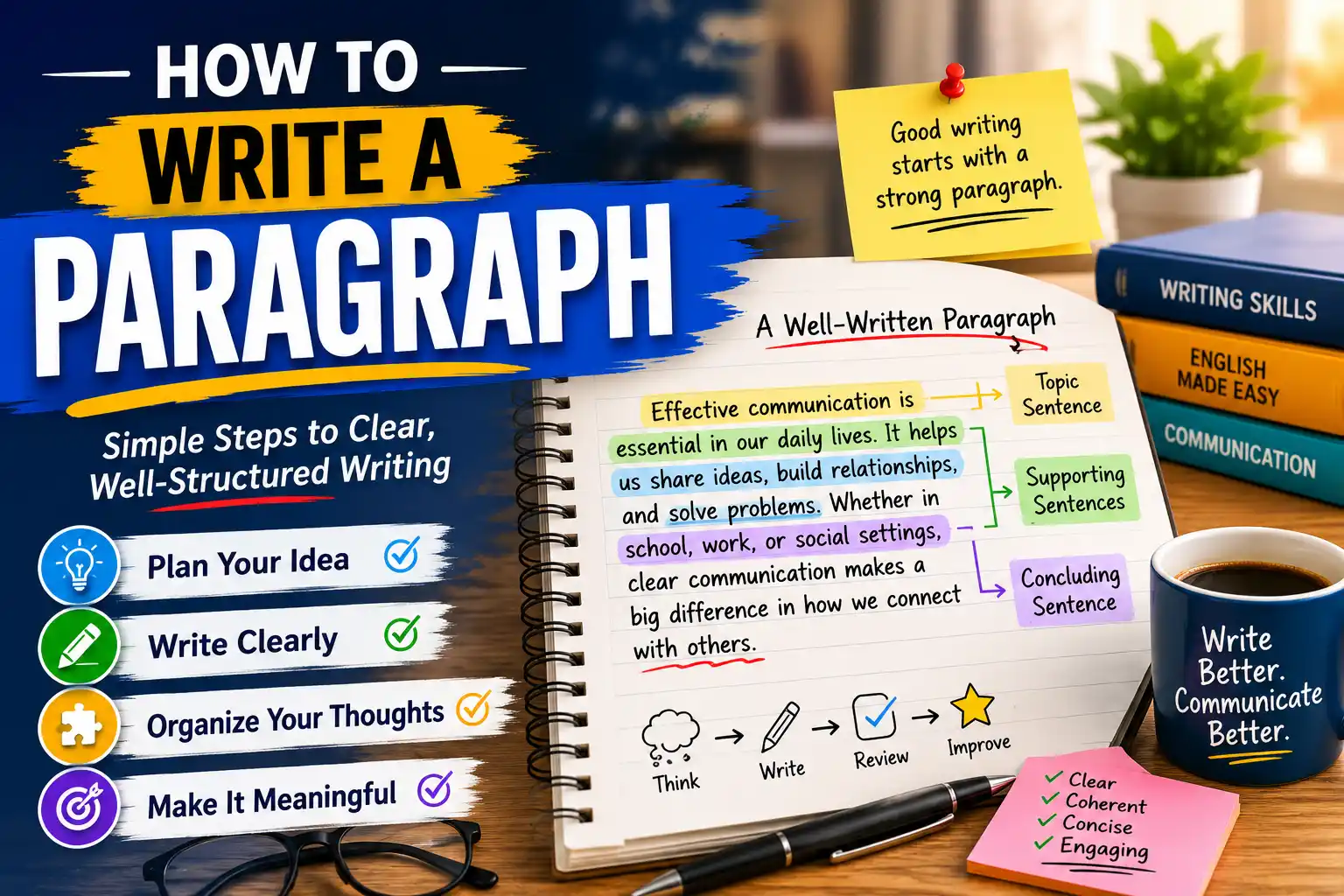
Every effective paragraph contains three essential parts: a topic sentence, supporting sentences, and a concluding sentence. These parts work together to create unity and coherence. Here is a breakdown of each element.
Topic Sentence
The topic sentence is the most important sentence in a paragraph. It states the main idea of the paragraph and tells the reader what to expect. A good topic sentence is:
- Clear: It expresses a single, specific idea.
- Focused: It limits the paragraph to one main point.
- Engaging: It draws the reader in and makes them want to read more.
As the NDLA guide explains, a topic sentence should give the reader "a clear understanding of the direction in which you are planning on going".
Supporting Sentences
Supporting sentences develop and explain the topic sentence. They provide evidence, examples, details, and analysis that support the main idea. Supporting sentences should:
- Explain: Clarify the topic sentence with further explanation.
- Provide evidence: Use facts, examples, quotes, or data to support the claim.
- Build on each other: As the NDLA guide notes, supporting sentences should "build on each other and clearly relate to the topic sentence".
Concluding Sentence
The concluding sentence is the last sentence of the paragraph. It summarises the main point and brings the paragraph to a close. A good concluding sentence:
- Restates the main idea: It reminds the reader of the topic sentence in different words.
- Provides closure: It signals that the paragraph is complete.
- May transition: It can also provide a bridge to the next paragraph.
The TEEL Model
A simple way to remember paragraph structure is the TEEL model:
- T , Topic sentence: state the main idea
- E , Explanation: explain the idea in more detail
- E , Evidence: provide examples, facts, or quotes
- L , Link: summarise or connect to the next paragraph
3 How to Write a Topic Sentence
The topic sentence is the foundation of your paragraph. Here is how to write one that is clear, focused, and effective.
State One Main Idea
Your topic sentence should state one main idea. If you have more than one idea, you need more than one paragraph. A focused topic sentence keeps your paragraph on track and prevents it from becoming confusing or scattered.
Make It Specific
A vague topic sentence will not guide your reader effectively. Make your topic sentence specific and informative. Instead of "This paragraph is about exercise," try "Regular exercise improves cardiovascular health and reduces the risk of chronic disease."
Use a Controlling Idea
A strong topic sentence includes a controlling idea , a word or phrase that limits the scope of the paragraph. For example, in "Regular exercise improves cardiovascular health and reduces the risk of chronic disease," the controlling idea is "improves cardiovascular health and reduces the risk of chronic disease." This tells the reader exactly what to expect.
Strong Topic Sentences
- "Social media has a significant impact on adolescent mental health."
- "Effective time management is essential for academic success."
- "Climate change poses a serious threat to coastal communities."
Weak Topic Sentences
- "This paragraph will talk about social media."
- "Time management is important."
- "Climate change is a thing."
4 How to Write Supporting Sentences
Supporting sentences are the body of your paragraph. They develop and explain the topic sentence. Here is how to write them effectively.
Provide Evidence and Examples
Supporting sentences should include evidence and examples that back up your topic sentence. This could be facts, statistics, quotes, anecdotes, or personal experiences. Evidence makes your argument more convincing and helps your reader connect to your ideas.
Explain and Analyse
Do not just present evidence , explain it. Tell the reader why the evidence matters and how it supports the topic sentence. Analysis shows that you have thought critically about your topic and helps your reader understand your reasoning.
Keep It Relevant
Every supporting sentence should relate to the topic sentence. If a sentence does not support the main idea, it does not belong in the paragraph. As the USC guide advises, "Ensure each sentence relates clearly to the key idea of the paragraph".
Use Transitional Words
Transitional words and phrases help guide the reader through your paragraph. Words like "first," "next," "for example," "in addition," and "however" show the relationship between sentences and create a smooth flow.
Supporting Sentences Example
Topic Sentence: Regular exercise improves cardiovascular health and reduces the risk of chronic disease.
Supporting Sentences: For example, studies have shown that 30 minutes of moderate exercise five times a week can lower blood pressure and cholesterol levels. Additionally, physical activity helps maintain a healthy weight, which reduces the risk of developing type 2 diabetes. Moreover, regular exercise strengthens the heart muscle, making it more efficient at pumping blood throughout the body.
5 How to Write a Concluding Sentence
The concluding sentence brings your paragraph to a close and reinforces the main idea. Here is how to write one effectively.
Restate the Main Idea
The concluding sentence should restate the main idea of the paragraph, but in different words. This reminds the reader of the key point and gives the paragraph a sense of closure.
Summarise the Key Points
You can also summarise the key points of the paragraph. This is especially useful for longer paragraphs where the reader might need a brief recap.
Link to the Next Paragraph
A concluding sentence can also serve as a bridge to the next paragraph. By hinting at what is coming next, you create a smooth transition that keeps the reader engaged.
Concluding Sentence Example
Topic Sentence: Regular exercise improves cardiovascular health and reduces the risk of chronic disease.
Supporting Sentences: For example, studies have shown that 30 minutes of moderate exercise five times a week can lower blood pressure and cholesterol levels. Additionally, physical activity helps maintain a healthy weight, which reduces the risk of developing type 2 diabetes. Moreover, regular exercise strengthens the heart muscle, making it more efficient at pumping blood throughout the body.
Concluding Sentence: In short, incorporating regular physical activity into your daily routine is one of the most effective ways to protect your long-term health and well-being.
6 Common Paragraph Structures
There are several effective ways to structure a paragraph. Here are some of the most common models.
TEEL Structure
Topic sentence , Explanation , Evidence , Link
This model is widely used in academic writing. It ensures that each paragraph has a clear main point, is developed with evidence, and connects to the overall argument.
Best for: Academic essays, persuasive writing, and analytical pieces.
PEEL Structure
Point , Evidence , Explanation , Link
Similar to TEEL, the PEEL model focuses on making a clear point, supporting it with evidence, explaining the significance, and linking to the next point.
Best for: Persuasive writing, argumentative essays, and opinion pieces.
TTEB Structure
Transition , Topic sentence , specific Evidence and analysis , Brief wrap-up (warrant)
This model from the Purdue OWL emphasises the importance of transitions between paragraphs and the need for a brief concluding sentence that ties everything together.
Best for: Academic writing, research papers, and well-structured essays.
TEC Structure
Topic sentence , Explanation, example, evidence , Concluding sentence or connecting sentence
A simple and effective model that focuses on the three essential parts of a paragraph: topic, evidence, and conclusion.
Best for: General writing, business communication, and clear, concise paragraphs.
7 Common Paragraph Mistakes to Avoid
Even experienced writers make mistakes. Here are the most common errors in paragraph writing and how to avoid them.
Lack of Unity
Including sentences that do not relate to the topic sentence. This confuses the reader and weakens your argument.
Fix: Every sentence should support the main idea. If it does not, cut it or move it to a new paragraph.
No Topic Sentence
Writing a paragraph without a clear topic sentence. The reader is left guessing about the main idea.
Fix: Start with a clear topic sentence that states the main idea. This anchors the paragraph and guides the reader.
Too Many Ideas
Including multiple main ideas in one paragraph. This makes the paragraph confusing and unfocused.
Fix: Stick to one main idea per paragraph. If you have more than one idea, start a new paragraph.
Lack of Coherence
Sentences that do not flow logically from one to the next. The paragraph feels choppy and disconnected.
Fix: Use transitional words and phrases. Repeat key words to keep the reader focused. Use parallel structure.
Too Long or Too Short
A paragraph that is either too long (overwhelming) or too short (underdeveloped).
Fix: Aim for 4–7 sentences per paragraph. Develop your ideas fully, but do not ramble.
No Concluding Sentence
Ending a paragraph abruptly without a concluding sentence. This leaves the reader feeling unsatisfied.
Fix: Include a concluding sentence that summarises the main point and provides closure.
8 How to Revise Your Paragraphs
Revision is where your paragraphs go from good to great. Here is a step-by-step process for revising your paragraphs.
Step 1: Check for Unity
Read your paragraph and identify the main idea. Does every sentence support that idea? If not, cut or revise the sentences that do not.
Step 2: Check the Topic Sentence
Is your topic sentence clear and focused? Does it state the main idea effectively? If not, rewrite it.
Step 3: Check for Development
Have you provided enough supporting evidence and examples? Are your ideas fully developed? If not, add more detail.
Step 4: Check for Coherence
Does your paragraph flow logically? Are there clear connections between sentences? Add transitional words where needed.
Step 5: Check the Concluding Sentence
Does your paragraph have a concluding sentence? Does it summarise the main point and provide closure? If not, add one.
Step 6: Read It Aloud
Read your paragraph aloud. Does it sound natural? Are there any awkward phrases? Reading aloud helps you catch issues you might miss when reading silently.
9 Paragraph Examples
Here are some examples of well-written paragraphs to illustrate the principles covered in this guide.
Example 1: Academic Paragraph (TEEL Structure)
Topic Sentence: Climate change poses a serious threat to coastal communities around the world.
Explanation: Rising sea levels, driven by melting polar ice caps and thermal expansion, are already causing increased flooding and erosion in coastal areas.
Evidence: According to the Intergovernmental Panel on Climate Change, global sea levels could rise by up to one metre by 2100 if current emission trends continue, putting millions of people at risk of displacement.
Link: As a result, governments and communities must urgently develop adaptation strategies to protect vulnerable populations and infrastructure.
Example 2: Persuasive Paragraph (PEEL Structure)
Point: Schools should incorporate digital literacy into their core curriculum.
Evidence: In today's digital age, students need to be able to evaluate online sources, protect their privacy, and use technology responsibly , skills that are not always taught at home.
Explanation: Without formal instruction, many students are vulnerable to misinformation, cyberbullying, and online scams. Teaching digital literacy equips students with the critical thinking skills they need to navigate the digital world safely and effectively.
Link: Moreover, these skills are increasingly essential for success in higher education and the modern workforce.
Example 3: Descriptive Paragraph
Topic Sentence: The old bookstore on Main Street was a treasure trove of forgotten stories.
Supporting Details: Dusty shelves stretched from floor to ceiling, crammed with leather-bound volumes and dog-eared paperbacks. The smell of aged paper and wood polish hung in the air, a comforting presence that seemed to slow time itself. Sunlight filtered through the grimy windows, illuminating the tiny particles of dust that danced in the golden light.
Concluding Sentence: For any lover of books, stepping into this shop was like coming home.
10 Practice Exercises to Improve Your Paragraphs
The best way to get better at writing paragraphs is to practice. Here are some exercises to help you sharpen your skills.
Exercise 1: Write a Topic Sentence
Choose a topic and write three different topic sentences for it. Make each one increasingly specific. Practice narrowing your focus.
Exercise 2: Develop a Paragraph
Take a topic sentence and write a full paragraph around it. Include supporting sentences and a concluding sentence.
Exercise 3: The "Cut the Clutter" Challenge
Take a paragraph you have written and try to cut 20% of the words without losing the meaning. This forces you to be concise and eliminate unnecessary words.
Exercise 4: Identify Paragraph Structure
Find a paragraph in a book or article. Identify the topic sentence, supporting sentences, and concluding sentence. Notice how the paragraph is structured.
Final Thoughts
Writing a paragraph is a fundamental skill that underpins all effective communication. A well-written paragraph is clear, focused, and coherent. It guides the reader through your ideas and makes your writing more persuasive and engaging.
Remember that every paragraph should have a clear purpose. As the Purdue OWL advises, "If you begin to transition into a new idea, it belongs in a new paragraph". Each paragraph is a building block in your overall argument or narrative.
Keep these principles in mind as you write:
- Start with a clear topic sentence. State the main idea of the paragraph.
- Develop your ideas fully. Use evidence, examples, and explanation to support your point.
- End with a concluding sentence. Summarise the main point and provide closure.
- Keep one idea per paragraph. If you start a new idea, start a new paragraph.
- Use transitional words. Guide the reader through your paragraph and create a smooth flow.
- Revise carefully. Great paragraphs are the result of careful rewriting.
Writing paragraphs is a skill that improves with practice. The more you write, the more natural it will become. With time and effort, you will develop the ability to write paragraphs that are clear, compelling, and effective.
Now go write a paragraph that makes an impact.