How to Write a Literature Review: Complete Guide for Students
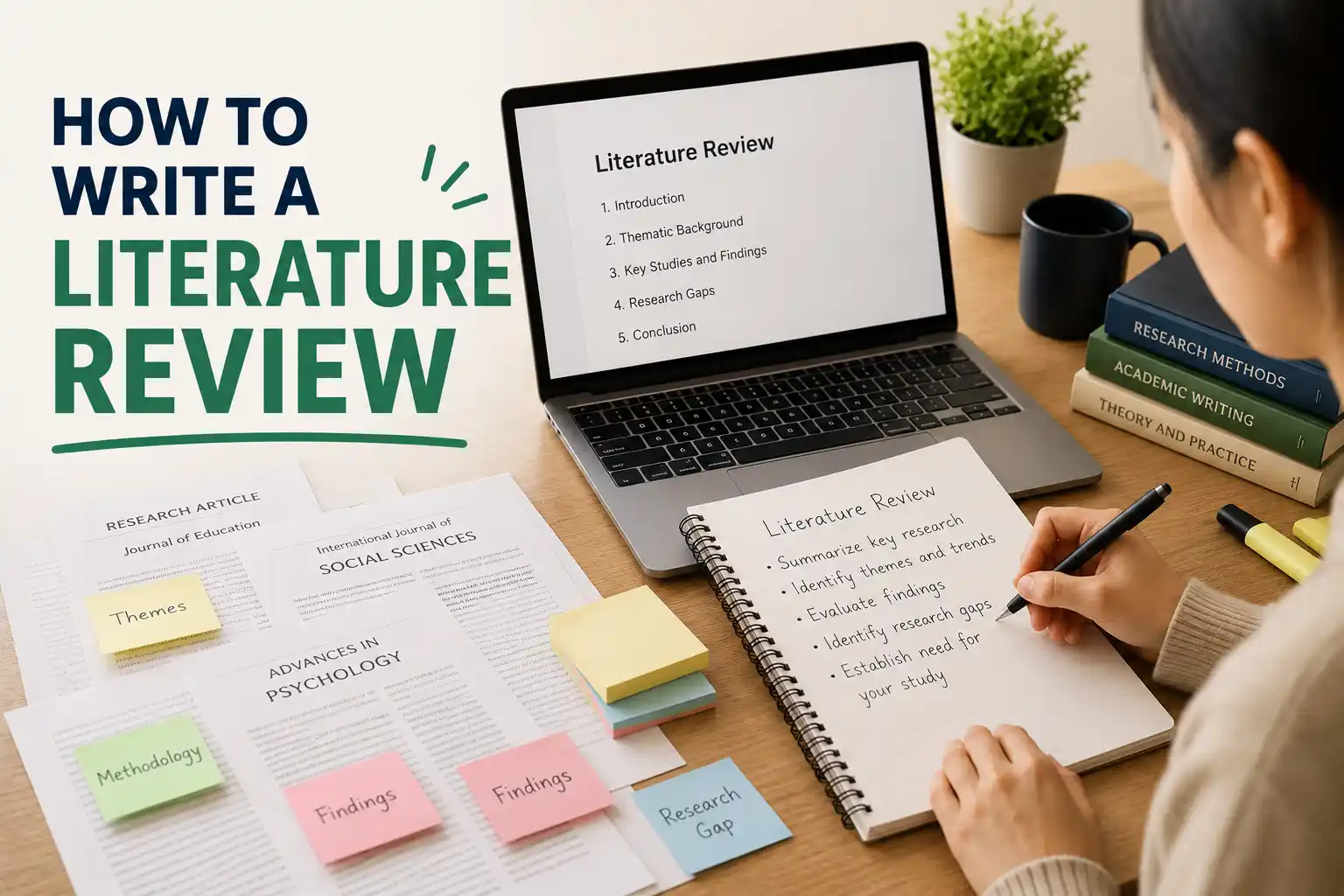
The literature review. For many students, those two words trigger anxiety. You've gathered dozens of articles, but now you need to synthesize them into a coherent narrative. Where do you even start?
Here's the truth: a literature review isn't just a summary of what others have written. It's a strategic analysis that identifies patterns, debates, and gaps in research. And once you understand the structure, it becomes much less intimidating.
This guide walks you through every step of writing a literature review,from searching for sources to synthesizing findings to structuring your final draft. Plus, real examples you can learn from.
Literature Review at a Glance
Pro tip: Start early. A good literature review takes time to research, read, and synthesize.
1 What Is a Literature Review? (And What It's Not)
A literature review is a comprehensive survey and analysis of published research on a specific topic. It's not:
- An annotated bibliography — Not a list of summaries with individual evaluations
- A research paper — You're not presenting new findings, you're synthesizing existing ones
- A book report — You're not describing individual studies in isolation
Instead, a literature review:
- Identifies what's known about a topic
- Reveals debates and disagreements in the field
- Highlights methodological approaches
- Identifies gaps for future research
- Establishes credibility and expertise
When You'll Write One
• Undergraduate thesis
• Master's thesis or dissertation
• PhD dissertation
• Journal article introduction
• Grant proposal
• Research proposal
Why It Matters
• Shows you understand the field
• Identifies where your research fits
• Avoids duplicating existing work
• Builds theoretical framework
• Demonstrates critical thinking
2 The 5-Step Literature Review Process
Step 1: Search for Literature
Identify keywords, search databases (Google Scholar, JSTOR, PubMed), and collect relevant sources. Use Boolean operators (AND, OR, NOT) to refine searches.
Step 2: Evaluate & Select Sources
Not every source is worth including. Prioritize peer-reviewed articles, recent publications, and highly cited works in your field.
Step 3: Identify Themes & Patterns
As you read, look for recurring themes, methodological approaches, debates, and gaps. Create categories that organize the literature.
Step 4: Outline Your Structure
Decide how to organize your review: chronologically, thematically, methodologically, or by theoretical framework.
Step 5: Write & Revise
Write your first draft following your outline. Then revise for synthesis, clarity, and flow. Get feedback from advisors or peers.
3 How to Structure Your Literature Review
Every literature review needs a clear structure. Here are the four main organizational approaches:
Chronological
Organized by publication date or historical development. Best for showing how ideas evolved over time. Example: "Research on climate change denial from 1990 to present."
Thematic
Organized by themes or topics. Most common approach. Example: "Economic impacts of immigration" with sections on wages, employment, and innovation.
Methodological
Organized by research methods used. Best for comparing quantitative vs qualitative approaches. Example: "Studies on meditation: RCTs vs longitudinal studies."
Theoretical
Organized by competing theories or frameworks. Best for fields with multiple theoretical perspectives. Example: "Leadership theories: trait, behavioral, and contingency approaches."
Introduction: Define scope and organization | Body: Present themes with synthesis | Conclusion: Summarize findings and identify gaps
4 Synthesis vs. Summary: The Key Difference
The biggest mistake students make is writing a series of summaries instead of a synthesis. Here's the difference:
Summary (What NOT to do)
❌ "Smith (2019) found that X causes Y. Jones (2020) also found that X causes Y. Brown (2021) found that X causes Y in certain conditions."
This is just listing what each author said. No analysis. No connection.
Synthesis (What TO do)
✅ "Most researchers agree that X causes Y (Smith, 2019; Jones, 2020). However, Brown (2021) argues this relationship depends on contextual factors, suggesting the need for more nuanced investigation."
This shows agreement, disagreement, and identifies implications.
How to Synthesize: The "They Say / I Say" Method
Track Your Literature Review Length
Keep your literature review within the required length. Use our word counter to monitor your progress as you write and revise.
Track Your Word Count5 Writing the Introduction Section
Your introduction should accomplish three things:
1. Define your topic and scope
2. Explain your organization
3. State your research question or purpose
Introduction Checklist
✓ Clear topic statement
✓ Defined scope (dates, source types, geographic focus)
✓ Organization preview
✓ Research question or purpose statement
✓ Brief rationale for why this review matters
6 Writing the Body Paragraphs
Each body paragraph should present a theme or finding, supported by multiple sources. Use the P.E.E.L. structure:
P - Point (Topic Sentence)
E - Evidence (Cite Multiple Sources)
E - Explain (Your Analysis)
L - Link (Connect to Thesis)
7 Writing the Conclusion Section
Your conclusion should accomplish three things:
1. Summarize key findings
"This review reveals three main findings: first, social media use correlates with increased anxiety; second, effects vary by platform type; third, social support moderates negative impacts."
2. Identify limitations and gaps
"However, most studies rely on self-reported data, and few examine long-term effects. Additionally, research on underrepresented populations remains limited."
3. Suggest future research directions
"Future research should employ longitudinal designs, examine causal mechanisms, and include diverse adolescent populations to address current gaps."
Conclusion Checklist
8 Common Literature Review Mistakes to Avoid
DO This
✅ Synthesize sources (show relationships)
✅ Use recent, peer-reviewed sources
✅ Be critical, not just descriptive
✅ Show how sources relate to each other
✅ Identify gaps and contradictions
✅ Connect everything to your research question
✅ Use clear topic sentences and transitions
DON'T Do This
❌ List summaries one after another
❌ Use only old or non-academic sources
❌ Ignore contradictory findings
❌ Forget to cite properly
❌ Include irrelevant sources
❌ Write without a clear structure
❌ Forget to proofread for clarity
9 Managing Your Sources Effectively
With dozens or hundreds of sources, organization is critical. Here's how to stay organized:
Literature Review Matrix
Create a table with columns for: author/year, research question, methods, key findings, strengths, limitations, and themes. This makes synthesis much easier.
Citation Managers
Use Zotero, Mendeley, or EndNote to organize PDFs, generate citations, and insert references as you write.
Thematic Folders
Organize PDFs into folders by theme or argument. This helps you see which sources belong together when writing.
Annotate as You Read
Highlight key passages and write notes in the margins. Note how each source connects to your themes before you forget.
Sample Literature Review Matrix
10 Real Example: Before and After
Weak Example (Just Summary)
Strong Example (Synthesis)
The Bottom Line
A literature review is challenging but manageable. Break it down into steps: search, evaluate, synthesize, outline, write, revise.
Remember the golden rule: Synthesize, don't just summarize. Show how sources relate to each other. Identify patterns, debates, and gaps.
Start with a literature review matrix to organize your sources. Use a clear structure (introduction, body by theme, conclusion). Write multiple drafts. Get feedback. And don't forget to proofread.
Your literature review establishes your expertise. Make it count.