How to Write a Covering Letter: The Complete Guide with Examples
You have found the perfect job. Your CV is polished and ready. But there is one more thing standing between you and that interview: the covering letter. You stare at the blank page, unsure how to introduce yourself, what to include, or how to make it compelling.
You are not alone. Writing a covering letter is one of the most challenging parts of the job application process. But a well-written covering letter can be the difference between landing an interview and being overlooked. It is your chance to tell your story, showcase your personality, and demonstrate why you are the perfect candidate.
This guide will teach you everything you need to know about how to write a covering letter that gets results. We will cover the structure, the content, the formatting, and the common mistakes to avoid. By the end, you will have the tools to write a covering letter that opens doors and gets you noticed.
Covering Letter at a Glance
1 What Is a Covering Letter and Why Does It Matter?
A covering letter , also known as a cover letter , is a one-page document that accompanies your CV when you apply for a job. It introduces you to the employer, highlights your most relevant skills and experiences, and explains why you are the ideal candidate for the position.
Your covering letter is your first impression on a potential employer. It demonstrates your communication skills, your enthusiasm for the role, and your understanding of the company. A well-written covering letter can make you stand out from the competition and encourage the employer to read your CV with greater interest.
Think of your covering letter as your personal sales pitch. It is your opportunity to connect the dots between your experience and the employer's needs, to show your personality, and to make a compelling case for why you should be invited for an interview.
First Impression
Your covering letter is often the first thing a recruiter reads. It sets the tone for your entire application.
Shows Your Personality
While a CV lists facts, a covering letter reveals your enthusiasm, motivation, and communication style.
Demonstrates Research
A tailored covering letter shows that you have researched the company and understand what they are looking for.
Connects the Dots
It explains how your skills and experiences make you a perfect fit for the specific role.
2 The Fundamentals of Writing a Covering Letter
Before you start writing, you need to understand the foundational principles that underpin every effective covering letter.
Tailor Every Letter to the Job
This is the single most important rule of covering letter writing. Never send the same generic letter to every employer. Recruiters can spot a generic letter instantly. It shows a lack of effort and does not demonstrate how your skills match the specific role. Tailor your letter for each application by referencing the job description and the company.
Focus on What You Can Offer
Your covering letter is not about what you want , it is about what you can give. Instead of saying "I am looking for a job where I can develop my skills," say "I can bring [specific skills] to help your company achieve [specific goals]."
Be Enthusiastic and Professional
Show genuine enthusiasm for the role and the company. But keep the tone professional. Enthusiasm without professionalism can come across as unpolished. Strike a balance between warmth and professionalism.
The "Show, Don't Tell" Rule
Instead of telling the employer you are a "hard worker" or a "great team player," show them with specific examples. "I led a team of five to complete a project two weeks ahead of schedule" is much more compelling than "I am a good leader."
3 How to Format a Covering Letter
Proper formatting gives your covering letter a professional appearance. Here are the key formatting rules to follow.
Use Business Letter Format
A covering letter should follow standard business letter format. This includes your contact information, the date, the employer's contact information, a formal salutation, and a professional closing.
Font and Margins
Use a clean, professional font like Arial, Calibri, or Times New Roman in 10–12 point size. Maintain standard margins of 1 inch on all sides.
Length
A covering letter should be one page with three to four paragraphs. Keep it concise and to the point. Recruiters are busy , make it easy for them to understand your value quickly.
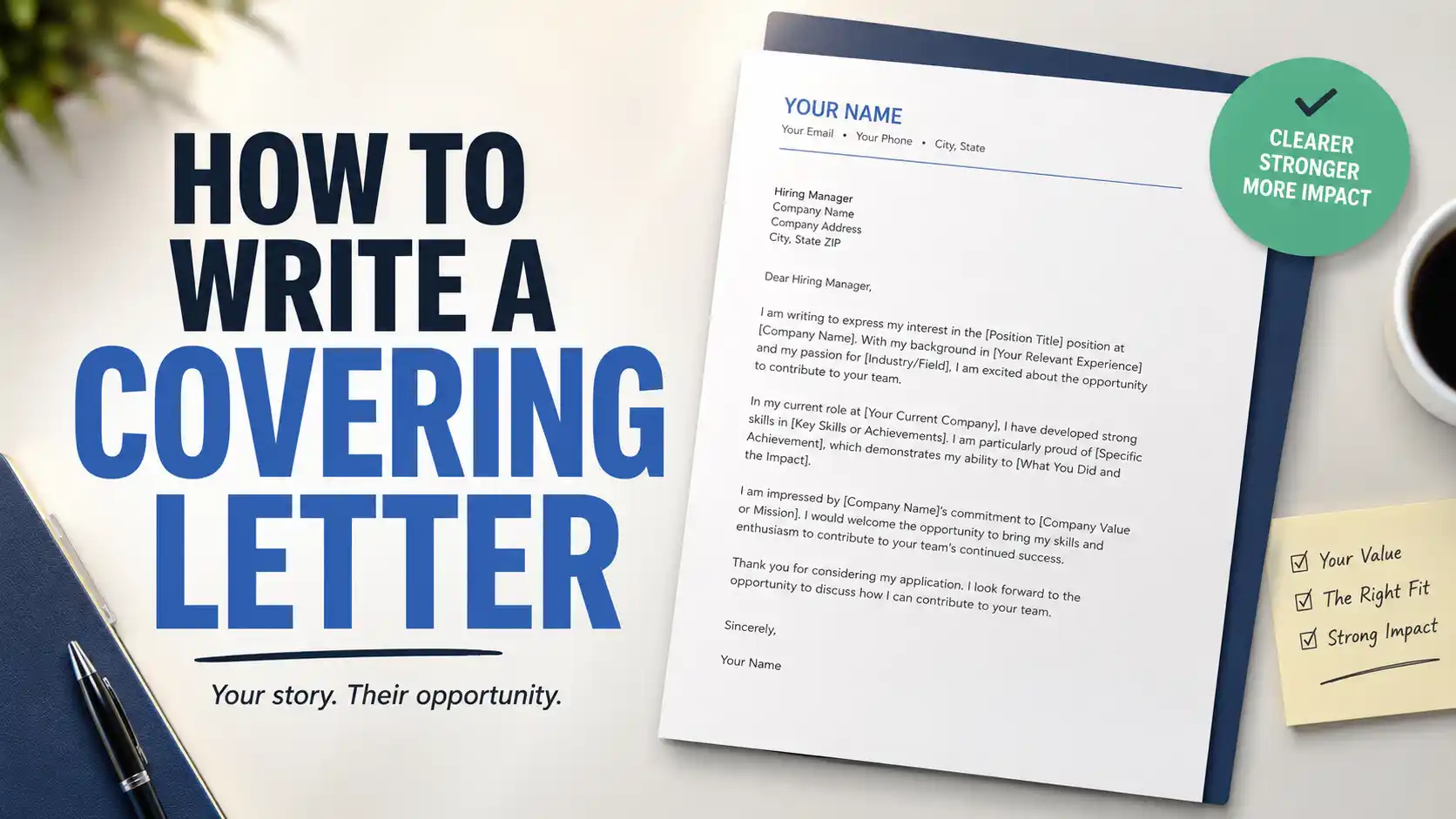
Standard Covering Letter Format
- Your contact information (name, address, phone, email, LinkedIn URL)
- Date
- Recipient's contact information (hiring manager's name, title, company)
- Salutation: "Dear [Hiring Manager's Name]" (or "Dear Hiring Manager" if unknown)
- Opening paragraph: State the position you are applying for and express enthusiasm
- Body paragraphs: Highlight your skills, achievements, and fit for the role
- Closing paragraph: Express interest in an interview and thank the reader
- Closing: "Yours sincerely," or "Sincerely,"
- Your signature (if sending a physical letter) and typed name
4 What to Include in a Covering Letter
Every covering letter should include certain essential elements. Here is what to include, section by section.
Opening Paragraph
Introduce yourself and state the position you are applying for. Express your enthusiasm for the role and the company. Mention how you found out about the position. This paragraph should grab the reader's attention and make them want to read more.
Example
"I am writing to express my strong interest in the Marketing Manager position at XYZ Company, as advertised on LinkedIn. With over five years of experience in digital marketing and a proven track record of driving engagement, I am excited about the opportunity to contribute to your innovative team."
Body Paragraphs
This is where you make your case. Highlight your most relevant skills and achievements. Use specific examples to demonstrate how your experience aligns with the job requirements. This is the heart of your covering letter.
Example
"In my current role as Senior Marketing Associate at ABC Company, I led a campaign that increased social media engagement by 40% and generated a 25% increase in leads. I am confident that my skills in content strategy and data analysis would enable me to make a significant contribution to your marketing team."
Closing Paragraph
Summarise your interest and express your desire for an interview. Thank the reader for their time and consideration. This paragraph should be polite and professional.
Example
"Thank you for considering my application. I would welcome the opportunity to discuss how my skills and experience can contribute to the success of XYZ Company. I look forward to hearing from you."
5 How to Write a Covering Letter: Step-by-Step
Here is a step-by-step process for writing a covering letter.
Step 1: Research the Company and Role
Before you write, research the company and the role. Understand their values, mission, and what they are looking for in a candidate. This will help you tailor your letter effectively.
Step 2: Identify Your Key Selling Points
What are your strongest skills and experiences that are relevant to this role? Identify 2–3 key selling points that you will highlight in your letter.
Step 3: Write the Opening
Start with a strong opening paragraph that expresses enthusiasm and states the position you are applying for.
Step 4: Write the Body
Highlight your key selling points with specific examples. Connect your experience to the employer's needs.
Step 5: Write the Closing
Summarise your interest, express your desire for an interview, and thank the reader.
Step 6: Revise and Proofread
Check for clarity, tone, and errors. A polished covering letter demonstrates professionalism.
Sample Covering Letter
[Your Name]
[Your Address]
[Your Phone]
[Your Email]
[Date]
[Hiring Manager Name]
[Company Name]
[Company Address]
Dear [Hiring Manager Name],
I am writing to apply for the [Position Name] role at [Company Name], as advertised on [Platform]. With [X] years of experience in [field] and a strong background in [key skill], I am excited about the opportunity to contribute to your team.
In my current role at [Current Company], I have successfully [key achievement]. I am particularly drawn to [Company Name]'s commitment to [value or mission], and I believe my skills in [skill] would enable me to make a meaningful contribution.
Thank you for considering my application. I would welcome the opportunity to discuss my qualifications further. I look forward to hearing from you.
Yours sincerely,
[Your Typed Name]
6 Common Mistakes to Avoid
Even experienced professionals make mistakes. Here are the most common errors and how to avoid them.
Sending a Generic Letter
Using the same covering letter for every application. Recruiters can spot this instantly.
Fix: Tailor each letter to the specific job and company.
Being Too Long
Writing a covering letter that is more than one page. Recruiters are busy and will not read a long letter.
Fix: Keep it concise. Aim for three to four paragraphs.
Focusing on What You Want
Talking about what you are looking for rather than what you can offer.
Fix: Focus on the employer's needs and how you can meet them.
Repeating Your CV
Simply repeating the information from your CV. A covering letter should add context and personality.
Fix: Highlight key achievements and explain why they are relevant to the role.
Spelling and Grammar Errors
Typos and grammatical errors suggest a lack of attention to detail.
Fix: Proofread carefully. Read it aloud. Ask someone else to review it.
Using the Wrong Name or Title
Addressing the letter to the wrong person or using the wrong title.
Fix: Double-check the hiring manager's name and title. If unsure, use "Dear Hiring Manager."
7 How to Tailor Your Covering Letter to the Job
Tailoring your covering letter is the key to success. Here is how to do it effectively.
Study the Job Description
Read the job description carefully. Identify the key skills and qualifications the employer is looking for. Make a list of these requirements.
Match Your Skills to Their Requirements
For each requirement in the job description, identify a corresponding skill or experience you possess. Use specific examples to demonstrate your fit.
Research the Company
Visit the company's website. Read about their mission, values, and recent news. Mention something you admire about the company in your letter.
Use Keywords from the Job Description
Incorporate keywords from the job description into your letter. This shows that you have read the description carefully and understand what the employer is looking for.
Example: Before and After Tailoring
Generic: "I have experience in marketing and am looking for a new challenge."
Tailored: "With over five years of experience in digital marketing and a proven track record of increasing engagement by 40%, I am excited about the opportunity to bring my skills in content strategy and data analysis to [Company Name]."
8 How to Write a Covering Letter with No Experience
Writing a covering letter when you have limited experience can feel daunting. But you can still make a compelling case by focusing on your transferable skills, education, and enthusiasm.
Focus on Transferable Skills
Think about skills you have developed through education, volunteering, or extracurricular activities. Communication, teamwork, problem-solving, and organisation are all valuable skills.
Highlight Your Education
If you are a recent graduate, emphasise your academic achievements, relevant coursework, and any projects or research that demonstrate your skills.
Show Your Enthusiasm
Enthusiasm can compensate for a lack of experience. Show that you are eager to learn and passionate about the industry.
Use Examples from Other Areas
Your experience does not have to be from a job. Volunteer work, internships, and personal projects all count. Use these to demonstrate your skills and dedication.
Example for a Graduate
"As a recent graduate with a degree in Business Administration, I have developed strong analytical and communication skills through my coursework and a summer internship at a local start-up. I am passionate about marketing and eager to apply my skills to help [Company Name] achieve its goals."
9 How to Revise Your Covering Letter
A great covering letter is not written; it is rewritten. Revision is where your letter goes from good to great. Here is a step-by-step process for revising your covering letter.
Step 1: Read It Aloud
Read your covering letter aloud. Does it sound professional and natural? Are there any awkward phrases? Reading aloud helps you catch issues you might miss when reading silently.
Step 2: Check for Clarity
Is your message clear? Would a recruiter understand why you are a good fit? If not, revise for clarity.
Step 3: Check the Tone
Is the tone professional and enthusiastic? Is it appropriate for the company and role? If it feels too formal or too casual, adjust the language.
Step 4: Check for Tailoring
Have you tailored the letter to the specific job and company? If it could be sent to any employer, it needs more tailoring.
Step 5: Check for Errors
Proofread carefully for spelling, grammar, and punctuation errors. A polished letter demonstrates attention to detail.
Step 6: Get Feedback
Ask a trusted colleague, mentor, or friend to review your covering letter. Fresh eyes can catch issues you have missed.
10 Practice Exercises to Improve Your Covering Letters
The best way to get better at writing covering letters is to practice. Here are some exercises to help you sharpen your skills.
Exercise 1: Write a Covering Letter for a Fictional Job
Find a job advertisement online. Write a covering letter tailored to that specific role. Practice researching the company and matching your skills to their requirements.
Exercise 2: The "Generic to Tailored" Rewrite
Take a generic covering letter and rewrite it to be tailored for a specific job. Notice the difference in impact.
Exercise 3: Peer Review Swap
Swap covering letters with a colleague. Review each other's letters and provide honest feedback. What is working? What could be stronger?
Exercise 4: Write a Letter with No Experience
Practice writing a covering letter with limited experience. Focus on transferable skills, education, and enthusiasm.
Final Thoughts
Writing a covering letter is an essential skill for any job seeker. A well-crafted letter can open doors, get you interviews, and help you land the job you want. It is your chance to tell your story, showcase your personality, and demonstrate your value to a potential employer.
Remember that your covering letter is not just a formality. It is a powerful tool that can set you apart from other candidates. Take the time to write a letter that is tailored, specific, and compelling.
Keep these principles in mind as you write:
- Tailor every letter to the job. Generic letters are easily spotted and ignored.
- Focus on what you can offer. Show the employer how you can help them.
- Be enthusiastic and professional. Strike the right balance.
- Use specific examples. Show, don't tell, your skills and achievements.
- Proofread carefully. Errors suggest a lack of attention to detail.
Your dream job is out there. Your covering letter is the key that opens the door. Take the time to write it well, and you will give yourself the best possible chance of success.
Now go write a covering letter that gets you noticed.