How to Write a Check: The Complete Guide with Examples
You have been asked to write a check. Perhaps it is for rent, a gift, or a payment to a contractor who does not accept digital payments. You reach for your checkbook, but you hesitate. Where do you start? What goes where? You worry about making a mistake.
You are not alone. In an age of digital payments, writing a check can feel like a forgotten skill. But checks are still widely used , Americans wrote roughly 9 billion checks in 2025. Knowing how to write one correctly is essential for rent payments, large purchases, gifts, and business transactions.
This guide will teach you everything you need to know about how to write a check correctly and confidently. We will cover the six simple steps, the formatting rules, the common mistakes to avoid, and how to protect yourself from fraud. By the end, you will be able to write a check like a pro.
Check Writing at a Glance
1 What Is a Check and Why Does It Still Matter?
A check is a written document that instructs your bank to pay a specific amount of money from your checking account to a specific person or business. It is a legal document that serves as a promise of payment.
Checks still matter because they are widely used and sometimes required. Landlords, service providers, schools, and small businesses often prefer checks for easier bookkeeping. Checks are also a safe way to send money through the mail, as they are more secure than cash.
Writing a check is a fundamental financial skill that everyone should know. Even if you rarely use checks, knowing how to write one correctly can save you from delays, fees, and embarrassment.
Rent & Utilities
Many landlords and property managers still require rent payments by check. It provides a clear paper trail for both parties.
Gifts & Personal Payments
Checks are a popular way to give money as a gift for birthdays, weddings, and graduations.
Business Transactions
Small businesses often use checks to pay vendors, contractors, and certain government fees.
Paper Record
Checks provide a clear paper record of payment, which can be useful for tax purposes and dispute resolution.
2 What You Need Before You Start
Before you write a check, make sure you have the following:
- A checking account with enough money to cover the check amount
- A pen with blue or black ink , never a pencil or erasable pen
- The payee's full, correct name , a person, business, or organisation
- The exact dollar amount you are paying
Why Ink Matters
Always use a pen with blue or black ink when writing a check. Pencil or erasable ink can be easily altered, making your check vulnerable to fraud. A permanent gel pen is even more secure because the ink is difficult to alter or wash off.
3 How to Write a Check: Step-by-Step
Writing a check is a straightforward process once you understand the format. Follow these six steps to fill out a check correctly.
Step 1: Write the Date
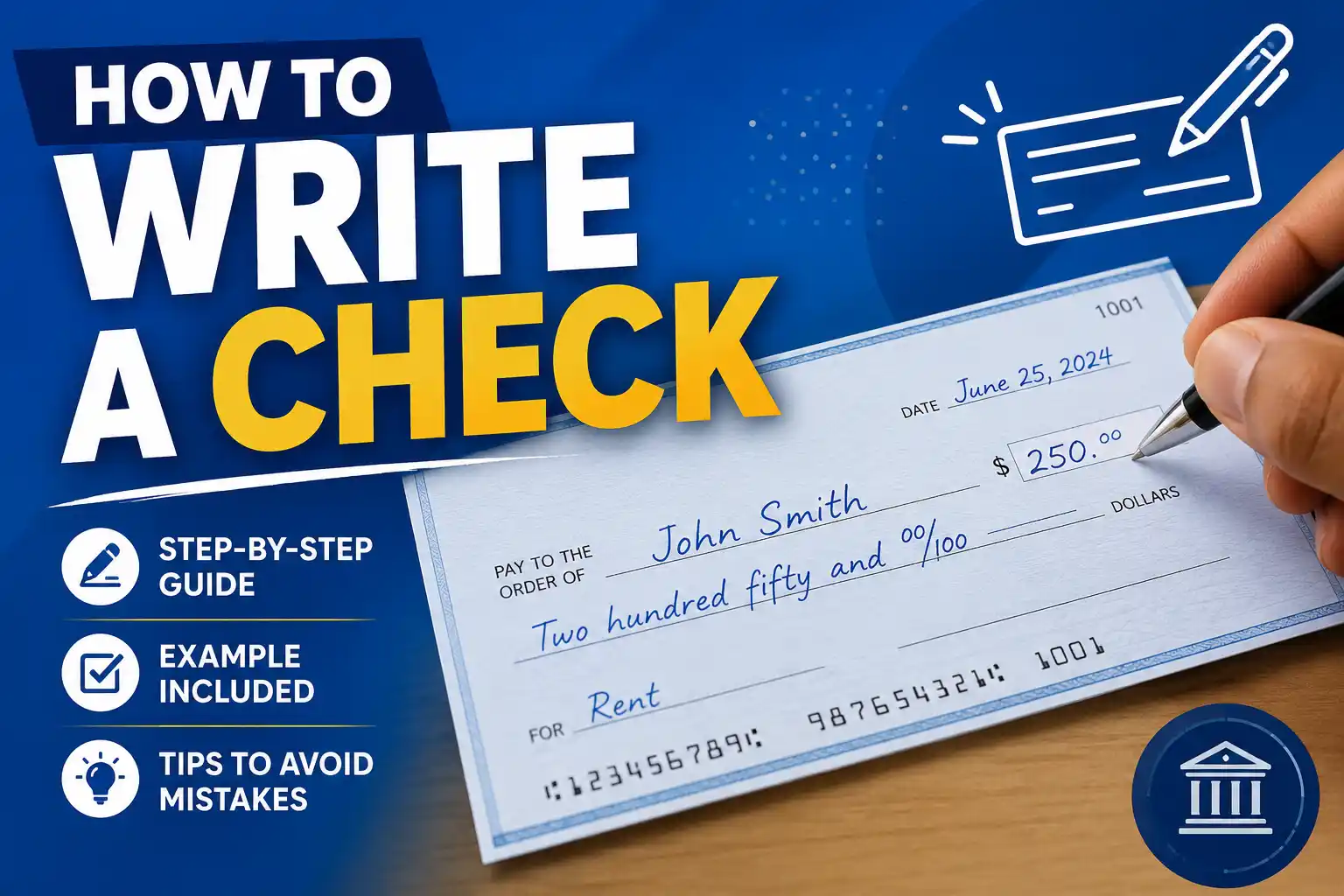
Write the current date on the line in the top right-hand corner of the check. This tells the bank and the recipient when you wrote the check. You can use either format:
- Numerical: 07/19/2026
- Long form: July 19, 2026
A Note About Postdating
Some people write a future date (postdating) hoping the recipient will wait to cash the check. However, most banks will process checks immediately regardless of the date written. If you need to delay a payment, use your bank's scheduled payment feature instead.
Step 2: Write the Payee
On the line that says "Pay to the order of," write the full name of the individual, business, or organisation you are paying. Use their complete legal name rather than a nickname to avoid confusion.
Example
"John Smith" for an individual
"ABC Plumbing, LLC" for a business
Step 3: Write the Amount in Numbers
In the small box to the right of the payee line, write the numerical dollar amount clearly. Include cents, even if you are paying a whole dollar amount.
- For $100.30, write "100.30"
- For $50.00, write "50.00"
Security Tip
Start as close to the dollar sign as possible and fill the box completely. This prevents someone from adding digits in front of your number.
Step 4: Write the Amount in Words
On the line below "Pay to the order of," spell out the dollar amount in words. This amount must match the numerical amount exactly. Write the cents as a fraction over 100.
- $100.30 → "One hundred and 30/100"
- $50.00 → "Fifty and 00/100"
- $1,250.75 → "One thousand two hundred fifty and 75/100"
Security Tip
Draw a line through any unused space on this line to prevent someone from adding extra words or amounts.
Step 5: Add a Memo (Optional)
Write the purpose of the check on the memo line in the bottom left corner. This is optional but helpful for your records.
Example
"Monthly rent" or "August 2025 Power Bill"
Step 6: Sign the Check
Sign your name on the signature line at the bottom right-hand corner. A check cannot be deposited or cashed without your signature. Your signature should match the one the bank has on file.
Warning
No signature = no money moves. It is just a sad piece of paper otherwise.
4 How to Write a Check with Cents
Writing a check with cents follows the same steps, but you need to be extra careful with the amount formatting.
Numeric Amount
In the small box, write the amount with two decimal places. For example, if you are paying $150.75, write "150.75".
Written Amount
On the line below the payee, write the amount in words and use a fraction for the cents. For example:
- $150.75 → "One hundred fifty dollars and 75/100"
- $100.50 → "One hundred and 50/100"
Whole Dollar Amounts
Even if the check amount is a round number, include "00/100" for additional clarity. For example, "$5,250.00" becomes "Five thousand two hundred fifty and 00/100."
5 Special Situations
Sometimes you may need to write a check in a special situation. Here is how to handle them.
Writing a Check to "Cash"
You can write a check to "Cash" if you do not know the payee's name. However, this is risky , anyone who finds the check can cash it. It is much safer to write a specific name.
Writing a Check to Two People
If you are writing a check to two people, the wording matters:
- "Person A and Person B" , both people must be present to deposit or cash the check.
- "Person A or Person B" , either person can deposit the check.
Writing a Check to Yourself
You can write a check to yourself if you need to withdraw or transfer funds between accounts. Simply write your own name on the payee line and follow the same steps.
Voiding a Check
If you make a mistake or need to provide a voided check for direct deposit, write "VOID" in large letters across the front of the check. Do not obscure the routing or account numbers. A voided check cannot be deposited or cashed.
6 Common Mistakes to Avoid
Even small errors can cause delays or rejected payments. Here are the most common mistakes and how to avoid them.
Mismatched Amounts
Writing different amounts in the numeric box and the written amount line. Banks generally honor the written amount, but this can cause delays.
Fix: Double-check that both amounts match exactly before signing.
Forgetting to Sign
Not signing the check on the signature line. An unsigned check is not valid.
Fix: Always sign your check before handing it over.
Incorrect or Missing Date
Leaving the date blank or writing an incorrect date. Partial dates may be considered invalid.
Fix: Always write the current date clearly.
Misspelling the Payee's Name
Spelling the recipient's name incorrectly. This can cause the check to be returned.
Fix: Double-check the payee's name before writing it.
Leaving Blank Spaces
Leaving blank space after the written dollar amount or on the payee line. This makes the check vulnerable to fraud.
Fix: Fill all blank spaces and draw lines through unused areas.
Using Pencil or Erasable Ink
Writing a check in pencil or erasable ink. This makes the check easy to alter.
Fix: Always use a pen with permanent ink.
7 Security Tips to Protect Yourself
Check fraud has surged in recent years. Here are essential security tips to protect yourself when writing checks.
Use a Permanent Pen
Always use a permanent gel pen with ink that cannot be washed off or easily altered. This prevents fraudsters from changing the amount or payee.
Fill All Blank Spaces
Fill out every field completely and draw lines through any unused space. This prevents anyone from adding extra information after you have written the check.
Store Your Checkbook Safely
Keep your checkbook in a safe place. Checks contain sensitive information that could be used for fraud.
Track Your Checks
Record every check you write in your checkbook register. Track the check number, date, payee, and amount. This helps you maintain an accurate balance and spot fraud early.
Monitor Your Account
Review your bank statements regularly to ensure all checks have been processed correctly. Report any suspicious activity to your bank immediately.
Mail Checks Securely
When mailing a check, use a secure envelope and consider using certified mail for added security.
8 How to Record and Balance Your Checks
Keeping track of your checks is essential for managing your finances and avoiding overdrafts.
Use a Checkbook Register
Every checkbook comes with a register where you can record each check you write. Include:
- Check number
- Date
- Payee
- Amount
- Purpose (memo)
Reconcile Your Account
Compare your checkbook register with your bank statement each month. This helps you:
- Catch any errors or unauthorised transactions
- Avoid overdrafts
- Maintain an accurate balance
Know Your Balance
Your available balance is the most up-to-date record of the money you can use. Knowing your balance helps you avoid overdrawing your account and ensures the check can be processed without issues.
9 Practice Exercises to Improve Your Check Writing
The best way to get comfortable with writing checks is to practice. Here are some exercises to help you build confidence.
Exercise 1: Write a Check for Rent
Write a check for $1,200.00 to "Parkview Apartments" for "October Rent." Practice filling out each field correctly.
Exercise 2: Write a Check with Cents
Write a check for $247.85 to "Green Energy Solutions" for "Electricity Bill." Focus on writing the cents correctly.
Exercise 3: Write a Check to a Business
Write a check for $350.00 to "Smith & Sons Landscaping, LLC" for "Lawn Care Services." Practice writing the business name correctly.
Exercise 4: Practice Voiding a Check
Take a practice check and write "VOID" across the front. Practice keeping the routing and account numbers visible.
Final Thoughts
Writing a check may seem like a skill from a bygone era, but it remains an essential part of personal finance. Whether you are paying rent, sending a gift, or making a business payment, knowing how to write a check correctly can save you from delays, fees, and embarrassment.
Remember that a check is a legal document that instructs your bank to pay money from your account. Take the time to fill it out carefully and completely. A well-written check protects you and the recipient.
Keep these principles in mind as you write:
- Use a pen , never pencil or erasable ink.
- Write clearly , make sure every field is legible.
- Match the amounts , the number and written amount must be identical.
- Fill all blanks , draw lines through unused spaces to prevent fraud.
- Sign your check , no signature means no payment.
- Record every check , track your payments in your checkbook register.
Writing a check is a straightforward skill that anyone can master. With practice, it will become second nature. The next time you reach for your checkbook, you will know exactly what to do.
Now go write a check with confidence.