How to Write a Bio: The Complete Guide with Examples
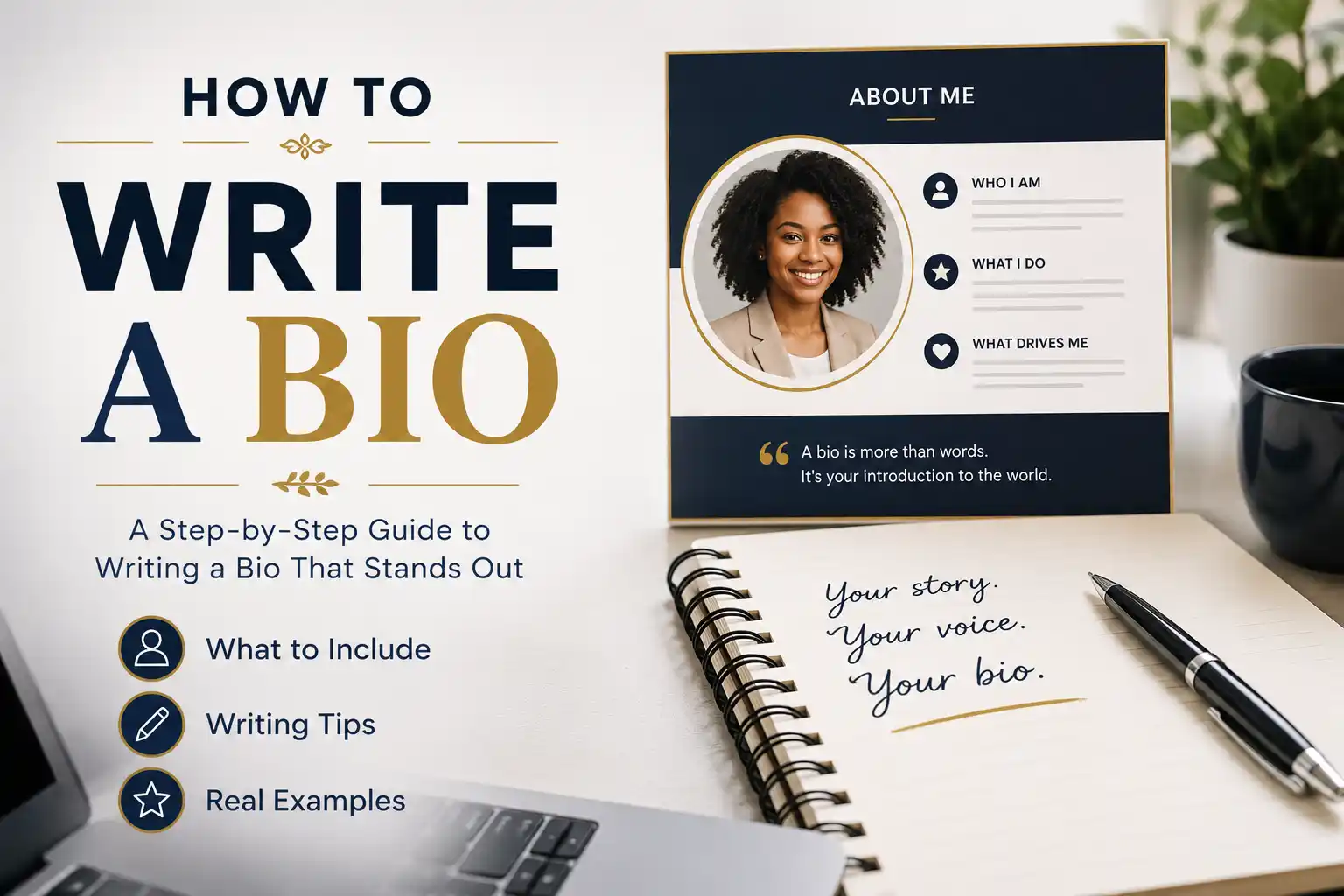
You need to write a bio. Maybe it is for a professional profile, a social media account, a speaking engagement, or a book jacket. You stare at the blank page and wonder: What should I say? How long should it be? What tone should I use? How do I make it sound like me?
You are not alone. Writing a bio is one of those tasks that seems simple but can feel surprisingly difficult. A good bio is a snapshot of who you are , a blend of your professional achievements, personal interests, and unique personality. It is often the first thing people read about you, so it matters.
This guide will teach you everything you need to know about how to write a bio , whether for work, social media, or personal branding. We will cover the different types of bios, the essential elements, the tone, and the common mistakes to avoid. By the end, you will have the tools to write a bio that genuinely represents you.
Bio Writing at a Glance
1 What Is a Bio and Why Does It Matter?
A bio , short for biography , is a brief written account of a person's life, achievements, and interests. It is a snapshot that introduces you to others, whether in a professional context, on social media, or in a personal setting.
Bios matter because they are often the first impression people have of you. A well-written bio can open doors, build connections, and establish your credibility. It tells people who you are, what you do, and why they should care. A poorly written bio can confuse, bore, or even turn people away.
Your bio is your personal brand in words. It is a chance to control your narrative and present yourself in the way you want to be seen. Whether you are looking for a job, building a following, or simply introducing yourself, a good bio is an essential tool.
First Impression
Your bio is often the first thing people read about you. It creates an immediate impression of who you are and what you offer.
Builds Credibility
A well-crafted bio highlights your achievements and expertise, building trust with your audience.
Establishes Connection
A personal touch , a hobby, a quirky fact, or a shared interest , can make you relatable and memorable.
Controls Your Narrative
Your bio is your chance to tell your story on your terms. It shapes how others perceive you.
2 The Fundamentals of Writing a Bio
Before you start writing, it helps to understand the core principles that guide effective bio writing.
Know Your Audience
Who is reading your bio? A potential employer? A social media follower? A conference attendee? Your audience determines what you include, how you word it, and what tone you use. Always write with your reader in mind.
Define Your Purpose
Why are you writing this bio? Is it to get a job, build a following, introduce yourself at an event, or promote your work? Your purpose determines what you emphasise. Focus on what matters most to your reader.
Be Authentic
Your bio should sound like you. Avoid trying to sound overly formal if that is not your style. Let your personality shine through. Authenticity is more memorable than perfection.
Be Specific
Vague statements like "I am passionate about marketing" are forgettable. Specific statements like "I help startups grow their audience through data-driven content strategies" are memorable and credible.
The "Elevator Pitch" Test
Your bio should be clear enough to explain who you are in the time it takes to ride an elevator. If you cannot summarise yourself concisely, you need to refine your bio. Practice saying it aloud , if it sounds awkward, revise it.
3 Types of Bios
There are several types of bios, each suited to a different context and audience. Here are the most common types.
Professional Bio
Used for resumes, LinkedIn, company websites, and professional profiles. Focuses on your career, achievements, skills, and professional goals.
Key trait: Professional, achievement-focused, and results-oriented.
Personal Bio
Used for personal websites, blogs, dating apps, or personal introductions. Focuses on your interests, values, and personality.
Key trait: Personal, conversational, and relatable.
Social Media Bio
Used for Twitter, Instagram, TikTok, and other social platforms. Very short (often 150 characters or fewer). Focuses on your niche, personality, or what you share.
Key trait: Concise, punchy, and attention-grabbing.
Speaker Bio
Used for conference programmes, event websites, and introductions. Focuses on your expertise, why you are qualified to speak on a topic, and your credibility.
Key trait: Credibility-focused and engaging.
Author Bio
Used for book jackets, book blurbs, and author websites. Focuses on your writing, publications, and personal connection to the reader.
Key trait: Warm, engaging, and reader-focused.
Company Bio
Used for "About Us" pages, press kits, and company profiles. Focuses on the company's mission, values, and achievements.
Key trait: Mission-driven and brand-focused.
4 What to Include in a Bio
There is no single formula for a perfect bio, but most effective bios include a combination of these essential elements.
Your Name and Role
Start with your name and what you do. This is the most basic information your reader needs. For example: "Sarah Johnson is a marketing strategist and writer based in New York."
Key Achievements
Highlight your most relevant achievements. Be specific and (where possible) include numbers: "She has helped over 50 startups increase their online engagement by 40%."
Your Expertise or Focus
What are you known for? What is your area of expertise or focus? This helps readers understand what you can offer.
A Personal Touch
A personal detail , a hobby, a value, or a quirky fact , makes you relatable and memorable. "When she is not writing, you can find her hiking in the mountains with her dog, Max."
A Call to Action (Optional)
What do you want the reader to do next? Include a link to your website, a call to connect, or an invitation to learn more about your work.
Bio Checklist
- Your name , Who are you?
- Your role , What do you do?
- Key achievements , What have you accomplished?
- Your expertise , What are you known for?
- A personal touch , What makes you relatable?
- A call to action , What do you want the reader to do?
5 How to Write a Bio: Step-by-Step
Here is a step-by-step process to help you write a bio that works for your context and audience.
Step 1: Define Your Purpose and Audience
Who is reading your bio, and what do you want them to think or do after reading it? This will guide every decision you make.
Step 2: Brainstorm Your Key Points
Jot down everything you might include: your role, achievements, expertise, interests, and personal touches. Do not worry about length or order yet , just get it down.
Step 3: Draft Your Bio
Write a first draft. Write it in the third person (for professional and formal bios) or first person (for personal and informal bios). The third person is often more professional; the first person is more personal.
Step 4: Cut and Refine
Most first drafts are too long. Be ruthless. Cut anything that does not serve your purpose. Keep what is most relevant to your audience.
Step 5: Add Personality
Is your bio dry and factual? Add a personal detail or a touch of humour. Make it sound like you.
Step 6: Read It Aloud
Read your bio aloud. Does it sound natural? Is it easy to understand? If you stumble, your readers will too.
Step 7: Get Feedback
Ask a friend or colleague to read your bio. What impression does it give? Is it accurate? Is it engaging?
Professional Bio Template
[Your Name] is a [your role] based in [your location]. With [number] years of experience in [your field], [he/she] specialises in [your expertise]. [He/She] has [key achievement]. [Personal touch].
For example: "James Chen is a product designer based in San Francisco. With over eight years of experience in UX design, he specialises in creating accessible digital experiences for underrepresented communities. He has led the redesign of three major healthcare apps and is a regular speaker at design conferences. Outside of work, James is an amateur potter and a passionate advocate for mental health awareness."
6 Common Mistakes to Avoid
Even experienced writers make mistakes. Here are the most common errors and how to avoid them.
Being Too Generic
"I am passionate about my work." "I am a hard-working team player." These statements could apply to anyone.
Fix: Be specific. Include concrete achievements, skills, and personal details.
Being Too Self-Promotional
Listing achievements without any humility or personality. This can come across as boastful or arrogant.
Fix: Balance achievements with personal touches. Show, don't just tell.
Forgetting the Audience
Writing a bio that does not speak to the reader's needs or interests.
Fix: Always write with your audience in mind. What do they need to know? What will engage them?
Using Jargon
Using technical terms or acronyms that your reader may not understand.
Fix: Use clear, accessible language. If you must use a technical term, explain it.
Writing in the Wrong Person
Using first person when third person is expected, or vice versa.
Fix: Use the third person for professional and formal bios. Use the first person for personal and informal bios.
Being Too Long or Too Short
A bio that is too long loses the reader's attention. A bio that is too short feels incomplete.
Fix: Aim for the right length for your context: 50–100 words for social media, 100–200 words for professional profiles.
7 How to Write a Bio for Different Platforms
Each platform has its own expectations and constraints. Here is how to tailor your bio for different contexts.
Your LinkedIn bio (the "About" section) should be professional and achievement-focused. Use the first person and include your current role, key achievements, and what you are passionate about. Add a call to action , invite people to connect or message you.
Length: 200–300 words.
Twitter / X
Twitter bios are short , 160 characters or fewer. Focus on your niche, personality, and what you share. Use keywords and emojis to stand out.
Length: 160 characters or fewer.
Instagram bios are also short. Include what you do, what you post about, and a personal touch. Use emojis and line breaks for readability.
Length: 150 characters or fewer.
Personal Website
Your personal website bio can be longer and more detailed. It should tell your story, highlight your work, and invite visitors to explore your site.
Length: 200–500 words.
Resume or CV
A resume bio (professional summary) is a short paragraph at the top of your CV. It should summarise your experience, key skills, and career goals.
Length: 50–100 words.
Conference or Event
A speaker bio should be engaging and credibility-focused. It should highlight why you are qualified to speak on your topic and include a personal touch to connect with the audience.
Length: 100–150 words.
8 Bio Examples
Here are some sample bios for different contexts to illustrate different styles and approaches.
Example 1: Professional Bio (LinkedIn)
"I am a senior product manager with over a decade of experience in B2B SaaS. I specialise in taking products from concept to market, building high-performing teams, and driving growth through data-informed decisions. Currently, I lead the product strategy at InnovateTech, where I have overseen the launch of three successful products that generated over $10 million in revenue. I am passionate about creating technology that solves real-world problems and mentoring the next generation of product leaders. Let's connect , I am always open to discussing new ideas and opportunities."
Example 2: Social Media Bio (Twitter)
"📝 Writer & storyteller | 🎙️ Host of The Creative Life podcast | ✍️ Helping you find your voice | 🌱 Believer in small, consistent actions | 📍 NYC"
Example 3: Personal Bio (Website)
"Hi, I am Maya. I am a writer, photographer, and perpetual learner based in Portland, Oregon. I believe in the power of stories to connect us, and I spend my days capturing them , whether through words, images, or conversations. When I am not writing, you will find me exploring the Pacific Northwest, tending to my garden, or reading a good book with a cup of tea in hand. Welcome to my little corner of the internet."
Example 4: Speaker Bio
"Dr. Elena Rodriguez is a clinical psychologist and a leading expert on resilience and mental health in the workplace. She is the author of the bestselling book The Resilient Mind and has been featured in The New York Times, TEDx, and the BBC. Elena's research has helped thousands of professionals build the skills they need to thrive in high-pressure environments. In her spare time, she is an avid salsa dancer and a volunteer mentor for young women in STEM."
Example 5: Author Bio
"David Kim writes stories about family, identity, and the spaces between. His debut novel, The Last Summer in Seoul, was a finalist for the PEN Literary Award. David grew up between two cultures , Korea and America , and his work explores the complexities of belonging and home. He lives in Los Angeles with his partner and their rescue dog, Luna. When he is not writing, he can be found cooking Korean food and debating the best way to make kimchi."
9 How to Revise Your Bio
Your bio is a living document. It will change as you grow and evolve. Here is a step-by-step process for revising your bio.
Step 1: Revisit Your Purpose
Has your purpose changed? Are you writing for a different audience? Make sure your bio still serves its intended purpose.
Step 2: Update Your Achievements
Have you accomplished anything new? Update your bio with recent achievements, projects, or publications.
Step 3: Check the Tone
Does your bio still sound like you? Is the tone appropriate for your audience? Adjust as needed.
Step 4: Cut the Clutter
Have you added new details without removing old ones? Keep your bio concise. Cut anything that no longer serves your purpose.
Step 5: Get Feedback
Ask someone to read your revised bio. Does it still represent you accurately? Is it engaging?
Step 6: Update Your Bios
Once you have a revised version, update it across all your platforms. Consistency helps build your personal brand.
10 Practice Exercises to Improve Your Bio Writing
The best way to get better at writing bios is to practice. Here are some exercises to help you sharpen your skills.
Exercise 1: Write Three Versions
Write three versions of your bio: a short social media version (50 words), a professional version (150 words), and a personal version (200+ words). Notice how the focus and tone change.
Exercise 2: Analyse Other Bios
Find five bios of people you admire. Analyse them. What do they include? What tone do they use? What makes them effective?
Exercise 3: The "Generic to Specific" Rewrite
Take a generic bio and rewrite it to be specific and personal. Add concrete achievements, unique details, and a distinctive voice.
Exercise 4: Peer Review
Swap bios with a friend or colleague. Provide honest feedback on what works and what could be improved.
Final Thoughts
Writing a bio is an opportunity to introduce yourself to the world on your own terms. It is a chance to share who you are, what you do, and what matters to you. A well-written bio can open doors, build connections, and leave a lasting impression.
Remember that your bio is not set in stone. It can evolve as you grow and change. The best bios are authentic, specific, and audience-focused. They balance professionalism with personality and achievements with relatability.
Keep these principles in mind as you write:
- Know your audience. Write for the people who will read your bio.
- Be specific. Concrete details are more memorable than vague claims.
- Be authentic. Let your personality shine through.
- Balance professionalism and personality. Achievements matter, but so does relatability.
- Revise and update. Your bio should grow with you.
Your bio is your story, told in your words. Take the time to write it well. It will be read by people who matter , and it might just open the door to something wonderful.
Now go write a bio that represents the best of who you are.