How to Draw Up a Business Plan: The Complete Guide with Examples
You have a great business idea. You have the passion and the drive. But when you sit down to draw up a business plan, you are not sure where to start. What goes into a business plan? How do you structure it? How do you make it convincing enough to attract investors or secure a loan?
You are not alone. Drawing up a business plan is one of the most important , and most intimidating , tasks for any entrepreneur. But a well-crafted business plan is more than just a document for investors. It is a roadmap for your business. It clarifies your vision, identifies potential challenges, and helps you stay on track as you grow.
This guide will teach you everything you need to know about how to draw up a business plan that is clear, comprehensive, and compelling. We will cover the structure, the content, the financials, and the common mistakes to avoid. By the end, you will have the tools to create a business plan that guides your business to success.
Business Plan at a Glance
1 What Is a Business Plan and Why Does It Matter?
A business plan is a formal document that outlines your business goals, strategies, and the path to profitability. It explains what your business does, who it serves, and how it will make money. A business plan sets out how a business idea is meant to become a viable business model, helping you structure your idea, weigh up opportunities and risks, and prepare your financing.
Business plans matter for several reasons. First, they clarify your ideas. Writing down your strategy gives it structure and substance. Second, they prove you are serious. A well-researched plan shows banks, investors, and partners that your business is credible. Third, they help you stay focused as you grow. Research shows that businesses with a plan grow 30% faster than those without one.
As Tim Berry, founder of Palo Alto Software, puts it: "The value of a business plan is measured in what it does for your business, not in the plan itself. A good plan is only good if it helps you run your company better".
Attracts Investment
A strong business plan is essential for securing funding from banks, investors, or grant programs.
Clarifies Your Vision
Writing a plan forces you to think through every aspect of your business, from marketing to operations.
Guides Decision-Making
Your business plan becomes a reference point for strategic decisions, helping you stay aligned with your goals.
Tracks Progress
A living business plan allows you to compare actual results against projections and adjust your strategy accordingly.
2 The Fundamentals of Drawing Up a Business Plan
Before you start writing, it is essential to understand the core principles that guide effective business planning.
Start with Clear, Concrete Basics
Skip vague descriptions. Define your business in 2–3 sentences: who you serve, the problem your business is addressing, what you offer (your solution), and how you deliver value. This clarity will guide every other section of your plan.
Ground Your Plan in Research
A business plan is not a work of fiction. Every claim you make should be supported by research. This includes market research, competitive analysis, and realistic financial projections. As the proverb says, "In God we trust; all others must bring data."
Choose the Right Format
Business plans come in different formats. A traditional comprehensive plan is best when seeking bank loans or investor funding. A lean one-page plan is ideal if you are self-funding or need to test ideas quickly. Choose the format that aligns with your goals.
Treat It as a Living Document
Your business plan is not meant to sit in a drawer. Review it at least once a year, track actual results against projections, and update it when market conditions or your business circumstances change significantly.
The Planning Paradox
As Tim Berry notes: "The plan isn't finished when you finish writing it. A real plan is a living thing , you review it, you compare it to what actually happened, and you change it. The planning is what matters, not the plan". The process of planning is more valuable than the document itself.
3 How to Structure a Business Plan
A well-structured business plan follows a standard format that readers expect. Here are the essential sections.
Executive Summary
The executive summary is an overview of your business and your plans. It comes first in your plan but is ideally written last, after you have completed the other sections. It should be 1–2 pages and act as a stand-alone document that covers the highlights of your detailed plan. Include:
- A summary of the problem you are solving
- A description of your product or service
- An overview of your target market
- A brief description of your team
- A summary of your financials
- Your funding requirements (if you are raising money)
Company Description
The company description explains why you are in business and what you are selling. It should include your mission statement, the problem your business solves, a brief overview of your products and services, and your ownership structure.
Products and Services Description
This section describes exactly what you are selling and how it solves a problem for your target market. Start by describing the problem that exists for your customers, then describe how you plan to solve that problem. Include any competitive advantages you may have, like specific intellectual property or patents.
Market Analysis
The market analysis brings together everything you know about your target market. Include information such as demographics (age, income level, location) and psychographics (interests, habits). Also include information about the size of your market and whether it is growing or shrinking. Use the TAM, SAM, SOM framework to size your market.
Competitive Analysis
Every business has competition. A good competitive analysis lays out the competitive landscape and explains how your business is different. Maybe your products are better made, or cheaper, or your customer service is superior.
Marketing and Sales Plan
This section covers how you will position your product or service in the market, the marketing channels and messaging you will use, and your sales tactics. Start with a positioning statement that explains how your business fits into the overall market.
Operations Plan
The operations section describes the necessary requirements for your business to run smoothly. This may include inventory, supply chain management, manufacturing processes, equipment, and distribution.
Organization and Management Team
Investors look for great teams, not just great ideas. Use this section to describe your current team and who you need to hire. Highlight the relevant experiences of each key team member.
Financial Plan
The financial plan is one of the most important parts of a business plan. It should include:
- Sales forecast: An estimate of the sales expected over a given period
- Expense budget: Your planned spending on personnel, marketing, and taxes
- Profit & Loss statement: Brings together your sales and expenses
- Cash flow statement: Shows how cash moves into and out of your business
- Balance sheet: A list of assets, liabilities, and equity
Appendix
This is the place for additional data, charts, or other information that supports your plan. Include it, but remember that your business plan should stand on its own even if the reader skips this section.
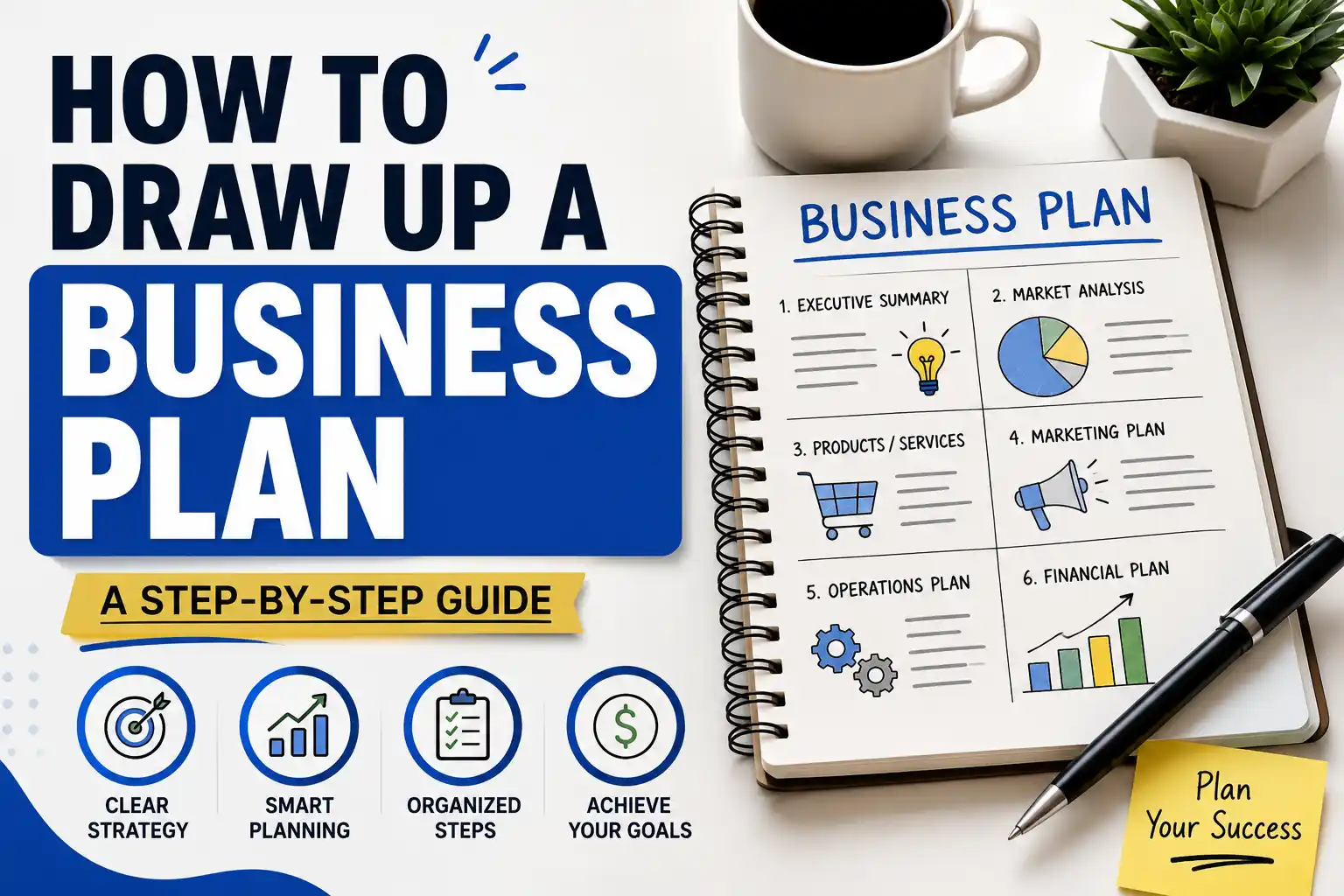
Standard Business Plan Structure
- 1. Executive Summary , Overview of the business
- 2. Company Description , Mission, problem, solution
- 3. Products and Services , What you sell and why
- 4. Market Analysis , Target market and industry
- 5. Competitive Analysis , Competitors and advantages
- 6. Marketing and Sales , How you will reach customers
- 7. Operations , How your business will run
- 8. Management Team , Who will lead the business
- 9. Financial Plan , Forecasts and projections
- 10. Appendix , Supporting documents and data
4 How to Write Each Section
Here is a detailed breakdown of what to include in each section of your business plan.
Executive Summary
Keep it to one or two pages. Write it last, after you have completed the other sections. It should be a stand-alone document that covers the highlights of your plan. Think of it as your elevator pitch , it should grab the reader's attention and make them want to read more.
Company Description
Describe the purpose of your business. Include your mission statement, the problem your business solves, a brief overview of your products and services, and your ownership structure. Be clear about what makes your business unique.
Products and Services
Describe what you are selling and how it solves a problem for your customers. Include details about pricing, production, and any competitive advantages. If you have any initial sales or contracts, include that information as well.
Market Analysis
Describe your target market in detail. Include demographics, psychographics, and information about the size and growth of your market. Avoid defining your market as "everyone". Use the TAM, SAM, SOM framework to be more specific.
Competitive Analysis
Identify your direct and indirect competitors. Explain their strengths and weaknesses. Then explain how your business is different and why customers would choose you over them. Do not claim you have no competition , everyone has competition.
Marketing and Sales
Explain how you will reach your customers and convince them to buy. This includes your marketing channels, messaging, and sales tactics. Start with a positioning statement that explains how your business fits into the market.
Operations
Describe the day-to-day operations of your business. This could include inventory management, supply chain, manufacturing, or technology. Keep it as detailed as necessary for your business type.
Management Team
Introduce your team and explain why they are the right people to lead the business. Highlight relevant experience and past successes. If you still need to hire key roles, note those gaps.
Financial Plan
Include realistic financial projections. This is not about perfect forecasts, but about realistic assumptions. Include a sales forecast, expense budget, profit and loss statement, cash flow statement, and balance sheet. Be honest about your assumptions.
Appendix
Include supporting documents such as resumes, product photos, market research data, or detailed financial spreadsheets. This section is optional but can add credibility.
5 How to Draw Up a Business Plan: Step-by-Step
Here is a step-by-step process for drawing up your business plan.
Step 1: Define Your Purpose
Why are you writing a business plan? Are you raising money? Guiding your team? Planning a new period of growth? Knowing your purpose will help you stay focused.
Step 2: Conduct Research
Research your market, target group, and competition. Gather data on your industry, customer needs, and competitors. This research will ground your plan in reality.
Step 3: Write the Body Sections
Start with the sections that are easiest for you. Many entrepreneurs find it helpful to start with the market analysis and products/services sections, then move on to operations and management.
Step 4: Create Financial Projections
Build your financial forecasts. Start with a sales forecast, then estimate your expenses, and finally create your profit and loss, cash flow, and balance sheet projections.
Step 5: Write the Executive Summary
Write the executive summary last, after you have completed all the other sections. This ensures it accurately summarises the entire plan.
Step 6: Review and Revise
Have someone review your business plan. Ask for feedback on clarity, completeness, and feasibility. Revise based on their input.
Step 7: Update Regularly
Your business plan is a living document. Review it at least once a year and update it as your business grows and market conditions change.
6 Common Business Plan Mistakes to Avoid
Even experienced entrepreneurs make mistakes. Here are the most common errors and how to avoid them.
Overly Optimistic Financial Projections
Projecting revenues that are unrealistically high and costs that are unrealistically low.
Fix: Be conservative. Use realistic assumptions and test your numbers against industry benchmarks.
Vague or Undefined Goals
Writing a plan without clear, measurable objectives.
Fix: Set specific, measurable, achievable, relevant, and time-bound (SMART) goals.
Not Writing for the Right Audience
Using jargon that your readers do not understand.
Fix: Write in plain language. If you must use technical terms, explain them.
Writing a Plan That Is Too Long
Creating a 40-page document that no one will read.
Fix: Keep your plan concise. As Tim Berry says: "Nobody is going to read a 40-page business plan".
Ignoring the Competition
Claiming you have no competition or failing to analyse your competitive landscape.
Fix: Every business has competition. Identify your competitors and explain your competitive advantage.
Not Taking the Planning Process Seriously
Writing a plan just to "tick the box" without genuinely thinking through your business strategy.
Fix: Use the planning process to strengthen your understanding of how your business will be successful.
7 How to Write a Convincing Executive Summary
The executive summary is the most important part of your business plan. It is often the only part that investors read. Here is how to make it compelling.
Keep It to One or Two Pages
Your executive summary should be concise. It is a snapshot of your entire plan, not a detailed document.
Start with a Strong Hook
Begin with a clear, compelling statement about your business. What problem do you solve? Why does it matter?
Cover the Key Points
Include a summary of the problem you are solving, a description of your product or service, an overview of your target market, a brief description of your team, a summary of your financials, and your funding requirements.
Write It Last
Write the executive summary after you have completed all the other sections. This ensures it accurately summarises the entire plan.
Sample Executive Summary Opening
"GreenLeaf Organics is a premium organic food delivery service serving health-conscious consumers in the Greater London area. We solve the problem of limited access to fresh, organic produce by offering a subscription-based delivery service that sources directly from local farms. Our target market is busy professionals and families who value health and convenience. With a founding team that has over 15 years of combined experience in the food and logistics industries, we are poised to capture a growing share of the $5 billion UK organic food market."
8 How to Build a Realistic Financial Plan
The financial plan is often the most daunting part of a business plan. Here is how to build a realistic financial forecast.
Start with a Sales Forecast
Estimate the sales you expect over a given period. Break down your forecast into key revenue streams. Be realistic , do not assume you will capture a huge market share immediately.
Estimate Your Expenses
List all your planned spending, including personnel costs, marketing expenses, rent, utilities, and taxes. Be thorough and realistic.
Create a Profit and Loss Statement
Bring together your sales and expenses to calculate your planned profits. This shows whether your business is viable.
Build a Cash Flow Statement
Cash and profit are not the same thing. Your cash flow statement shows how cash moves into and out of your business. It is essential for understanding your liquidity.
Include a Balance Sheet
This provides an overview of the financial health of your business by listing your assets, liabilities, and equity.
Be Conservative
As Tim Berry advises: "Don't paint a rosy picture. Assume fewer customers will show up than you hope. If the business still works on conservative numbers, you've got something real".
Key Financial Terms
- Sales forecast: Projected revenue over a period
- Expense budget: Planned spending
- Profit & Loss (P&L): Revenue minus expenses
- Cash flow: Cash moving in and out of the business
- Balance sheet: Assets, liabilities, and equity
- Break-even analysis: The point at which revenue covers costs
9 How to Revise Your Business Plan
A great business plan is not written; it is rewritten. Revision is where your plan goes from good to great. Here is a step-by-step process for revising your business plan.
Step 1: Check for Completeness
Have you included all the essential sections? Is there any missing information? Review the structure above to ensure you have covered everything.
Step 2: Check for Consistency
Are your financial projections consistent with your market analysis? Does your marketing plan align with your target market? Look for any gaps or contradictions.
Step 3: Check the Numbers
Review your financial projections. Are they realistic? Are your assumptions clearly stated? As Tim Berry says, "Keep your forecast honest".
Step 4: Check for Clarity
Is your plan easy to read and understand? Use bullet points and short sentences where possible. Avoid jargon.
Step 5: Get Feedback
Have someone else review your plan. Ask them what questions your plan leaves unanswered. Use their feedback to strengthen your plan.
Step 6: Update Regularly
Your business plan is a living document. Review it at least once a year and update it as your business grows.
10 Practice Exercises to Improve Your Business Planning
The best way to get better at drawing up a business plan is to practice. Here are some exercises to help you sharpen your skills.
Exercise 1: Write a One-Page Plan
Write a one-page business plan for a business idea you have. Focus on the key elements: problem, solution, target market, competitive advantage, and financial goals.
Exercise 2: Conduct a Competitive Analysis
Choose a business in your industry. Research its strengths and weaknesses. Write a competitive analysis that explains how your business would differentiate itself.
Exercise 3: Build a Financial Forecast
Create a simple financial forecast for a business idea. Include a sales forecast, expense budget, and profit and loss statement for the first year.
Exercise 4: Pitch Your Plan
Practice presenting your business plan in 5 minutes. Focus on the key points: the problem, your solution, your target market, and your financial projections.
Final Thoughts
Drawing up a business plan is an essential step for any entrepreneur. It clarifies your vision, attracts investors, and guides your business to success. But remember: the plan itself is not the goal. The goal is to build a successful business.
As Tim Berry puts it: "The value of a business plan is measured in what it does for your business, not in the plan itself". Use your plan as a tool to guide your decisions, track your progress, and adapt to changing circumstances.
Keep these principles in mind as you write:
- Start with clear, concrete basics. Define your business in 2–3 sentences.
- Ground your plan in research. Use data to support your claims.
- Be realistic. Use conservative assumptions in your financial projections.
- Keep it concise. No one will read a 40-page business plan.
- Treat it as a living document. Review and update your plan regularly.
- Get feedback. Have others review your plan and ask questions.
Your business idea has potential. With a well-crafted business plan, you can turn that potential into reality. Take the time to write a plan that is clear, comprehensive, and compelling. Your future business will thank you.
Now go draw up a business plan that builds your future.