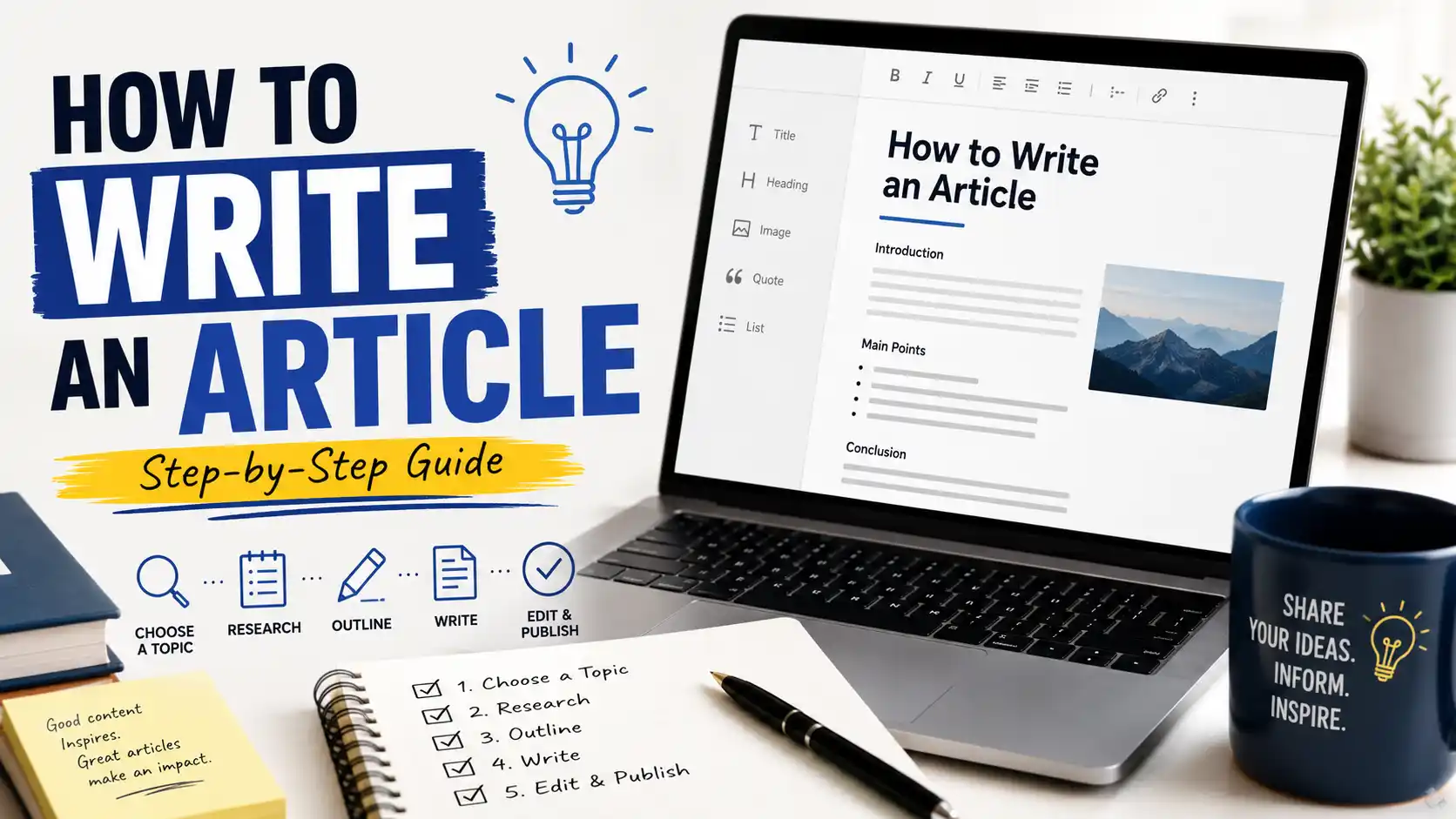
How to Write an Article: The Complete Guide with Examples
You have an idea. You have a message you want to share. But when you sit down to write an article, you are not sure where to start. How do you structure it? What should you include? How do you keep readers engaged from beginning to end?
You are not alone. Writing an article is a skill that many people find challenging. But it is also one of the most valuable skills you can develop. Whether you are writing for a blog, a magazine, a website, or your own publication, a well-written article can inform, persuade, entertain, and inspire.
This guide will teach you everything you need to know about how to write an article that engages readers and communicates your message effectively. We will cover the structure, the research, the writing process, and the common mistakes to avoid. By the end, you will have the tools to write articles that people actually want to read.
Article Writing at a Glance
1 What Is an Article and Why Does It Matter?
An article is a piece of writing that explores a topic, presents information, or shares a perspective. Articles are published in newspapers, magazines, blogs, websites, academic journals, and countless other platforms. They are one of the most common and versatile forms of written communication.
Articles matter because they are how we share knowledge and ideas with the world. A well-written article can educate readers, change opinions, inspire action, or simply entertain. It is a way to contribute to the global conversation and establish yourself as a thought leader in your field.
Whether you are writing for a personal blog or a major publication, the ability to write a clear, engaging article is an essential skill in today's information-driven world.
Connects with Readers
Articles allow you to share your ideas and connect with people who share your interests.
Builds Authority
Publishing well-researched articles establishes you as an expert in your field.
Drives Action
Articles can inform, persuade, and inspire readers to take action.
Preserves Knowledge
Articles create a permanent record of ideas, research, and perspectives.
2 The Fundamentals of Article Writing
Before you start writing, you need to understand the core principles that guide effective article writing.
Know Your Audience
This is the single most important rule of article writing. Who are you writing for? What do they already know? What do they need to know? What will they find interesting? Write with your audience in mind, and your article will resonate with them.
Have a Clear Purpose
Every article should have a clear purpose. Are you informing, persuading, entertaining, or inspiring? What do you want readers to think, feel, or do after reading your article? Be clear about your purpose before you start writing.
Be Clear and Concise
Readers are busy. They do not have time to wade through long, complex sentences. Use clear, simple language. Get straight to the point. Cut unnecessary words. As the writer E.B. White said, "Omit needless words."
Back Up Your Claims
If you are making claims or presenting information, support them with evidence. Use data, quotes, examples, and research to back up your arguments. This builds credibility and trust with your readers.
The "So What?" Test
For every sentence you write, ask yourself: "So what?" Why should the reader care? If you cannot answer that question, revise or remove the sentence. Every word should serve a purpose.
3 How to Structure an Article
A well-structured article is easy to read and understand. Here is the standard structure that works for most articles.
Headline
Your headline is the most important part of your article. It must grab attention and make readers want to click and read. A good headline is clear, compelling, and promises value.
Introduction
The introduction sets the stage for your article. It should:
- Hook the reader with a compelling opening
- Introduce the topic and why it matters
- State the main point or thesis
- Give readers a reason to keep reading
Body
The body is where you develop your main points. Use:
- Clear subheadings to break up the text
- Short paragraphs for easy reading
- Evidence and examples to support your claims
- Transitions to guide the reader through your argument
Conclusion
The conclusion wraps up your article. It should:
- Summarise the main points
- Reinforce the main message
- Leave the reader with something to think about
- Include a call to action if appropriate
Article Structure Template
- Headline: Clear, compelling, and promise-driven
- Introduction: Hook, context, thesis
- Body: Main points with evidence and examples
- Conclusion: Summary, reinforcement, call to action
4 How to Write a Compelling Headline
Your headline is your first , and sometimes only , chance to grab a reader's attention. Here is how to write headlines that get clicks.
Use Strong, Action-Oriented Language
Use active verbs and strong language. Instead of "Tips for Writing," try "10 Proven Tips to Transform Your Writing." Action words create energy and urgency.
Make a Promise
Your headline should promise value to the reader. What will they learn, gain, or achieve by reading your article? Be specific. "How to Save $500 on Your Grocery Bill" is more compelling than "Tips for Saving Money."
Use Numbers and Lists
Headlines with numbers perform well. "7 Ways to Boost Your Productivity" is more clickable than "Ways to Boost Your Productivity." Numbers set clear expectations and make the content feel more digestible.
Create Curiosity
A headline that sparks curiosity makes readers want to click. "The One Habit That Changed My Life" creates curiosity. But be careful , do not be misleading. Your article should deliver on the promise of the headline.
Strong Headline Examples
- "10 Proven Strategies to Double Your Blog Traffic"
- "Why Most People Fail at Goal Setting (And How to Succeed)"
- "The One Skill That Will Make You More Productive"
Weak Headline Examples
- "Some Tips for Blogging"
- "Goal Setting"
- "Productivity"
5 How to Write a Strong Introduction
Your introduction must hook the reader and make them want to read more. Here is how to write an introduction that works.
Start with a Hook
Begin with something that grabs attention. This could be:
- A surprising fact or statistic
- A compelling question
- A short anecdote or story
- A bold statement or opinion
Introduce the Topic
After the hook, introduce your topic and explain why it matters. Give readers the context they need to understand your article.
State Your Thesis
Clearly state the main point of your article. What is your argument or key message? This gives readers a roadmap for what is to come.
Preview What Is to Come
Briefly preview the main points you will cover. This helps readers understand the structure of your article and gives them a reason to keep reading.
Introduction Example
"Did you know that the average person spends nearly two hours a day on social media? That is over 700 hours a year , time that could be spent learning, creating, or connecting with loved ones. In this article, we will explore five proven strategies to reduce your social media usage and reclaim your time."
6 How to Write the Body of Your Article
The body is where you develop your ideas and make your case. Here is how to write a body that keeps readers engaged.
Use Subheadings
Subheadings break up the text and make your article easy to scan. They also help readers understand the structure of your argument. Use descriptive subheadings that summarise what each section is about.
Keep Paragraphs Short
Short paragraphs are easier to read than long ones. Aim for 2–4 sentences per paragraph. This creates white space and makes your article feel less intimidating.
Use Evidence and Examples
Support your points with evidence. This could include data, quotes, case studies, or personal anecdotes. Examples make your writing more concrete and relatable.
Use Transitions
Transitions help guide the reader through your argument. Use phrases like "furthermore," "however," "in addition," and "as a result" to show the logical flow of your ideas.
Body Paragraph Structure
- Topic sentence: States the main point of the paragraph
- Evidence: Supports the topic sentence with facts, examples, or quotes
- Analysis: Explains how the evidence supports your point
- Transition: Connects to the next paragraph
7 How to Write a Strong Conclusion
Your conclusion is the last thing readers will remember. Here is how to write a conclusion that leaves a lasting impression.
Summarise Your Main Points
Briefly recap the main points of your article. This reinforces your message and helps readers remember what they have learned.
Reinforce Your Main Message
Restate your thesis or main message in a fresh way. Remind readers why your topic matters and what they should take away from your article.
Include a Call to Action
What do you want readers to do after reading your article? A call to action could be leaving a comment, sharing the article, signing up for a newsletter, or taking action on what they have learned.
End with a Memorable Statement
Finish with something memorable , a powerful quote, a thought-provoking question, or a final insight that lingers in the reader's mind.
Conclusion Example
"In conclusion, reducing your social media usage is not about eliminating technology from your life , it is about using it intentionally. By implementing these five strategies, you can reclaim your time, improve your focus, and build deeper connections with the people who matter most. So, what will you do with the extra 700 hours you will save this year?"
8 Common Article Writing Mistakes to Avoid
Even experienced writers make mistakes. Here are the most common errors and how to avoid them.
No Clear Structure
Writing without a clear structure or logical flow. Readers get lost and stop reading.
Fix: Create an outline before you write. Use headings and subheadings to organise your ideas.
Weak Headline
A headline that is vague, boring, or does not promise value. No one will click.
Fix: Write a clear, compelling headline that promises value and grabs attention.
Not Knowing Your Audience
Writing without considering who your readers are or what they need.
Fix: Define your audience before you write. Write for them, not for yourself.
Too Much Jargon
Using technical terms or jargon that your readers may not understand.
Fix: Use clear, simple language. Define any necessary terms.
Weak Conclusion
A conclusion that fizzles out or does not reinforce the main message.
Fix: End with a strong conclusion that summarises, reinforces, and includes a call to action.
Not Proofreading
Publishing an article with spelling, grammar, or factual errors. This undermines your credibility.
Fix: Proofread carefully. Read it aloud. Ask someone else to review it.
9 How to Revise and Edit Your Article
A great article is not written; it is rewritten. Revision is where your article goes from good to great. Here is a step-by-step process for revising your article.
Step 1: Take a Break
Step away from your article for a few hours or a day. This gives you fresh eyes and helps you see your work more objectively.
Step 2: Read It Aloud
Read your article aloud. Does it sound natural? Are there any awkward phrases? Reading aloud helps you catch issues you might miss when reading silently.
Step 3: Check the Structure
Does your article have a clear structure? Is the introduction compelling? Is the body well-organised? Is the conclusion strong?
Step 4: Cut the Clutter
Cut unnecessary words, phrases, and sentences. Every word should earn its place.
Step 5: Check for Clarity
Is your article easy to understand? Is your main point clear? If not, revise for clarity.
Step 6: Proofread
Check for spelling, grammar, and punctuation errors. A polished article demonstrates professionalism.
10 Practice Exercises to Improve Your Article Writing
The best way to get better at writing articles is to practice. Here are some exercises to help you sharpen your skills.
Exercise 1: Write a Headline
Choose a topic and write five different headlines. Make each one progressively more compelling. Practice grabbing attention with your words.
Exercise 2: Write an Introduction
Write three different introductions for the same article. Try a question, a statistic, and a story. Which one is most effective?
Exercise 3: Rewrite a Weak Article
Find an article that could be improved. Rewrite it using the principles in this guide. Compare the two versions.
Exercise 4: Write a Short Article
Write a 500-word article on a topic you know well. Focus on structure, clarity, and engaging your readers.
Final Thoughts
Writing an article is a skill that can be learned and improved with practice. A well-written article can inform, persuade, entertain, and inspire. It is a powerful way to share your ideas with the world.
Remember that the best articles are not written , they are rewritten. Take the time to revise and polish your work. Your readers will appreciate the effort, and your message will be more impactful.
Keep these principles in mind as you write:
- Know your audience. Write for them, not for yourself.
- Have a clear purpose. Know what you want to achieve.
- Be clear and concise. Every word should earn its place.
- Structure your article. Use headlines, subheadings, and paragraphs effectively.
- Revise and proofread. A polished article builds credibility.
Article writing is a journey of discovery. Each article you write will be better than the last. With practice, patience, and persistence, you will become a confident and effective writer.
Now go write an article that makes a difference.