How to Write a Thesis: The Complete Guide with Examples
You have spent years studying your subject. You have read hundreds of articles and books. You have a research question that you are passionate about. But now you face the most daunting task of your academic career: writing your thesis.
You are not alone. Writing a thesis is one of the most challenging and rewarding academic undertakings. A thesis is not just a long paper , it is a sustained, original contribution to knowledge that demonstrates your ability to conduct independent research and engage with scholarly debates.
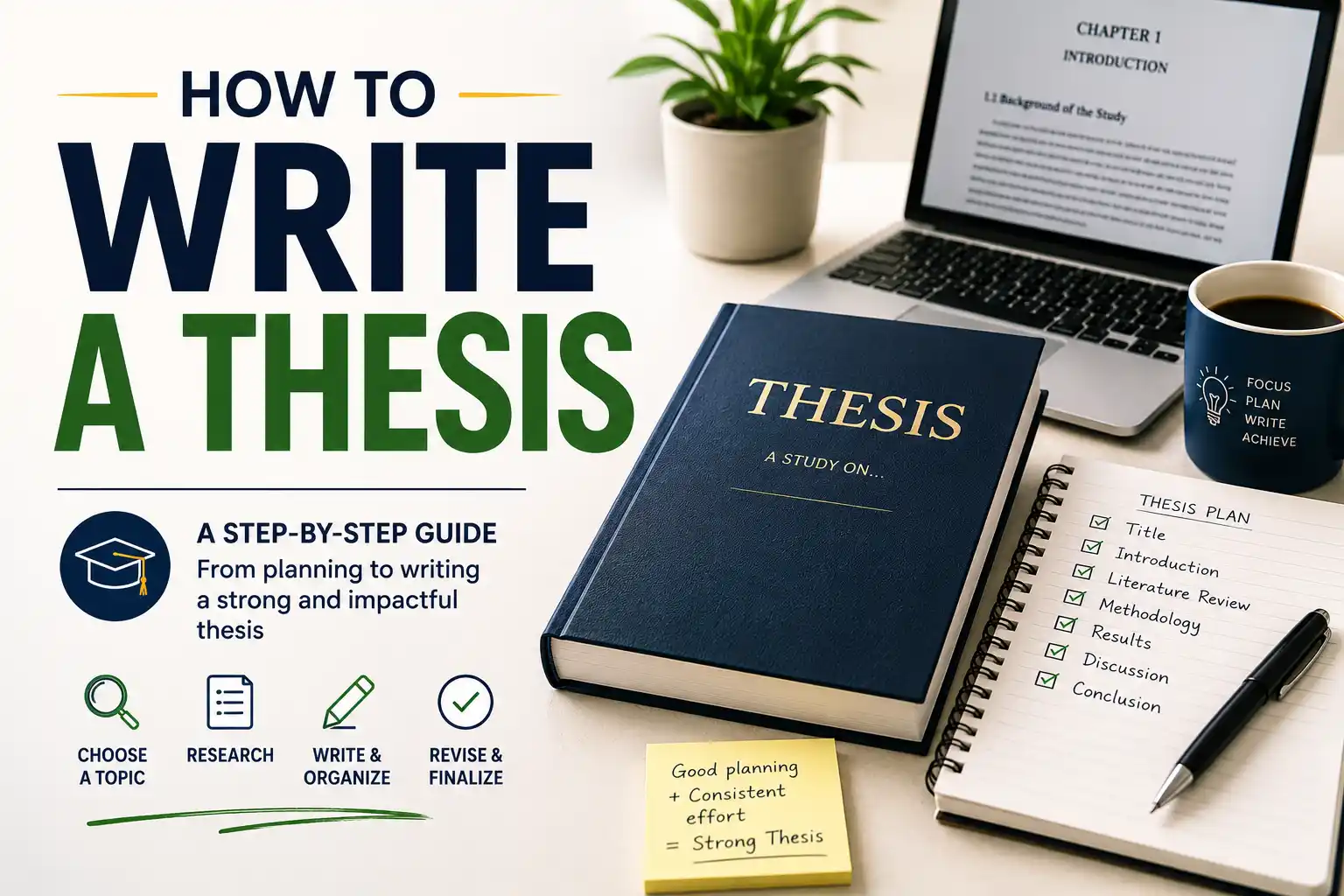
This guide will teach you everything you need to know about how to write a thesis , from choosing a topic to defending your final draft. We will cover the structure, the research process, the writing techniques, and the common mistakes to avoid. By the end, you will have the tools to write a thesis that is clear, compelling, and academically rigorous.
Thesis Writing at a Glance
1 What Is a Thesis and Why Does It Matter?
A thesis is a substantial piece of academic writing that presents the results of original research on a specific topic. It is the culminating project of a Master's or doctoral degree and demonstrates a student's ability to conduct independent research, engage with scholarly debates, and contribute new knowledge to their field.
Unlike a research paper, a thesis is longer, more comprehensive, and more original. It requires you to identify a gap in the existing literature, develop a research question, design and execute a study, and present your findings in a structured format. It is your chance to make a meaningful contribution to your discipline.
Writing a thesis matters because it is the capstone of your academic training. It demonstrates that you can think critically, work independently, and communicate complex ideas effectively. It also serves as a foundation for future research and can open doors to academic and professional opportunities.
Demonstrates Expertise
A thesis shows that you have mastered your subject and can contribute original insights to your field.
Builds Research Skills
Writing a thesis develops essential skills: critical thinking, research design, data analysis, and academic writing.
Contributes to Knowledge
Your thesis adds to the collective understanding of your topic and can influence future research.
Opens Career Opportunities
A well-written thesis demonstrates your capabilities to employers and can lead to academic or professional positions.
2 The Fundamentals of Writing a Thesis
Before you begin writing, it is essential to understand the core principles that guide effective thesis writing.
Make an Original Contribution
Your thesis must do more than summarise existing research. It must contribute something new , a new argument, new data, a new interpretation, or a new method. As the University of Sydney advises, a thesis is "not just a report of what you have read, but a demonstration of your ability to think independently and critically."
Develop a Clear Research Question
Your research question is the guiding star of your thesis. It should be specific, answerable, and significant. Everything in your thesis , from the literature review to the conclusion , should serve this question. A fuzzy research question leads to a fuzzy thesis.
Engage with the Scholarly Conversation
Your thesis is not written in a vacuum. It is part of an ongoing scholarly conversation. You must situate your work within the existing literature, show how your research builds on or challenges previous work, and demonstrate your understanding of the key debates in your field.
Write with Clarity and Precision
Academic writing should be clear, precise, and formal. Avoid jargon and unnecessary complexity. As the University of Leicester notes, "Clarity and precision are the hallmarks of good academic writing." Your goal is to communicate your ideas as clearly as possible to your readers.
The Thesis as a Journey
As the University of Sydney observes, "A thesis is a journey, not a destination." It is a process of discovery, refinement, and growth. Embrace the journey, and do not be afraid to revise your ideas as you learn more.
3 How to Structure a Thesis
Most theses follow a standard structure that readers and examiners expect. While the exact structure may vary by discipline, the following sections are common to most theses.
Title Page
Your title page should include the title of your thesis, your name, your institution, the degree you are seeking, and the date of submission. Follow your university's specific formatting requirements.
Abstract
The abstract is a concise summary of your thesis , typically 250–300 words. It should cover the research question, methodology, key findings, and main conclusions. Write the abstract last, after you have completed the thesis.
Acknowledgements
The acknowledgements section is optional but customary. It is your chance to thank the people who supported you , supervisors, family, friends, and colleagues.
Table of Contents
A table of contents lists all the sections and subsections of your thesis, with page numbers. It helps readers navigate your work.
Introduction
The introduction sets the stage for your thesis. It should:
- Introduce your topic and its significance
- State your research question or thesis statement
- Provide an overview of your argument
- Outline the structure of your thesis
Literature Review
The literature review situates your research within the existing body of knowledge. It should:
- Summarise and evaluate relevant scholarly work
- Identify gaps in the literature
- Show how your research addresses those gaps
Methodology
The methodology section explains how you conducted your research. It should include:
- Research design and approach
- Data collection methods
- Data analysis techniques
- Ethical considerations
- Limitations
Results (or Findings)
The results section presents your findings objectively, without interpretation. Use:
- Textual summaries
- Tables and figures
- Statistical analyses
Discussion
The discussion interprets your results and explains their significance. Address:
- What your findings mean
- How they relate to your research question
- How they compare to existing research
- Implications and limitations
- Suggestions for future research
Conclusion
The conclusion summarises your main findings and their significance. It should be brief and reinforce the key takeaways. Do not introduce new information here.
References
List all sources cited in your thesis using the required citation style (APA, MLA, Chicago, etc.). Be consistent and thorough.
Appendices
Include appendices for supplementary material , interview transcripts, survey instruments, raw data, or other supporting documents.
Standard Thesis Structure
- Title Page , Title, author, institution, degree, date
- Abstract , Concise summary of the thesis
- Acknowledgements , Thanks to supporters
- Table of Contents , Navigation guide
- Introduction , Context, research question, overview
- Literature Review , Existing scholarship and gaps
- Methodology , Research design and methods
- Results , Objective presentation of findings
- Discussion , Interpretation and significance
- Conclusion , Summary and implications
- References , List of cited sources
- Appendices , Supplementary material
4 How to Choose a Topic and Develop a Research Question
Choosing the right topic is one of the most important decisions you will make in your thesis journey. Here is how to find a topic that is both interesting and manageable.
Start with Your Interests
Write about something that genuinely interests you. Your enthusiasm will sustain you through the long process of research and writing. Ask yourself: What topics have you enjoyed studying? What questions do you have about your field? What issues keep you up at night?
Identify a Gap in the Literature
A good thesis addresses a gap in the existing literature. What questions have not been answered? What perspectives have been overlooked? What assumptions need to be challenged? Your literature review will help you identify these gaps.
Develop a Research Question
Turn your topic into a research question. This question will guide your research and help you stay focused. A good research question is:
- Specific: It is focused and answerable.
- Significant: It matters to your field.
- Original: It has not been answered before.
- Feasible: It can be answered within the scope of your thesis.
Consult Your Supervisor
Your supervisor is your most important resource. Discuss your ideas with them early and often. They can help you refine your topic, identify gaps, and develop a feasible research question.
Research Question Examples
5 How to Conduct Research for Your Thesis
Conducting effective research is the foundation of a strong thesis. Here is how to gather and evaluate sources.
Develop a Research Strategy
Before you dive into research, develop a strategy. What databases will you search? What keywords will you use? What types of sources do you need? A clear strategy saves time and produces better results.
Use Scholarly Sources
For your thesis, you should prioritise scholarly sources , peer-reviewed journal articles, academic books, and reputable conference proceedings. These sources have been vetted by experts and carry authority.
Evaluate Your Sources
Not all sources are created equal. Evaluate each source using the CRAAP test: Currency, Relevance, Authority, Accuracy, and Purpose. Ask yourself: Is this source current? Is it relevant to my topic? Is the author an expert? Is the information accurate? What is the purpose of this source?
Take Effective Notes
As you read, take notes. Record key ideas, quotes, and page numbers. Use a system that works for you , index cards, a notebook, or digital tools like Zotero or EndNote. Always note where you found the information so you can cite it correctly.
Keep a Research Journal
A research journal helps you track your progress, record your thoughts, and reflect on your findings. It can also be a valuable resource when writing your methodology section.
The CRAAP Test
- Currency: When was it published? Is it up to date?
- Relevance: Is it relevant to your research question?
- Authority: Who is the author? Are they an expert?
- Accuracy: Is the information supported by evidence?
- Purpose: Why was this source written? Is there bias?
6 How to Write the First Draft
Writing the first draft is where you transform your research and outline into a complete thesis. Here is how to approach it.
Write Without Perfectionism
The first draft does not need to be perfect. It just needs to exist. Do not worry about grammar, style, or exact wording. Focus on getting your ideas down on paper. You will polish later.
Follow Your Outline
Your outline is your road map. Follow it as you write. Each section should flow logically from the previous one. If you find yourself going off track, refer back to your outline.
Write in the Active Voice
Use the active voice for clarity and directness. "The researcher conducted the experiment" is stronger than "The experiment was conducted by the researcher."
Integrate Sources Smoothly
When you cite sources, integrate them smoothly into your writing. Do not just drop quotes in without context. Introduce the source, present the evidence, and explain its significance.
Write the Introduction and Conclusion Last
While the introduction appears first in your thesis, it is often best to write it last. You cannot introduce what you have not yet written. Similarly, write the conclusion after you have completed the rest of the thesis.
The "Shitty First Draft"
As Anne Lamott writes, "The first draft is the child's draft, where you let it all pour out and then let it romp all over the place." Give yourself permission to write a messy first draft. You can always revise, but you cannot revise a blank page.
7 Common Mistakes to Avoid
Even experienced thesis writers make mistakes. Here are the most common errors and how to avoid them.
Unclear Research Question
A research question that is too broad, too vague, or not answerable. This leads to a thesis that lacks focus and direction.
Fix: Spend time refining your research question. Make it specific, significant, and feasible.
Weak Literature Review
A literature review that is just a list of summaries, without analysis or synthesis. It does not identify gaps or show how your research contributes.
Fix: Analyse and synthesise the literature. Identify themes, debates, and gaps. Show how your research addresses those gaps.
Poor Methodology
A methodology section that is unclear, incomplete, or inappropriate for the research question.
Fix: Ensure your methodology is appropriate for your research question. Describe it clearly and justify your choices.
Overuse of Quotes
Using too many direct quotes instead of paraphrasing and synthesising. This can make your thesis feel like a collection of other people's ideas.
Fix: Paraphrase most sources. Use quotes only when the exact wording is important.
Ignoring Feedback
Not incorporating feedback from your supervisor or readers. Your supervisor is there to help you improve.
Fix: Take feedback seriously. Revise your work in response to constructive criticism.
Procrastination
Putting off writing until the last minute. Thesis writing is a marathon, not a sprint.
Fix: Write regularly. Set small, achievable goals. Do not wait for inspiration , write even when you do not feel like it.
8 How to Revise and Edit
Revision is where your thesis goes from good to great. Here is a step-by-step process for revising your thesis.
Step 1: Take a Break
Step away from your thesis for a few days. This gives you fresh eyes and helps you see your work more objectively.
Step 2: Read It Aloud
Read your thesis aloud. Does it flow smoothly? Are there any awkward sentences? Reading aloud helps you catch issues you might miss when reading silently.
Step 3: Check the Structure
Does your thesis follow the standard structure? Is each section clear and focused? Does the argument flow logically from one section to the next?
Step 4: Strengthen Your Argument
Is your research question clear? Is your argument well-supported? Are your conclusions warranted by your findings?
Step 5: Check Your Sources
Have you cited all your sources correctly? Is your reference list complete and consistent? Check that every citation in the text appears in the reference list.
Step 6: Edit for Clarity and Style
Check for clarity, conciseness, and style. Cut unnecessary words. Replace weak verbs with strong ones. Vary your sentence structure.
Step 7: Proofread
Check for spelling, grammar, and punctuation errors. A polished thesis demonstrates professionalism and attention to detail.
9 Working with Your Supervisor
Your supervisor is your most important resource during the thesis process. Here is how to make the most of this relationship.
Communicate Regularly
Meet with your supervisor regularly , at least once a month. Keep them updated on your progress, challenges, and successes. Regular communication helps you stay on track and prevents problems from escalating.
Come Prepared
When you meet with your supervisor, come prepared. Have specific questions, share your writing, and be ready to discuss your progress. This makes the most of your time together.
Be Open to Feedback
Your supervisor's job is to help you improve. Be open to feedback, even when it is challenging. Do not take criticism personally , it is a sign that your supervisor is invested in your success.
Advocate for Yourself
Remember that your thesis is ultimately your project. While your supervisor is there to guide you, you are responsible for the final product. Advocate for your ideas and take ownership of your work.
Tips for a Successful Supervisor Relationship
- Be proactive: Do not wait for your supervisor to reach out.
- Be honest: Share your struggles and challenges.
- Be receptive: Listen to feedback and act on it.
- Be respectful: Your supervisor is busy , use their time wisely.
- Be grateful: Acknowledge their support and guidance.
10 Practice Exercises to Improve Your Thesis Writing
The best way to get better at writing a thesis is to practice. Here are some exercises to help you sharpen your skills.
Exercise 1: Develop a Research Question
Choose a topic and develop three different research questions. Make each one increasingly specific and focused. Practice narrowing your focus.
Exercise 2: Write a Literature Review
Find five sources on a topic and write a mini literature review. Summarise, analyse, and synthesise the sources. Identify gaps and show how your research would contribute.
Exercise 3: Write a Thesis Outline
Create a detailed outline for a thesis on a topic of your choice. Include all major sections and key points. This will help you think about structure and organisation.
Exercise 4: Practice Revision
Take a piece of your own writing and revise it extensively. Focus on clarity, conciseness, and structure. Compare the before and after versions.
Final Thoughts
Writing a thesis is one of the most challenging and rewarding academic endeavours. It is an opportunity to make a genuine contribution to knowledge, to develop your skills as a researcher and writer, and to demonstrate your expertise in your field.
Remember that a thesis is not just a long paper. It is a sustained argument that demonstrates your ability to think critically, work independently, and communicate complex ideas. Approach it as a conversation with other scholars , and your contribution matters.
Keep these principles in mind as you write:
- Start with a clear research question. Your question is the guiding star of your thesis.
- Make an original contribution. Your thesis should add something new to your field.
- Engage with the scholarly conversation. Show how your work builds on existing research.
- Write regularly and seek feedback. Do not wait for inspiration , write every day.
- Revise thoroughly. Great theses are the result of careful revision.
Writing a thesis is a journey of discovery. You will learn not only about your topic but also about yourself as a scholar. Embrace the process, trust your abilities, and know that each step brings you closer to your goal.
Now go write a thesis that makes a difference.