How to Write a Research Proposal: The Complete Guide with Examples
You have a research idea. You know it is important. But when you sit down to write your research proposal, you are not sure where to start. What should you include? How do you structure it? How do you convince the review committee that your project is worth funding or approval?
You are not alone. Writing a research proposal is one of the most important , and challenging , tasks in academic research. A well-written proposal can open doors to funding, admission to graduate programs, and approval for your research project. It is your chance to make a compelling case for your research.
This guide will teach you everything you need to know about how to write a research proposal , from choosing a topic to submitting your final draft. We will cover the structure, the key sections, the writing techniques, and the common mistakes to avoid. By the end, you will have the tools to write a research proposal that gets approved.
Research Proposal at a Glance
1 What Is a Research Proposal and Why Does It Matter?
A research proposal is a formal document that outlines a planned research project. It explains what you plan to study, why the topic matters, and how you intend to carry out the research. It is typically submitted to secure approval, funding, or admission to a graduate program.
Research proposals matter because they are the gateway to conducting research. A strong proposal demonstrates that you have a clear research question, a solid understanding of the relevant literature, a feasible methodology, and the ability to complete the project successfully. It is your opportunity to convince reviewers that your research is worth supporting.
Writing a research proposal also forces you to think through your project in detail. It helps you identify potential challenges, refine your research questions, and develop a clear plan for your work. It is an essential step in the research process.
Secures Approval
A research proposal is often required to gain approval for a thesis, dissertation, or research project from an academic institution or ethics committee.
Attracts Funding
Grant-making organisations and funding bodies require proposals to evaluate whether a project is worth investing in.
Clarifies Your Thinking
Writing a proposal forces you to articulate your research question, methodology, and significance clearly.
Demonstrates Expertise
A well-written proposal shows that you understand your field and are prepared to contribute to it.
2 The Fundamentals of Writing a Research Proposal
Before you begin writing, it is essential to understand the core principles that guide effective research proposal writing.
Clearly Define Your Research Question
Your research question is the heart of your proposal. It should be specific, focused, and answerable within the scope of your project. Avoid questions that are too broad or too vague. A well-defined research question guides every other part of your proposal.
Demonstrate Significance
You must convince the reader that your research matters. Why is this research important? Who will benefit from it? How will it contribute to knowledge, practice, or policy? A strong proposal clearly articulates the significance of the research.
Show Feasibility
Reviewers need to be confident that your project is doable. Can you complete the research within the available time and resources? Do you have access to the necessary data, equipment, or participants? A feasible project is more likely to be approved.
Align with the Funder's Priorities
If you are applying for funding, make sure your proposal aligns with the priorities and goals of the funding organisation. Read the call for proposals carefully and tailor your proposal accordingly.
The "So What?" Test
For every section of your proposal, ask yourself: "So what?" Why does this matter? Why should anyone care? If you cannot answer that question, you need to strengthen your justification. A successful proposal leaves no doubt about the importance of the research.
3 How to Structure a Research Proposal
The structure of a research proposal varies by discipline and institution, but most proposals include the following key sections.
Title
Your title should be concise, descriptive, and informative. It should give readers a clear idea of your research topic and approach. Aim for 10–15 words that capture the essence of your project.
Abstract / Executive Summary
The abstract is a brief summary of your proposal , typically 150–250 words. It should cover the research question, the significance of the research, the methods you will use, and the expected outcomes. Write the abstract last, after you have completed the rest of the proposal.
Introduction
The introduction sets the stage for your research. It should:
- Provide background and context for your research topic
- State the research problem or gap in knowledge
- Present your research question(s) or hypotheses
- Explain the significance and importance of the research
Literature Review
The literature review situates your research within the existing body of knowledge. It should:
- Summarise and evaluate relevant scholarly work
- Identify gaps or unresolved questions in the literature
- Show how your research will address those gaps
Research Questions and Objectives
Clearly state your research questions and objectives. Objectives should be specific, measurable, and achievable. Divide them into main and subsidiary objectives where appropriate.
Methodology
The methodology section explains how you will conduct your research. It should include:
- Research design and approach (qualitative, quantitative, or mixed methods)
- Data collection methods (surveys, interviews, experiments, etc.)
- Data analysis techniques
- Ethical considerations
- Limitations and potential challenges
Timeline
Provide a realistic timeline for your project. Break the research down into phases and estimate how long each phase will take. This demonstrates that you have thought carefully about project management.
Budget (if applicable)
If you are applying for funding, include a budget that outlines the costs of your research. Be specific and justify each expense.
References
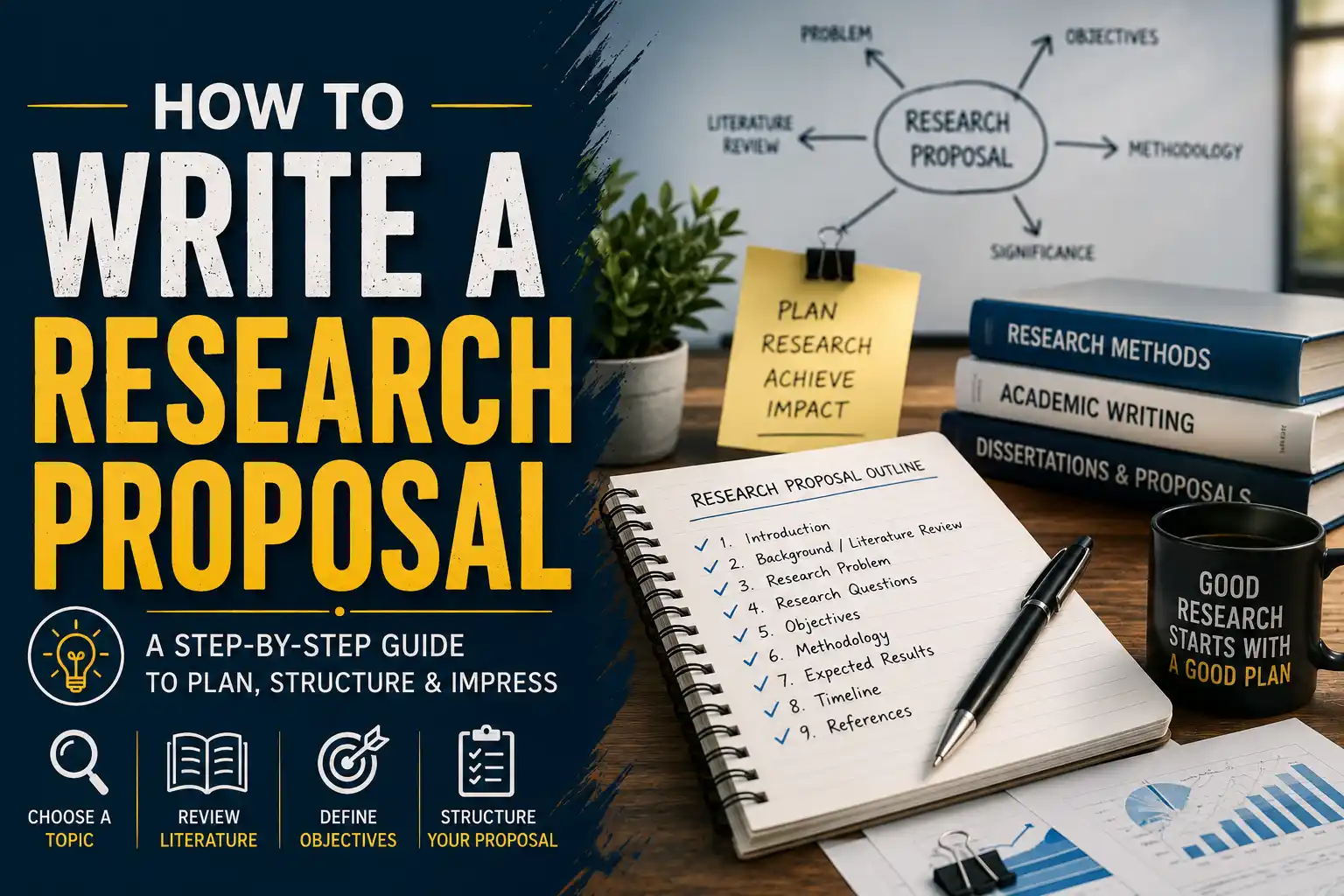
List all sources cited in your proposal using the required citation style. A thorough reference list demonstrates that you have engaged with the relevant literature.
Standard Research Proposal Structure
- Title: Concise and descriptive
- Abstract: Brief summary of the proposal
- Introduction: Background, problem, research question
- Literature Review: Summary of existing research and identification of gaps
- Research Questions & Objectives: Clear, specific, and achievable
- Methodology: Research design, methods, and analysis
- Timeline: Realistic project schedule
- Budget: Itemised costs (if applicable)
- References: List of cited sources
4 How to Write the Key Sections
Here is a detailed breakdown of what to include in each key section of your research proposal.
Introduction
The introduction is your opportunity to hook the reader. Start with a compelling opening that establishes the importance of your topic. Then:
- Provide the background context for your research
- Identify the research problem or gap
- Explain why this problem matters
- State your research question(s) clearly
- Outline the structure of your proposal
Literature Review
The literature review should not just summarise sources , it should synthesise and evaluate them. As one guide notes, you should "describe the problem that you aim to investigate" and show how your research will address gaps in the existing literature. Organise your literature review thematically, not just chronologically.
Methodology
The methodology section must be detailed and convincing. Reviewers need to be confident that your methods are appropriate for your research question. Include:
- A clear description of your research design
- Justification for your chosen methods
- Details about data collection and analysis
- Discussion of ethical considerations
- Explanation of how you will address potential limitations
Timeline
Break your project into phases (e.g., literature review, data collection, analysis, writing). Estimate how long each phase will take. A realistic timeline shows that you have thought carefully about project management.
Sample Research Proposal Outline
- Title: The Impact of Social Media on Adolescent Mental Health: A Mixed-Methods Study
- Introduction: Background on adolescent mental health, the rise of social media, and the research problem
- Literature Review: Summary of existing studies on social media and mental health, identification of gaps
- Research Questions: How does social media use affect adolescent mental health? What are the mediating factors?
- Methodology: Mixed-methods design combining surveys and interviews
- Timeline: 12-month project with clear phases
- References: APA-formatted reference list
5 How to Write a Research Proposal: Step-by-Step
Here is a step-by-step process to help you write a strong research proposal.
Step 1: Choose a Topic and Develop a Research Question
Start with a topic that genuinely interests you. Then narrow your focus to a specific research question. As one guide notes, this begins with "identifying a topic of personal or academic interest, exploring the topic in-depth, [and] refining the chosen topic into a well-developed research question".
Step 2: Conduct Preliminary Research
Before you write your proposal, do some preliminary reading. This will help you understand the existing literature, identify gaps, and refine your research question.
Step 3: Create a Detailed Outline
Outline your proposal section by section. This will help you organise your thoughts and ensure you cover all the essential elements.
Step 4: Write the Introduction
Start with a strong introduction that establishes the significance of your research. State your research question clearly.
Step 5: Write the Literature Review
Summarise and evaluate the relevant literature. Show how your research will address gaps in the existing knowledge.
Step 6: Write the Methodology
Describe your research design and methods in detail. Justify your choices.
Step 7: Include a Timeline and Budget
Provide a realistic timeline and, if applicable, a detailed budget.
Step 8: Write the Abstract Last
Write the abstract after you have completed the rest of the proposal. It should summarise the entire proposal concisely.
Step 9: Revise and Proofread
Review your proposal for clarity, coherence, and completeness. Check for errors and ask a colleague or mentor to review it.
The Revision Process
As one guide advises, "Be prepared to revise your opening paragraph multiple times". Revision is where your proposal goes from good to great. Seek feedback from peers, faculty, or writing consultants, and reflect carefully on their suggestions.
6 Common Mistakes to Avoid
Even experienced researchers make mistakes. Here are the most common errors in research proposal writing and how to avoid them.
Vague Research Question
A research question that is too broad, too vague, or not clearly defined.
Fix: Be specific. Your research question should be focused and answerable within the scope of your project.
Weak Justification
Failing to explain why your research matters or how it will contribute to knowledge.
Fix: Clearly articulate the significance of your research. Show how it addresses a gap or solves a problem.
Underdeveloped Methodology
A methodology section that is vague or does not justify the chosen methods.
Fix: Be detailed. Explain why your methods are appropriate for your research question.
Unrealistic Timeline
A timeline that is too ambitious or does not account for potential delays.
Fix: Be realistic. Break the project into manageable phases and allow for some flexibility.
Poor Writing and Proofreading
Proposals with spelling errors, grammatical mistakes, or unclear writing.
Fix: Proofread carefully. Ask someone else to review your proposal.
Ignoring the Funder's Guidelines
Submitting a proposal that does not follow the funder's format, length, or priority requirements.
Fix: Read the call for proposals carefully and follow all guidelines.
7 How to Tailor Your Proposal for Different Audiences
The approach to writing a research proposal may vary depending on the audience. Here are some considerations for different contexts.
For a Thesis or Dissertation
Focus on demonstrating your understanding of the field, your ability to conduct independent research, and the feasibility of your project. Your proposal should convince your supervisor and committee that you are prepared for the research.
Key trait: Demonstrates readiness and feasibility.
For Grant Funding
Focus on the significance of your research, its potential impact, and alignment with the funder's priorities. Be clear about how the funding will be used and what outcomes you expect.
Key trait: Demonstrates significance and alignment with funder priorities.
For a Research Degree Application
Focus on your research question, your understanding of the literature, and your proposed methodology. Show that you are capable of completing the research within the available time.
Key trait: Demonstrates knowledge and research capability.
For Ethics Approval
Focus on ethical considerations, participant protection, and data management. Show that you have thought carefully about the ethical implications of your research.
Key trait: Demonstrates ethical awareness and planning.
8 How to Revise Your Research Proposal
Revision is where your proposal goes from good to great. Here is a step-by-step process for revising your research proposal.
Step 1: Take a Break
Step away from your proposal for a day or two. This gives you fresh eyes and helps you see your work more objectively.
Step 2: Read It Aloud
Read your proposal aloud. Does it flow smoothly? Are there any awkward sentences? Reading aloud helps you catch issues you might miss when reading silently.
Step 3: Check the Structure
Does your proposal follow the standard structure? Is each section clear and focused? Does the argument flow logically from one section to the next?
Step 4: Strengthen Your Argument
Is your research question clear? Is your justification strong? Is your methodology convincing? Strengthen any weak sections.
Step 5: Check for Consistency
Are your research question, objectives, and methodology aligned? Does your proposal tell a coherent story?
Step 6: Proofread
Check for spelling, grammar, and punctuation errors. A polished proposal demonstrates professionalism and attention to detail.
Step 7: Get Feedback
Ask a colleague, mentor, or supervisor to review your proposal. Fresh eyes can catch issues you have missed.
9 Research Proposal Examples and Analysis
Here is a sample research proposal outline to illustrate the structure and content of a strong proposal.
Sample Research Proposal: The Impact of Remote Work on Employee Productivity
Title: The Impact of Remote Work on Employee Productivity: A Mixed-Methods Study
Introduction: The COVID-19 pandemic accelerated the shift to remote work, raising questions about its impact on productivity. While some studies suggest increased productivity, others report challenges with collaboration and work-life balance. This research aims to investigate the factors that influence productivity in remote work settings.
Literature Review: Existing research on remote work has focused on technology adoption, employee satisfaction, and organisational culture. However, there is limited research on the specific factors that mediate the relationship between remote work and productivity. This study addresses this gap.
Research Questions: 1. How does remote work affect employee productivity? 2. What factors mediate the relationship between remote work and productivity? 3. How do employees perceive the impact of remote work on their productivity?
Methodology: This study uses a mixed-methods design. Phase 1 involves a survey of 500 remote workers to measure productivity and identify key factors. Phase 2 involves semi-structured interviews with 20 employees to explore their experiences in depth. Data will be analysed using statistical analysis and thematic analysis.
Timeline: 12-month project with clear phases: literature review (months 1–2), survey design and data collection (months 3–6), interviews (months 7–9), analysis and writing (months 10–12).
References: APA-formatted reference list.
Why This Works
- Clear research question: The proposal asks specific, answerable questions.
- Strong justification: The literature review identifies a gap in existing research.
- Detailed methodology: The mixed-methods approach is clearly described and justified.
- Realistic timeline: The 12-month timeline is broken into manageable phases.
- Comprehensive structure: All essential sections are included.
10 Practice Exercises to Improve Your Research Proposals
The best way to get better at writing research proposals is to practice. Here are some exercises to help you sharpen your skills.
Exercise 1: Develop a Research Question
Choose a broad topic and develop three different research questions. Make each one increasingly specific and focused. Practice narrowing your focus.
Exercise 2: Write a Literature Review
Choose a topic and write a 500-word literature review. Summarise and evaluate the key sources. Identify gaps in the literature.
Exercise 3: Create a Proposal Outline
Create a detailed outline for a research proposal on a topic of your choice. Include all major sections and key points.
Exercise 4: Peer Review
Swap research proposals with a classmate. Provide constructive feedback on structure, argument, and clarity.
Final Thoughts
Writing a research proposal is a challenging but rewarding process. It is your opportunity to articulate your research vision, demonstrate your expertise, and make a compelling case for your project. A well-written proposal can open doors to funding, admission, and approval.
Remember that a research proposal is not just a formality. It is a roadmap for your research. It forces you to think through every aspect of your project , from the research question to the methodology to the timeline. The time you invest in writing a strong proposal will pay off when it comes time to conduct your research.
Keep these principles in mind as you write:
- Start with a clear research question. Your question should be specific, focused, and answerable.
- Demonstrate significance. Show why your research matters and how it will contribute to knowledge.
- Be detailed in your methodology. Reviewers need to be confident that your methods are appropriate and feasible.
- Follow the structure. Use the standard sections to organise your proposal and make it easy to read.
- Revise thoroughly. Great proposals are the result of careful revision and feedback.
Writing a research proposal is a skill that improves with practice. Each proposal you write will be better than the last. With persistence and attention to detail, you can write a proposal that convinces reviewers to support your research.
Now go write a research proposal that gets approved.