How to Write a Novel: A Complete Guide for First-Time Novelists
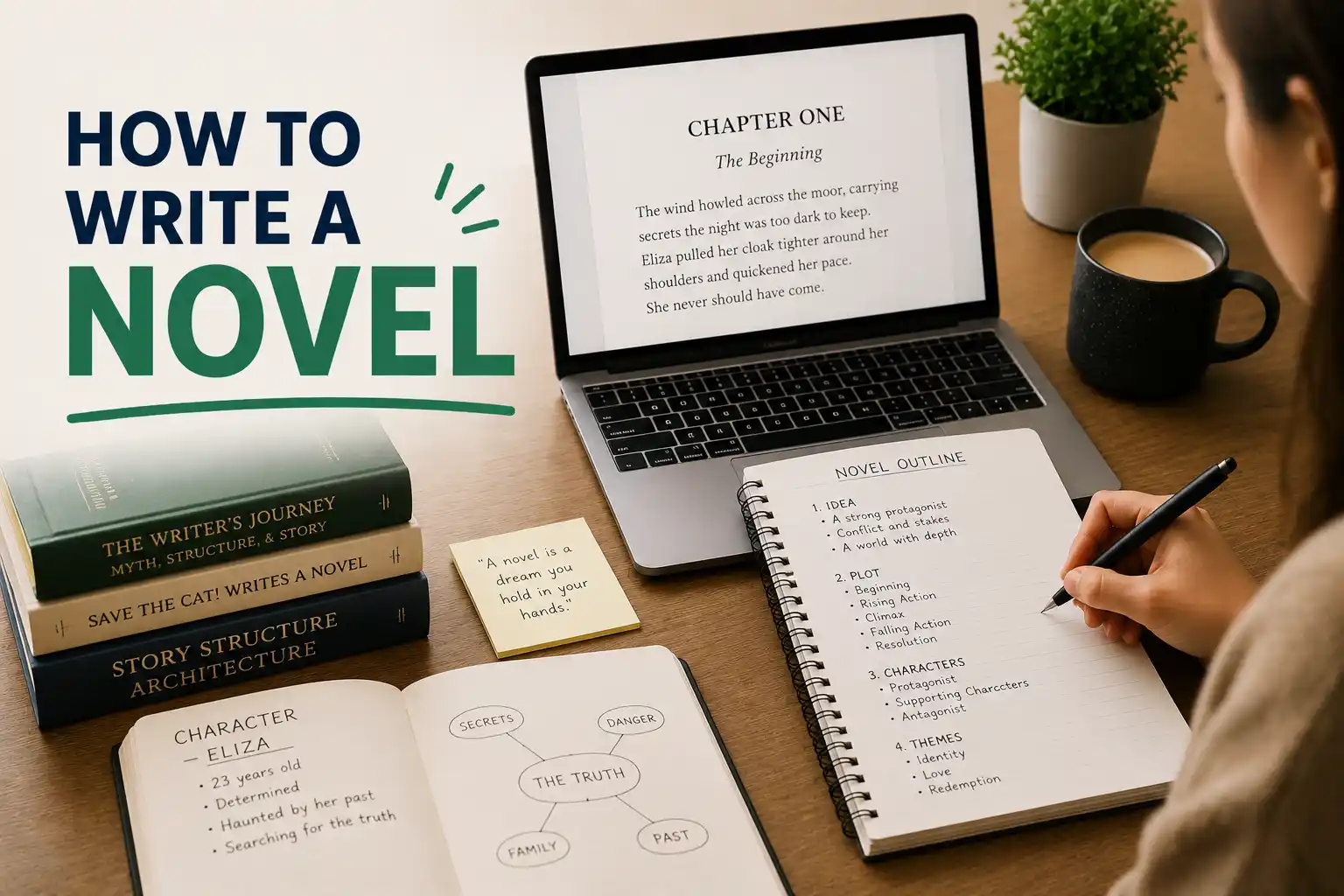
You have a story that won't leave you alone. Characters living in your head. A world only you can see. That's a novel waiting to be written.
But let's be honest: writing a novel is hard. It's a marathon, not a sprint. It will take months. Some days you'll love it. Some days you'll question everything. That's normal. That's the process.
This guide will walk you through everything you need to know to write your first novel—from finding your idea to finishing your first draft. No magic formula. Just practical advice from someone who has been where you are now.
Novel Writing at a Glance
The good news? Finishing puts you in an elite group. You can do this. One word at a time.
1 Why Write a Novel? Finding Your "Why"
Before you write a single word, know why you're doing this. Your "why" will carry you through the hard days.
Personal Fulfillment
Writing a novel is a major achievement. It's a legacy. Something you can be proud of forever. Many authors say finishing their novel was one of the most satisfying things they've ever done.
Creative Expression
A novel lets you build a world, create characters, and explore ideas. It's the ultimate creative project.
Impact
Your story might help someone feel less alone, see the world differently, or escape for a few hours. That's powerful.
Career Opportunities
A published novel can open doors—speaking engagements, teaching, more writing work, or a new career path.
2 The 10-Step Novel Writing Process
Step 1: Find Your Big Idea
What's the core of your novel? The premise that excites you enough to spend months writing it.
Step 2: Choose Your Genre
Romance? Mystery? Fantasy? Literary? Knowing your genre helps you meet reader expectations.
Step 3: Develop Your Characters
Create your protagonist, antagonist, and supporting cast. Give them desires, flaws, and secrets.
Step 4: Outline Your Plot
Some writers outline everything (plotters). Some discover as they go (pantsers). Find what works for you.
Step 5: Build Your World
Where does your story take place? The rules, history, geography, culture, technology.
Step 6: Set a Writing Schedule
Consistency beats intensity. Write a little every day rather than binging on weekends.
Step 7: Write the First Draft
Give yourself permission to write badly. The first draft just needs to exist. You'll fix it later.
Step 8: Let It Rest
Step away for 2-4 weeks. Don't look at it. Clear your mind. You'll return with fresh eyes.
Step 9: Revise and Rewrite
This is where good writing becomes great. Big picture edits first, then line edits, then proofreading.
Step 10: Get Feedback and Publish
Beta readers, critique partners, or professional editors. Then decide: traditional or self-publishing?
Self-pub: Edit professionally, design a cover, upload to Amazon KDP.
Track Your Progress
Use our free word counter to track your daily writing. Watch your word count grow from 0 to 90,000+ words. Every word counts.
Track Your Word Count3 Plot Structures That Work
The 3-Act Structure
Act 1 (25%): Setup. Introduce characters and ordinary world. Inciting incident. First plot point forces protagonist into the journey.
Act 2 (50%): Confrontation. Rising action. Obstacles, setbacks, mid-point twist. Darkest moment before the final push.
Act 3 (25%): Resolution. Climax. Final battle or decision. New normal showing how protagonist has changed.
The Hero's Journey
Ordinary world → Call to adventure → Refusal → Mentor → Crossing threshold → Tests and allies → Approach → Ordeal → Reward → Road back → Resurrection → Return with elixir.
Used in Star Wars, The Hobbit, The Matrix.
Save the Cat Beat Sheet
15 specific beats: Opening image, theme stated, set-up, catalyst, debate, break into two, B story, fun and games, midpoint, bad guys close in, all is lost, dark night of the soul, break into three, finale, final image.
The Fichtean Curve
Multiple rising actions (crises) that escalate in intensity. No long exposition. Jump straight into action. Popular in thrillers and mysteries.
Which Structure Should You Choose?
Try the 3-act structure for your first novel. It's simple, flexible, and works for most genres. Once you understand the rules, you can break them creatively.
4 Creating Characters Readers Love
The Protagonist
What do they want? External goal (save the world, win the game, get the job).
What do they need? Internal growth (learn to trust, forgive, be brave).
What's in their way? Antagonist, circumstances, their own flaws.
How do they change? Character arc from beginning to end.
The Antagonist
The antagonist isn't just "evil." They have their own goals, motivations, and reasons. The best villains believe they're the hero of their own story.
Questions to ask: What do they want? Why do they want it? What made them this way?
Character Questionnaire
5 World-Building: Making Your Setting Come Alive
For Contemporary Novels
Even realistic settings need attention. What makes your city/town unique? The coffee shop? The weather? Local culture? Specific details make settings feel real.
For Fantasy/Sci-Fi
Build the rules: magic system, technology, government, history, religion, social structure. Only share 10% with readers. The rest informs your writing.
For Historical Fiction
Research is essential. Daily life, clothing, speech patterns, technology, social norms. Accuracy builds credibility.
Sensory Details
Don't just describe what things look like. What does your world smell like? Sound like? Feel like? Taste like? Engage all five senses.
Describe your setting using all five senses. Write one paragraph for each sense. Then choose the three most vivid details to include in your novel. You'll be surprised how real your world feels with just a few specific details.
6 Writing Dialogue That Sings
Dialogue DOs
✓ Read dialogue aloud (if it sounds awkward spoken, rewrite it)
✓ Use subtext (what's unsaid is often more important)
✓ Give each character a unique voice (word choice, rhythm, vocabulary)
✓ Keep it brief (real conversation is full of pauses—trim them)
✓ Use dialogue to reveal character and advance plot
Dialogue DON'Ts
❌ "As you know..." dialogue (characters shouldn't tell each other things they already know)
❌ Overusing names in conversation ("Hello, John." "Hi, Mary.")
❌ Perfect grammar (people interrupt, use fragments, start sentences with "So" and "Well")
❌ On-the-nose emotions ("I'm so angry at you!")
Dialogue Examples
7 How to Build a Writing Habit That Sticks
Write at the Same Time Daily
Your brain learns to be creative at that time. Morning works for many. Others write late at night. Find your time and protect it.
Start Small
200 words is better than zero. 500 words daily adds up fast. Don't aim for 2,000 words if you can't sustain it.
Eliminate Distractions
Put your phone in another room. Use website blockers. Tell family you're not available. Treat writing time as sacred.
Track Your Progress
Use a spreadsheet, journal, or app. Seeing your word count grow is incredibly motivating. Celebrate milestones (10k, 25k, 50k words).
Daily Word Count Examples (90,000-word novel)
8 Overcoming Writer's Block (It Happens to Everyone)
Strategies That Work
✅ Write something else (a journal entry, a letter, a short story)
✅ Skip to a later scene you're excited about
✅ Lower your standards (bad writing is fixable; blank pages aren't)
✅ Change your environment (coffee shop, library, park)
✅ Set a timer for 10 minutes and just write
✅ Talk through the block with another writer
What Makes It Worse
❌ Waiting for inspiration (it rarely comes)
❌ Going back to edit what you already wrote
❌ Comparing your first draft to published books
❌ Telling yourself you're not a real writer
❌ Scrolling social media instead of writing
❌ Starting a new project (finish this one first)
9 How to Revise Your Novel Like a Pro
Pass 1: Big Picture
Read the entire draft without changing anything. Take notes on plot holes, pacing issues, missing scenes, character inconsistency, and theme.
Pass 2: Structural Edit
Move, add, or delete scenes. Rewrite problem areas. Ensure your beginning hooks and your ending satisfies. Check act breaks.
Pass 3: Line Edit
Focus on sentences and paragraphs. Improve clarity, rhythm, and word choice. Cut unnecessary words. Strengthen weak verbs.
Pass 4: Proofread
Catch spelling, grammar, and punctuation errors. Read aloud or use text-to-speech to hear mistakes. Fresh eyes are essential.
The "Let It Rest" Method
After finishing your first draft, step away for 2-4 weeks. Don't look at it. Read other books. Clear your mind. When you return, you'll see your work with fresh eyes and spot problems you missed before. This is non-negotiable.
10 Traditional vs. Self-Publishing: What's Right for You?
Traditional Publishing
Pros:
✓ No upfront costs
✓ Professional editing, cover, marketing
✓ Distribution to bookstores
✓ Credibility and prestige
Cons:
✗ Very competitive (under 1% acceptance rate)
✗ Takes 1-3 years to publish
✗ Low royalties (10-15% of net)
✗ Less creative control
Self-Publishing
Pros:
✓ Complete creative control
✓ Faster publishing (weeks, not years)
✓ Higher royalties (70% on Amazon KDP)
✓ Keep all rights
Cons:
✗ Upfront costs (editing, cover, formatting)
✗ You handle all marketing
✗ No bookstore distribution (mostly online)
✗ Less prestige (though changing)
11 Your Novel Writing Checklist
The Bottom Line
Writing a novel is a marathon, not a sprint. It will take months. Some days you'll love it. Some days you'll question everything. That's normal. That's the process.
Remember: every published author was once exactly where you are now. They didn't have more talent. They just kept going when others stopped.
Your story deserves to be told. The world is waiting. Now go write.