Word Count for Essays: A Complete Student Guide
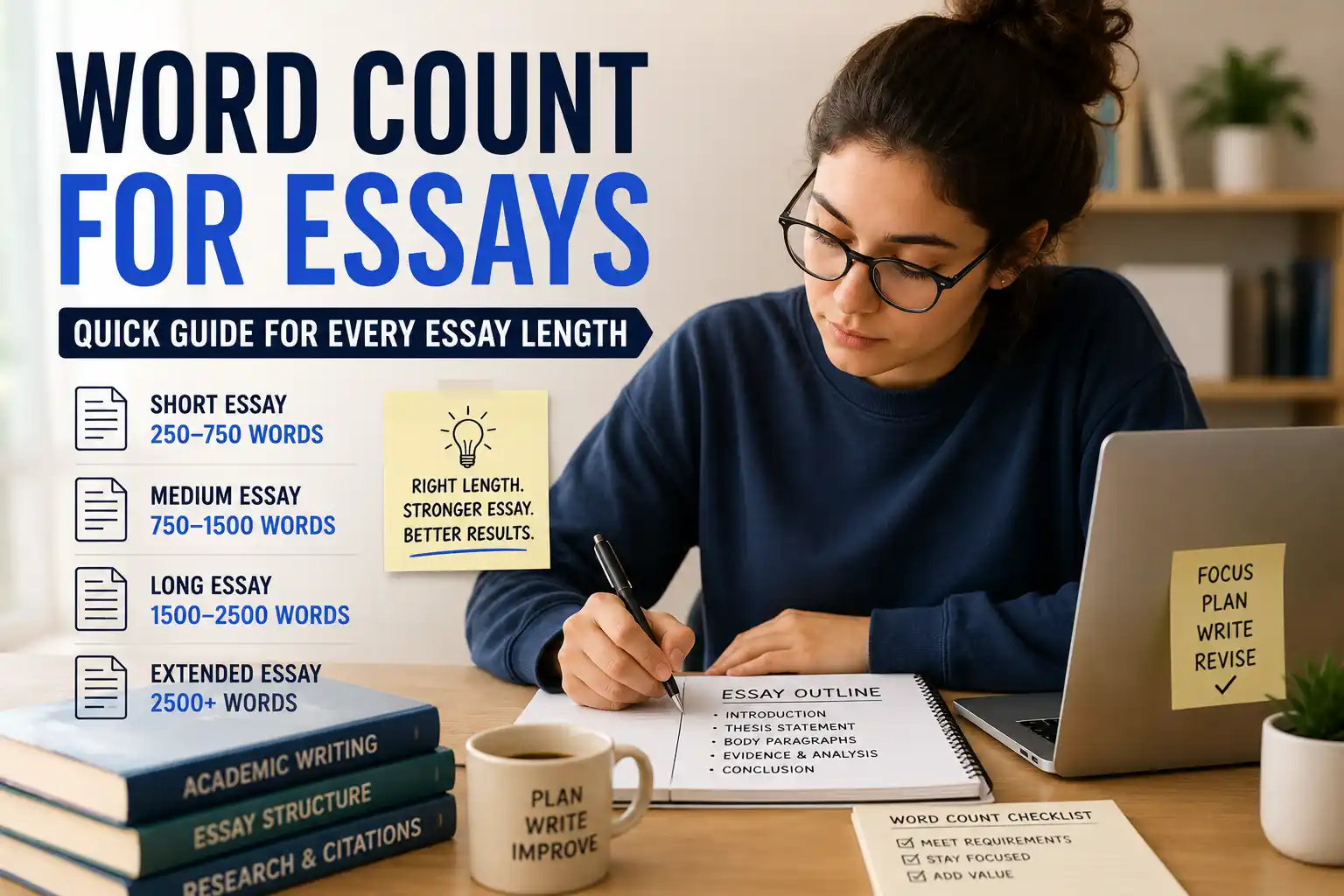
You've got a deadline tomorrow, and the prompt says "Write a 1,000-word essay." But what does that actually mean? How many pages is that? And what happens if you're 50 words over or under?
I've been there. Staring at the word counter, adding and deleting sentences, trying to hit that perfect number. It's stressful, but it doesn't have to be.
Here's everything you need to know about essay word counts, from middle school book reports to graduate school dissertations. Plus, practical tips to hit your target every time.
Quick Reference: Essay Word Counts at a Glance
Keep reading for detailed breakdowns by essay type, academic level, and practical tips to hit your target every time.
1 Why Word Count Matters in Academic Writing
Word count isn't just an arbitrary number professors use to torture students. It serves several important purposes in academic writing:
It teaches discipline. Learning to express ideas within a specific limit forces you to be concise and organized. Too short, and you haven't developed your argument. Too long, and you're including unnecessary information.
It ensures fair grading. When every student has the same length, professors can compare work more fairly. It also helps them manage their grading workload.
It reflects professional standards. Academic journals, conferences, and publications all have strict word limits. Learning to work within them now prepares you for the real world.
The Truth About Word Count Rules
2 Essay Word Count by Academic Level
Your grade level and the type of course significantly impact expected essay length. Here's what you can expect at each stage:
Middle School
Focus on basic structure: introduction, body paragraphs, conclusion. Learning to organize thoughts.
High School
Developing arguments with evidence. Standard 5-paragraph essays are common (about 500-800 words).
Undergraduate
Research papers, literature reviews, and analytical essays. Expect longer papers in upper-level courses.
Graduate
Seminar papers, research proposals, and literature reviews. Greater depth and analysis required.
3 Word Count by Essay Type
Different types of essays have different expectations. Here's what professors typically look for:
College Application Essays
The Common App essay has a strict limit of 650 words. Most supplements are 150-400 words. Admissions officers read thousands of essays, so shorter is often better. Every word must count.
Track Your Essay Word Count
Our free word counter helps you stay within limits. Type or paste your essay and watch the count update in real-time.
Try It Here (It's Free)4 How Many Pages Is That? Quick Conversion Guide
Most professors assign essays by word count, but sometimes you'll see page requirements. Here's how they convert:
Single-Spaced
• 250 words ≈ 0.5 page
• 500 words ≈ 1 page
• 1,000 words ≈ 2 pages
• 2,000 words ≈ 4 pages
• 5,000 words ≈ 10 pages
Double-Spaced (Standard)
• 250 words ≈ 1 page
• 500 words ≈ 2 pages
• 1,000 words ≈ 4 pages
• 2,000 words ≈ 8 pages
• 5,000 words ≈ 20 pages
Standard Formatting Assumptions
• 12pt Times New Roman or Arial
• 1-inch margins on all sides
• Double-spaced for academic papers
• Headers and footers don't count
Remember: Page counts vary by font and spacing. Always follow your professor's specific formatting guidelines.
5 How to Hit Your Word Count (Without Adding Fluff)
When You're Under
✅ Add more specific examples and evidence
✅ Expand your analysis of key quotes
✅ Address counterarguments thoroughly
✅ Add transitional sentences between ideas
✅ Include another body paragraph on a subtopic
✅ Strengthen your introduction and conclusion
✅ Ask "What else does the reader need to know?"
When You're Over
❌ Delete repetitive points and phrases
❌ Remove "very," "really," "quite" (empty words)
❌ Combine short, choppy sentences
❌ Cut weak examples that don't add value
❌ Remove redundant transitions
❌ Shorten quotes (use only key parts)
❌ Ask "Does every sentence advance my argument?"
Pro Tip: Write First, Edit Later
Don't worry about word count during your first draft. Just get your ideas on paper. You'll have plenty of time to add or cut during revision. The worst essays are the ones where students obsess over word count while writing instead of focusing on quality.
6 How to Distribute Words Across Your Essay
A well-structured essay follows a clear pattern. Here's how to allocate your word count for a standard 5-paragraph essay:
For a 1,000-word Essay
For a 2,000-word Research Paper
7 Common Word Count Mistakes (And How to Avoid Them)
The Bottom Line
Essay word counts exist to help you learn to write clearly and concisely. They're not arbitrary punishments.
The best essay is the one that fully answers the prompt in the clearest way possible, using the space you're given. Not a single word more than necessary. Not a single word less than needed.
Use the word count as a guide, not a goal. Focus on quality first. The right length will follow naturally.